“It takes an endless amount of history to make even a little tradition.” – Henry James
As this academic year comes to a close, our team of editors wanted to cultivate a tradition started last year of sending our readers off into the summer with something more personal. Last year, we offered recommendations for your ever-growing lists of content to consume. This year, we’re taking a different approach.
Warm weather and long days make the summer months ideal for travelling. And everyone travels differently. Some prefer wilderness. Others the bustle of a new city, or country. Some map out their itinerary with precision. Others wing it. Some stay close to home. Others trot the globe. Regardless of how you approach your travels, there is one common, underlying thread that all of our experiences share: you’re surrounded by history. In fact, if you look hard enough, you’re inundated by it. Every person, place, and thing has a past, and a story. As historians, we relish in this richness.
In this spirit, we have each come up with one “travel tip,” specifically to highlight ways and means that one can zero-in on the history the surrounds us. Or to share in our own experiences sifting through the noise to find the story within.
We are also happy to use this occasion to introduce the new editors on our team. Welcome Bianca and Anna! We will let their travel tips below serve as their official introductions.
This post will be our last before we sign off for the summer vacation. We will return in September to kick off the new academic year with more interesting finds on the shores of the history of science and the humanities. Until then, we wish you a happy and healthy summer!

Bianca Angelien Aban Claveria
Somebody Feed This Filipino
During my junior year in high school, we were asked to list our top three career choices. My mind began to drift and wander from one job opportunity to another, and after much “profound” contemplation and discernment, I recall seriously considering “travel TV show host”. Why not? I remember asking myself. But it was not really the prospect of filling the pages of my passport with stamps or collecting souvenir refrigerator magnets that enticed me to that job. It was the chance to feature delicious, flavorful, and unique spreads of food while hosting these shows, and that I would be paid to travel and seek them out. That was what reeled me in. Since I do not have the effortless charms and spontaneity of culinary travel hosts like Phil Rosenthal (Somebody Feed Phil) and Anthony Bourdain (Anthony Bourdain: No Reservations and Anthony Bourdain: Parts Unknown), I gave up on even trying early on. But I realized only after reading books on food history that I could still somehow live out a spin-off of this dream job, sans the lights, cameras, and film crew, whenever I travel abroad for research or conferences, or when I returned home to my Manila.
Travellers who have ventured the lush islands of the Philippines would agree with me when I say that Filipinos are in love with food. Food is a cornerstone of Filipino culture and traditions, and I highly recommend a book by Doreen G. Fernandez, entitled Tikim: Essays on Philippine Food and Culture toanyone who wants to take a bite into the cornucopia of Philippine cuisine. Food has always been a core element in my family’s life and history, and coming from two proudly Ilocano (an ethnolinguistic group in the Philippines) families, my taste buds were molded at an early age by the bitter taste of dinengdeng (a vegetable soup), and bagnet‘s (pork belly) dangerously oily yet satisfying taste. Pinakbet was another Ilocano vegetable dish that I grew up with, and whenever I ate it, it reminded me of the same pinakbet that my maternal grandmother would prepare for us during our Sunday visits. Pinakbet has numerous variations throughout the Philippines, as some would add chicharon (pork rinds) to add a jovial mood to the dish, coconut milk for a richer taste, or use tinapa (smoked fish) as a substitute to bagoong (a fermented fish or shrimp condiment). Though pinakbet‘s main ingredients could be easily substituted for taste or convenience, it is the freshness of the ingredients used that separates an excellent, “chef’s kiss”, pinakbet from a mediocre one.
To the curious and hungry wayfarer reading this blog: I hope that food and history will guide you to where Phil Rosenthal might be currently filming his next episode, or to parts unknown. Travel with an eager mind and a whetted appetite. Perhaps your travels will lead you to the Philippines, and if it does, I hope that the warm and welcoming Filipinos will offer you a place at their table. Kain tayo! Join us, let’s eat!

Anna Bruins
Years ago, as a young student on exchange in South Korea, I found myself reading the journal of a man by the name of Hendrick Hamel. Shipwrecked on the Korean shores in 1653 and kept hostage there until his miraculous escape in 1666, Hamel’s account provides a captivating glimpse of life in Korea. To my surprise, despite the 300-year separation, I recognised much of my own experiences in his words. Nowadays, as a historian of science focusing on travel, studying early modern journals such as Hamel’s has become my bread and butter.
With this in mind, my travel tip for you is twofold. Firstly, bring a historical travel account of your destination along: it’s the perfect holiday reading! And secondly, keep a journal of all your adventures. Who knows, maybe one day a historian will come across it and travel back in time with you

Marieke Gelderblom
A historical look at the map in your hands
There’s always plenty to see while in transit. But if you’re tired of staring out the window, I would recommend you take a look at the transit map in your hand. My travel tip for this summer is ‘not about the destination, but about the journey!’
Transit maps are iconic examples of modern design. They aren’t really ‘maps’ but diagrams, since they ignore the real spatial geography of a place. Map designers use idealized colour-coded lines and equal station spacing, so that you can read the map easily and find your way. A famous and telling example is the London Underground map, which looks surprisingly modern. Early versions of this map were based on a geographically realistic city map – until in 1931 Harry Beck revolutionised the layout. Beck realised that for travellers, the topology of the tube network (i.e. the order of stations) mattered more than their actual geography. His new map created a coherent, legible image of the city. The less accurate the map became, the more intuitive it was to use.
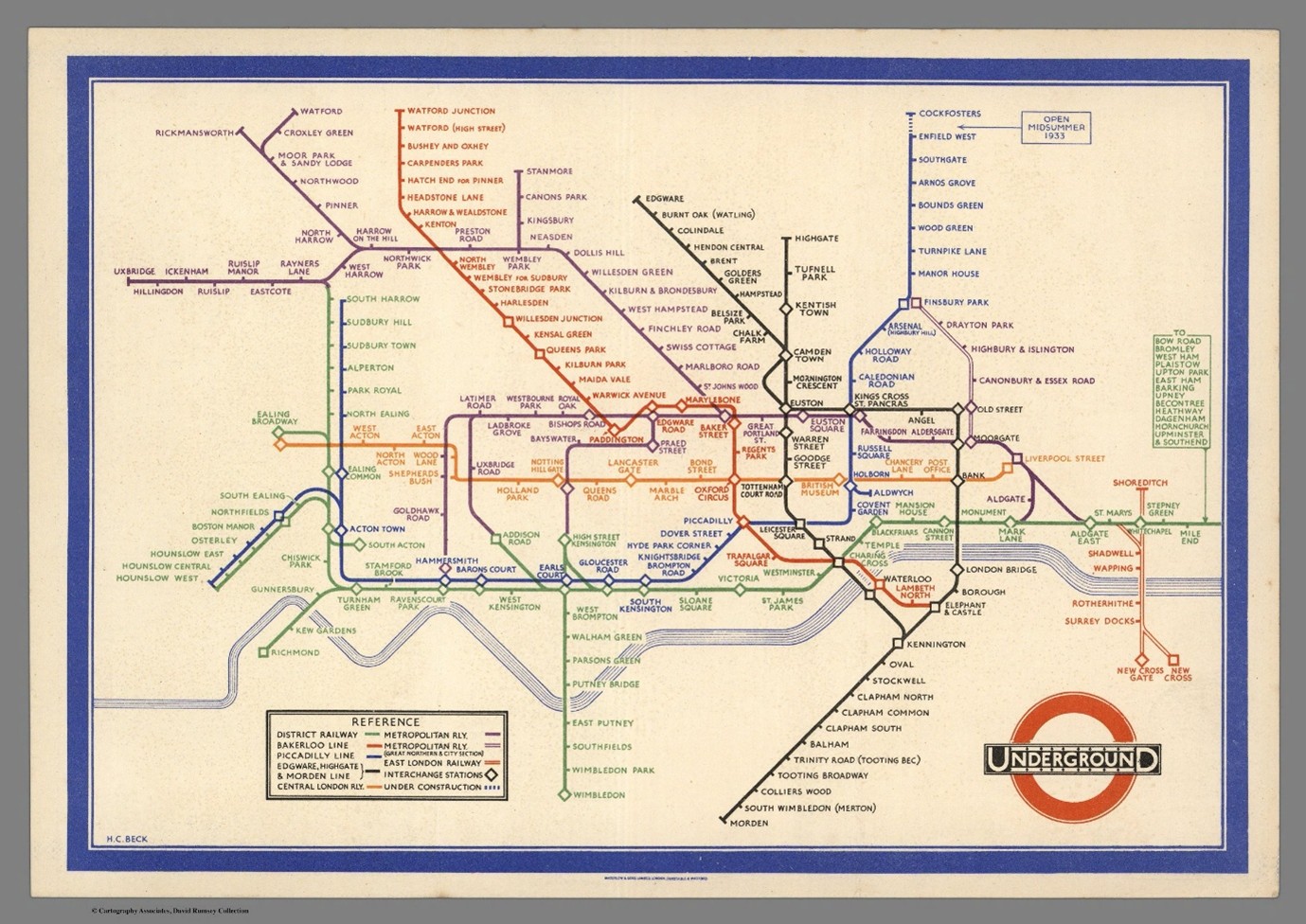
The map you’re using to navigate your journey probably looks quite similar to Beck’s. Compare the view from your car/train/plane window with the map, and try to imagine how the map designer translated these surroundings into lines and dots. How does the map reformulate the places you’re travelling through? Does that reshape the experience of your trip?
Beck’s map inspired transit maps around the globe. In the past 100 years, transit maps transformed what we consider close by and distant. Not geographical distance, but travel accessibility determined which neighbourhoods felt nearby and which we considered far away. This idea of spatiality has implications for our social experience of a place: transit maps can create connections and communities.
Unless you’ve borrowed your parents’ Lonely Planet from 1985 for this trip, it is likely that the map in your hands is fairly recent. Can you imagine its history, and how the trajectory has changed over time? Maybe this gives your journey a bit of historical perspective. Or at the very least, I hope it makes for a good backseat game.
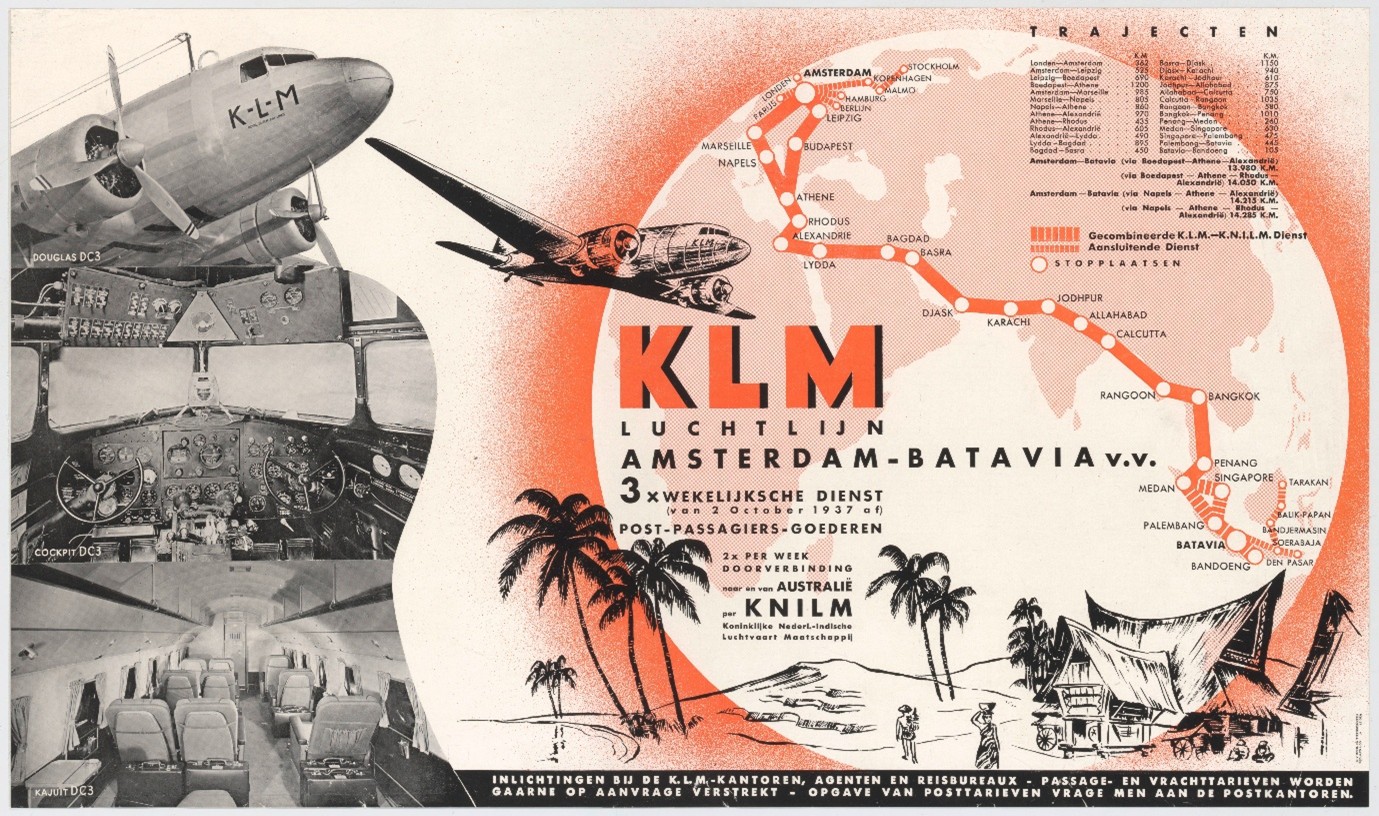
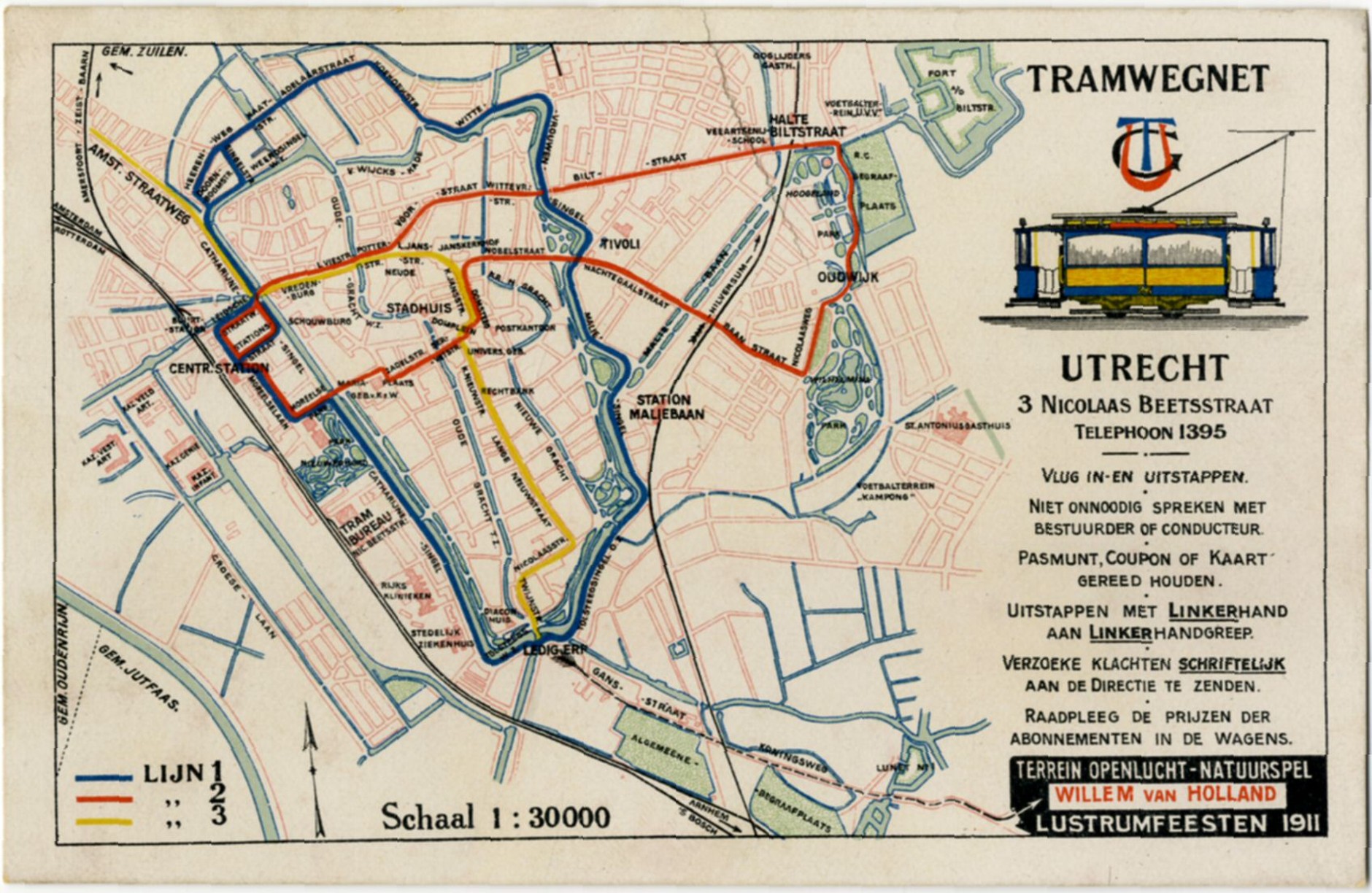
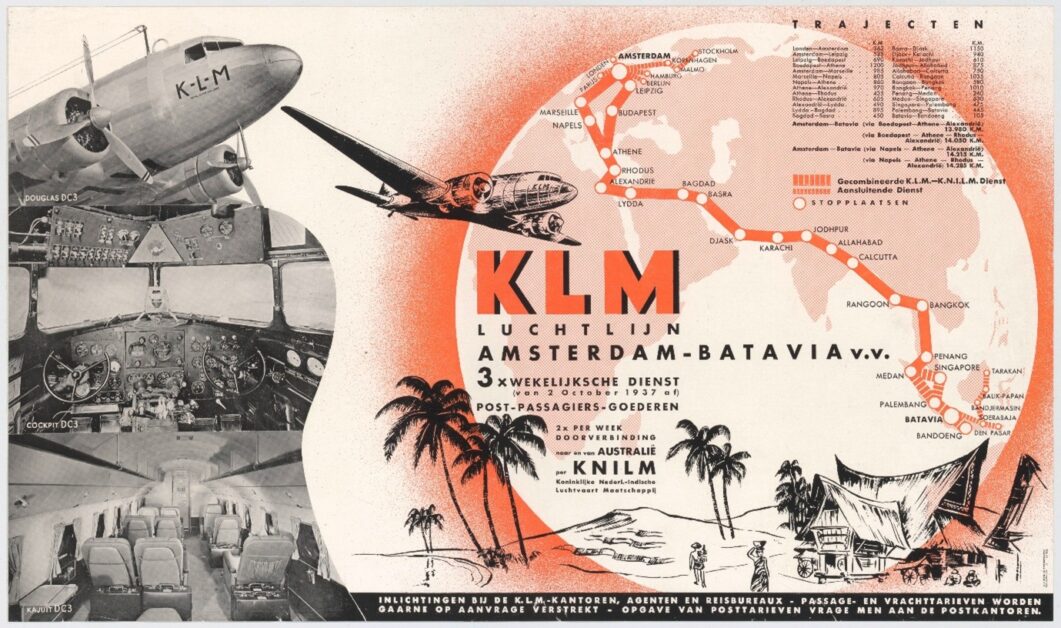
P.S. Not yet done travelling? Then take a look at footage of the Utrecht trams in the 1920s here.

David Skogerboe
Let’s be honest. Flying sucks. You’re jammed into a metal tube and fed sodium-rich gruel while you struggle to stay comfortable. Occasionally you glance at the time remaining on the flight and are distressed to see you still have hours and hours to go. At least you can (sometimes) watch movies or sleep, and the views can be impressive, so it’s not all bad, I suppose. But ultimately, the flight is the means to the end. A vital piece of the infrastructure that makes most of our world travels possible. Flying has become so ubiquitous, we approach it like taking a bus.
I offer you an alternative framing. One that I have cultivated through my love of aerospace history. Whenever I begin feeling frustrated, bored, or stir-crazy in transit, I remind myself of this:
You are on a sub-orbital rocket ship! In 12 hours, you can find yourself on the other side of the planet – a trip that would have taken MONTHS a few hundred years ago.
It’s almost like magic, if you think about it. At least it would have seemed so just five generations ago. As Arthur C. Clarke once said, “any sufficiently advanced technology is indistinguishable from magic.” Your standard Airbus is one such technology.
I will leave you with one specific instance where this perspective stood out to me most. For the Christmas holiday several years ago, my family was traveling to the US, specifically to my hometown in Colorado. Part of our itinerary was a lay-over in Salt Lake City, Utah. From there, it would be just an hour long flight to Denver. While waiting at our gate, I looked out the window of the airport and enjoyed the beautiful view of the snowcapped Wasatch mountain range, which sits at the western edge of the greater Rocky Mountains.
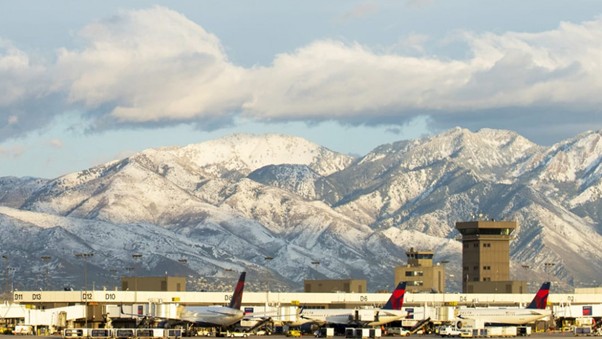
Then it dawned on me. If we had been standing on this spot 100 years ago, in the dead of winter, there is no way in hell we would be considering a perilous 500 mile (800 km) trip across the entire width of the Rocky Mountains to reach Denver. We would need to wait until late spring. And only then could we embark on the dangerous (yet beautiful) journey that would take us WEEKS. The history of western expansion in the United States is filled with stories that highlight the immense challenges that such mountain crossings entailed. You need look no further than the story of the Donner Party to understand why winter crossings were a big no-no. Warning: cannibalism.
But we live in the future, so we boarded our rocket ship, effectively hopping over the entire mountain range in an hour. By noon, we were eating lunch with my parents. In your dreams, ancestors!

Luca Forgiarini
Who says you have to go anywhere to travel?
As historians or historically-minded people, travelling can have as much a temporal dimension as a spatial one. Put differently, I consider learning about the history of a place – familiar or not – to also constitute a form of travel. So, for all of you who will not be travelling far (in the spatial sense) this summer, who just want to enjoy a small excursion, or who can’t stay still anticipating their upcoming holidays, why not take a stroll through one of the Netherlands’ many historical cities?
Personally, I find a leisurely stroll without clear direction, interrupted only by the odd refreshment here and there as perhaps the best way to explore a city and its history. If you pay attention to your surroundings, you’ll notice the odd information plaque telling you about the city’s past. This way of letting history come to you, instead of you going to it, can sometimes yield interesting surprises.
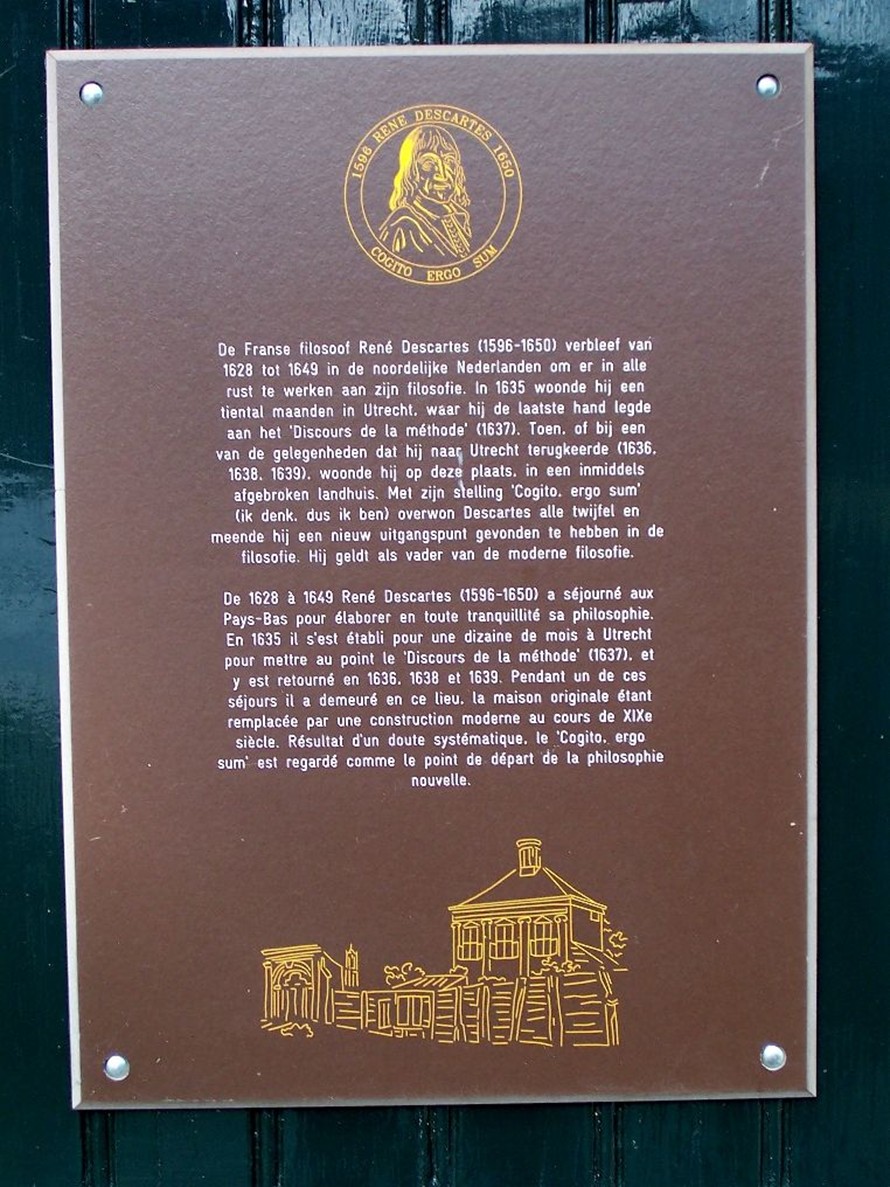
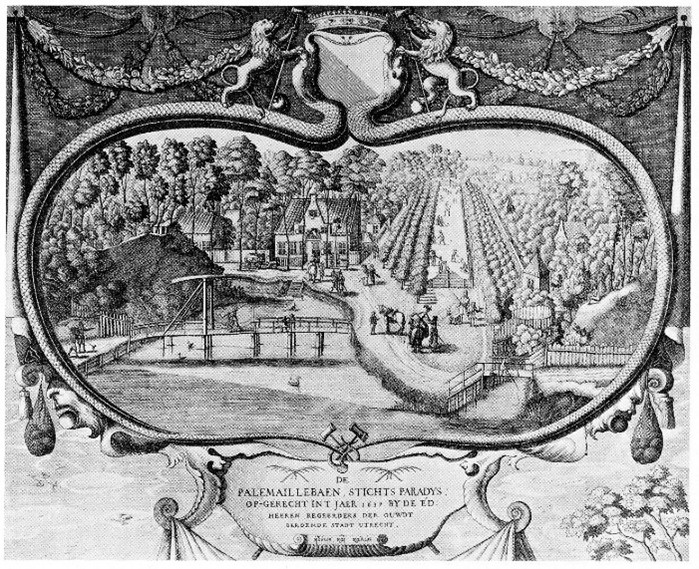
Utrecht, where I live, has a long history dating back to the Roman Empire. It features picturesque streets littered with sites of historical interest. On one such stroll through Utrecht, walking along the Maliebaan, a large tree-lined avenue where I lived for a number of years, I fell upon one particular plaque. Literally hiding in plain sight as its brown colour on a black door makes it hard to notice. This inconspicuous plaque marks the location of the house once occupied by René Descartes in the early 17th century. Though the original house no longer stands, it was here that Descartes lived for some time, starting in 1635, and wrote most of his Discours de la méthode. Published in 1637, this was the treatise in which he famously stated his ‘cogito ergo sum’.
I personally enjoy encounters such as this one, as it adds a tangible dimension to the otherwise abstract relationship one often has to historical actors, places, and events. Especially in a historical city like Utrecht, in which the city landscape has remained largely unchanged for hundreds of years, one can imagine what it must have been like to be René Descartes working out the details of his famous argument on the same street I once lived.

Maura Burke
A Dutch Summer in New York: Walking the Ghost Map of New Amsterdam
As a native New Yorker gone Dutch, the intersection of these two cultures holds a special place in my heart. I recommend that anyone who has ever wanted to visit New York to please just go! I love the city dearly and believe it holds a special place in the hearts and minds of many for good reason. If you find yourself in New York this summer, I encourage you to spend time in Lower Manhattan, where the city first took root in the hands of Dutch colonialists. As an added bonus, Lower Manhattan just so happens to be the unequivocal best part of the city. Coincidence? I think not.
Begin your journey on Stone Street, an aptly named cobbled lane paved by the Dutch in the 1650s. It’s one of the oldest streets in New York, and walking its uneven stones transports you back in time. A few paces away, turn right onto Broad Street, and soon you’ll arrive at Fraunces Tavern, a contender for the oldest bar in Manhattan, operational since 1762. While it isn’t Dutch (British, in fact), I can’t help including it in any self-respecting historical guide to NYC. Just south of the tavern you’ll hit Pearl Street, which once marked the original shoreline of Manhattan. It earned its name from the abundance of oyster shells scattered along its shores, and it even functioned as a Dutch canal before the British filled it in and paved it over.
From there, turn left and follow Pearl Street until it meets Wall Street, another aptly named street. The street marks the site of the original wall the Dutch built to defend New Amsterdam from potential threats, both Indigenous and European. As you walk toward the New York Stock Exchange, you’ll pass modern landmarks like The Fearless Girl and The Trump Building, each its own kind of monument to ambition. If you’d rather skip gazing upon the glory of global finance, continue west until you reach Broadway. Across the intersection stands Trinity Church, built in 1698 under British rule and home to the grave of Alexander Hamilton. If you’re a Hamilton musical devotee, this is a pilgrimage stop. If you’re strictly here for the Dutch, maybe skip it and keep walking.
At this point, I recommend heading south along Broadway for a few blocks until you reach Liberty Bagels on your left. Stop. Go inside. Order something simple and classic – perhaps a bacon, egg, and cheese on an everything bagel or a toasted egg bagel with scallion cream cheese. Accept that New York bagels are superior to all others, and enjoy. Once properly nourished, hop on the subway uptown (just slightly) to the Bowery.
The Bowery gets its name from Peter Stuyvesant’s sprawling bouwerij (Dutch for “farm”), which once occupied this entire area during colonial times. His legacy still defines the neighborhood. Look out for Stuyvesant Street, Stuyvesant Square Park, and even StuyTown, one of the largest residential complexes in the city, developed after WWII but named in his honor.
Three stops in the Bowery stand out: St. Mark’s Church-in-the-Bowery, the final resting place of Peter Stuyvesant himself and one of Manhattan’s oldest churches; Veselka, the best spot for Ukrainian dumplings in the city (go for the pierogi sampler); and Beauty Bar, probably the only place in the world where you can get your nails done under a disco ball while sipping champagne on tap in a nightclub. Okay, maybe I’ve drifted a bit from my austere Dutch historical guide—but some things are too good to leave out.
For those who love language, here are a few place names that trace directly back to Dutch roots: Harlem, from Haarlem; Brooklyn, from Breukelen; Staten Island, from Staaten Eylandt; Coney Island, from Konijn Eiland (“Rabbit Island”); Bushwick, from Boswijck (“Little town in the woods”); Flushing, from Vlissingen; and Gramercy Park, from Krom Moerasje (“Crooked little swamp”).
This city is layered in time. Walking through it with the Dutch past in mind turns familiar streets into archaeological remnants—ghosts of a world that never really vanished, only evolved. Have fun. Eat a lot of bagels. And if you’re lucky, maybe let the cobblestones remind you of how much history lives underfoot.

Elian Schure
Vacations and vaccinations in Brazil: Instituto Butantan
Those who have visited the industrious city of São Paulo, Brazil, know that the Universidade de São Paulo (USP) is hard to miss. With its numerous buildings scattered throughout the city and even the state, USP is an ever-present institution of monumental scale. A visit to the main campus is highly recommended. Besides the faculty buildings and libraries, the main campus features a lovely botanical garden and access to several museums. If, after visiting the Zoology Museum, the Museum of Archaeology, and the Museum of Human Anatomy, your museum cravings have not been satisfied, I would recommend a visit to the Instituto Butantan, which is located right next to the campus.
Instituto Butantan is one of the world’s leading research and production centres for vaccinations, medications, and notably, antivenoms. In addition to these research centres and pharmaceutical facilities, the institute also features a museum dedicated to its history, a forest garden, a serpentarium, a microbiology museum, and stunning Art Deco architecture for visitors to enjoy. I can highly recommend the microbiology museum and the exhibition on the history of vaccination development, as it presents the fascinating journey of vaccine development in one of the world’s most populous nations. There are few places I would deem to have ‘something for everyone’, but Instituto Butantan is certainly one of them. For the modest fee of 10 reais (about 2 euros) per adult, you are assured a day filled with delightful and remarkably diverse museums and activities in São Paulo.