Tell me where all times past are.
– John Donne1
1. Introduction: a missed epoch-making discovery?
As the century that saw the dawn of the nuclear age was drawing to a close, John A. Wheeler (1911-2008), approaching his ninetieth year, committed the memories of his long life and career to an autobiographical volume.2 An eminent physicist, Wheeler was also an exceptional mediator between different fields and generations, from that of his mentors Einstein and Bohr to the one that has shaped the frontiers of contemporary theoretical physics. In the middle of all this, he was involved in military affairs such as the Manhattan Project, which led to the atomic bomb, and the Matterhorn Project, which produced the hydrogen bomb. Both of these projects, and their consequences, left a profound impression on Wheeler’s life. If we look at his reminiscences from this perspective, one of their most striking and salient points is perhaps a rather strong and unexpected claim: “Had we followed her lead, we might have thought of fission”.3
Wheeler was referring to a physicist that is certainly not well-known among a wider audience: Katharine Way (1903-1995). The claim is surprising as, arguably, the main highlight of the first part of Wheeler’s own career consisted in having made, together with Niels Bohr, a decisive contribution to the understanding of nuclear fission, with all the implications it had for the unfolding of the artificial release of nuclear energy.4 Who was this Katharine Way, though? Although she was eight years Wheeler’s senior, she had been his very first Ph.D. student – one of many to come. The aim of this paper is to properly gauge Wheeler’s claim about Way’s quasi-discovery of fission; in order to do so, however, it is necessary to critically evaluate the historical information we have on Way, as well as the context and reasons of Wheeler’s words.
A remarkable obstacle to investigating Way’s work is the paucity of archival sources, as is unfortunately often the case when trying to reconstruct the stories and contributions of female scientists. The libraries of Duke University, for instance, where she spent a good part of her career after World War II, hold but a couple of slim folders, containing newspaper clippings that are not particularly informative about her research.5 Wheeler’s recollections and his rich archives are thus, of necessity, promoted to primary sources. This presents a number of historiographical and interpretational problems that I shall briefly mention in the following.6 This being said, in Section 2 I will sketch a brief portrait of Katharine Way; in Section 3 I will more closely examine Wheeler’s pronouncements on Way and on the history of nuclear fission; in Section 4 I will reconstruct the reasons that probably led Wheeler, toward the end of his life, to make the aforementioned claim about a missed opportunity to discover nuclear fission earlier.
2. Katharine Way – a short biography
Despite the paucity of archival sources about Katharine Way, there are actually a few texts – such as an obituary written by colleagues7 or biographical entries in larger collections8 – that allow us to offer at least a basic chronology of her life and activities.9 Katharine (“Kay”) Jones Way was born in Sewickley, Pennsylvania, in 1903, as the second of three siblings in a relatively affluent family that could afford to send her to private boarding schools, first in Plainfield, New Jersey, and subsequently in Greenwich, Connecticut. Her formative years were significantly impacted by the death of her mother when she was twelve years old. Soon after, her father, a lawyer, remarried a practicing otolaryngologist, who became for her an example of a professional woman. Her collegiate journey was fraught with difficulties for reasons that remain unclear, but that include health issues and shifting academic interests.
She first attended Vassar College in New York, in 1920, but had to pause her education just two years later due to suspected tuberculosis. After a two-year recovery period, she enrolled in Barnard College in New York City for a few semesters (1924-1925). However, still unsure about committing to a specific discipline, she paused her studies again. It was not until 1929 that she started focusing on mathematics at Columbia University, notably attending lectures by Edward Kasner, known today for coining the term “googol”. She attended classes there until 1934, earning her B.Sc. degree in 1932.
During her time at Columbia, she developed an interest in physics, which was deeply shaped by her meeting with Wheeler, who in 1935 had returned to the US from Copenhagen and held a position at Chapel Hill. She would later recall that she “was first seeing the world of physics through [Wheeler’s] eyes.”10 Way decided to pursue her graduate studies at the University of North Carolina, and went on to become the first graduate student of the young Professor Wheeler. Together they worked on the physics of nuclei; her dissertation focused on the photoelectric cross-section of the deuteron. Even if she could have completed her Ph.D. requirements earlier, she retained her status as a graduate student until 1938, largely due to the ongoing job shortages following the Great Depression. During this period, she continued her research in nuclear physics. In 1938 she received a research fellowship at Bryn Mawr College and, after she formally concluded her PhD studies, she transitioned to that renowned women’s institution for a year. After that, she secured a teaching position at the University of Tennessee, where she remained until 1942.
During World War II, after hearing speculation regarding a nuclear project in Chicago, Way inquired with Wheeler about potential contributions she could make. As a result, she became affiliated with the Manhattan Project, joining the Metallurgical Laboratory, where Wheeler was also employed.11 In this capacity, she initially collaborated with Alvin Weinberg to analyze data from Fermi’s first atomic reactors, assessing whether the neutron flux was adequate to facilitate a self-sustaining chain reaction. Following this, she teamed up with Eugene Wigner to formulate the Way-Wigner estimate of fission product decay. Her participation in wartime research prompted her to confront ethical dilemmas. In the summer of 1945, she endorsed the Szilard petition, which opposed the deployment of atomic bombs on Japan. Immediately after the war, while engaged in nuclear research at Oak Ridge National Laboratory, she took on the role of publishing director for the Federation of American Atomic Scientists. Alongside Dexter Masters, she co-edited the New York Times bestseller One World or None: A Report to the Public on the Full Meaning of the Atomic Bomb.12 This work featured perspectives from notable personalities such as Albert Einstein, Niels Bohr, Robert Oppenheimer, Eugene Wigner, Arthur Compton, and Leo Szilard, collectively expressing their anxieties and offering critical insights regarding the implications of the nuclear age.
After that, Way chose to focus on research instead of teaching and, in 1947, she began working at the National Bureau of Standards in Washington. During the post-war years and throughout the remainder of her career, Way mainly concentrated on organizing the Nuclear Data Project, which systematically collected, evaluated, and disseminated information about atomic and nuclear characteristics. In 1964, she launched the project’s inaugural journal, Nuclear Data Sheets, followed by another in 1965, Atomic Data and Nuclear Data Tables. This activity, together with the editing of important volumes such as Atomic Data and Nuclear Reprints,13 prompted Wheeler to describe her as “dear to the community of nuclear physicists for her own work in the field as well as for her contribution to theirs”.14 In a 1978 letter of nomination in which Wheeler – together with distinguished personalities such as Gertrude Scharff Goldhaber, Eugene Wigner, Alvin Weinberg, and others – was suggesting Way for the Tom W. Bonner Prize in nuclear physics (which, however, was not awarded to her), he would go as far as to say:
“I do not have to say anything about her unique contribution that is certainly worth the work of at least 20 people in analyzing nuclear data from a discriminating point of view so that it makes the lives of all of us so much more productive than would otherwise be the case. It has been said that she is responsible for the best storage and retrieval system in the whole of physics; and I agree completely”.15
Given the year of Way’s birth and the familial and educational environment in which she grew up, it seems as if she belonged to what John Slater (1900-1976) called “the lucky generation” of physicists, in parallel with Malcolm Cowley’s definition of that of literary figures such as dos Passos, Faulkner, Fitzgerald, and Hemingway.16 Their luck consisted in being witness to, or even contributing to, the rise of quantum mechanics, typically through formative experiences in Europe. However, it would be wrong to think that the race for decisive contributions was over once the foundations of quantum physics had been laid. After that, physicists would meet the challenge of understanding nuclear behavior and the subsequent practical and ethical issues that forcefully imposed themselves on everyone’s attention – and this is the context in which Katharine found her way in the physics community, in a manner that can be perhaps best summarized by the word “service”.
At the service of others: that also applies to her life more broadly speaking, since we can mention how, “while at graduate school in North Carolina, Way joined in efforts to provide food and clothing to textile workers who had lost their jobs as a result of strikes”,17 how she kept her active concern for other people also at an advanced age, and how she actively supported “triangle women”, i.e. women working in the “Research Triangle” whose vertices are Durham (Duke University), Raleigh (North Carolina State University) and Chapel Hill (University of North Carolina at Chapel Hill).18 This is also corroborated by another piece of information that has resurfaced more recently: in a letter from Way to C.S. Wu, dated March 12, 1971,19 she thanks her for sending “material on women in physics”, which she was going to put to “good use”. It is not clear, at the moment, whether this concerned also the role played by women in physics in a historical perspective. It is a bitter irony that the documentation concerning Way herself has not been better preserved or, at least, made available.
From 1968 until her retirement in 1983 Way was affiliated with Duke University. Twelve years later, in 1995, she passed away in Chapel Hill. Wheeler recalls a visit at her retirement community in 1993, for her ninetieth birthday, when he found her “as lively and opinionated as ever”.20 She never married nor had children; it is not known – at the moment, at least – what happened to notes and papers that she may have kept from previous decades.
3. Wheeler’s uses of the past and the (pre)history of fission
Against this backdrop, Wheeler’s claim about Way’s quasi-discovery of fission may sound even more surprising. Could it be that there was some specific reason why he only stated it so clearly after her death? We have enough archival material to reconstruct Wheeler’s thought-process and see how the situation was far more complex – for, as we shall soon discuss, when he spoke about Way’s work in his autobiography,21 it was not the first time that he was commenting on the history of nuclear physics or, even more on point, on the early research of his first graduate student. This involvement in historiographical research was not just due to Wheeler’s eminent status in the field, with his contributions and all the contacts he had had: his relationship with the past and his multifaceted uses of history are definitely outstanding among physicists of recent times.
Broadly speaking, the examination of Wheeler’s uses of the past is necessary to properly understand and gauge his historical or quasi-historical statements. In Wheeler’s writings we can detect, following Nietzsche’s famous tripartition, an antiquarian interest, a monumental use of the past, as well as a critical and selectively creative approach to history – even at the same time.22 In other words, Wheeler often took action to preserve the past for its own sake (“antiquarian” interest), but also used it to spur students and collaborators by adding some grand historical pathos to his speeches or to the presentation of his ideas (monumental use), which however was not merely rhetorical since he critically and selectively drew suggestions and analogies from the history of science and philosophy (critical use).
To give a more concrete example in the case of the history of nuclear physics, Wheeler actively promoted historiography about Lise Meitner, but also took the chance of using that kind of historiographical research as a way to spur younger generations to perform equally monumental deeds, and in the meanwhile he made methodological and heuristic commentaries that can be fully grasped only by knowing Wheeler’s own research at the time.23 The same applies to the case of Marie Skłodowska Curie, who of course was much less in need of historiographical promotion: here too, both for her centenary and in other occasions, Wheeler drew upon the past, celebrating her character and her results, but also intertwining it with his own research and the various lessons that he had somehow learned.
Particularly relevant, for the purposes of our discussion, is the suggestion that Marie Curie was a precursor of sorts to nuclear fission.24 This, at a first glance, may just seem the typical back-projection of later results that physicists without much of a historical sense often do, coupled with the no less typical rhetoric of the illustrious forerunner. What is actually interesting, however, is that this consideration was born out of a study of primary sources and was put forward by Wheeler in front of a selected and competent parterre, more precisely the 1977 Minnesota symposium Nuclear Physics in Retrospect,25 and would later present it in a course he held in Texas from 1978 on.26 Collectively, this reveals Wheeler’s effort and serious intellectual interest in examining what he perceived as the roots of an issue that deeply affected his scientific life, as well as everyone’s existence in the nuclear age: fission.
Wheeler produced a substantial contribution to the symposium (more than eighty pages, including the footnotes and the final discussion), from which historians have drawn significantly,27 which also mentions Way’s work. The tone and the claim, however, are rather different from Wheeler’s later recollections. Within his symposium contribution, Wheeler mentions the 1938 New York meeting of the American Physical Society, where Way presented the results of considering the cigar-like deformation of a spinning nucleus in view of different ways of modelling it, among which Bohr’s (or Gamow’s) liquid drop model.
“What about the rotation of heavier nuclei? Nothing was more obvious than to see what one could get out of the liquid drop model. The usefulness of this model had been demonstrated in von Weizsäcker‘s semiempirical formula for nuclear masses. Could one not go further and consider the implications of a surface tension for nuclear dynamics? And what was more natural than to go from statics to dynamics by the intermediate step of a steady rotation? Katherine [sic] Way and I asked each other what would be the order of magnitude of the magnetic moments one would expect for atomic nuclei on the liquid drop model. One day she came in and reported a difficulty. The equations gave no solution for the case of a sufficiently highly charged nucleus turning at a sufficiently great angular velocity. It was clear that one had to do in this case with some kind of instability. It took only 1939 and the discovery of Hahn and Strassmann to recognize the nature of the instability: nuclear fission. Why did we not go to the analysis of higher order terms in the deformation energy and predict fission in advance of its discovery? It was not any difficulty in the mathematics. It was a difficulty in the model. It failed to give the right magnitudes and the right trends for nuclear magnetic moments. […] We were not in the domain in which a statistical or liquid drop model of rapidly rotating nuclei is possible”.28
This recollection is quite sober: Wheeler just hints that, in retrospect, they could have dedicated more attention to that instability and thus, perhaps, nuclear fission would have been discovered a few months prior to the work of Hahn, Strassmann, Meitner, and Frisch. However, no such claim is made, and a sort of rationale is provided instead to explain why they did not think of going down that road. A couple of decades later, Wheeler was suggesting that the missed opportunity was “several years before”29 the actual discovery, and he even speaks of how “natural” it would have been to follow the path leading to fission:
“My student Katharine Way at the University of North Carolina had investigated magnetic properties of nuclei using the liquid-droplet model. Her equations had no solution when the nucleus rotated too fast. This told us that rapid spin could make a nucleus become unstable and fall apart. It would have been natural to ask ourselves whether there were other ways to make a nucleus come apart. Had we followed her lead, we might have thought of fission”.30
When writing about Way in the 1990s, some form of regret seems to have sunk in. However, when Wheeler retired from Princeton, at age 65, and moved to Texas, some of his former students gave him a collection of memories and tributes. Way wrote a poem which contains a few lines that, through their evocation of the mentor’s lesson, seem to express exactly the opposite of Wheeler’s regret for a missed opportunity:
“Dear John,
Here’s some of what I learned from you
On how to work, what to do.
Before you start, make due reflections
On all exceptions, all corrections;
Never think a small chance nil
For what can happen surely will.
Then calculate with all your might
Make it right, make it tight.
Check by day, recheck by night
Phys. Rev. at last will show delight.
Now a toast to you and Janette
You’ve made this earth a better planette”.31
Way did actually publish a paper based on her 1938 presentation in New York: it appeared in the May 1939 issue of Physical Review, thus shortly after fission became known.32 The paper includes a sort of introduction, most probably written in a second moment, in which there is a brief mention – without specific reference – to the new results on fission. The technical corpus of the paper could have definitely been written without knowing about these developments. The conclusion just comments, very plainly, on the lack of solutions within the framework of the liquid drop model for the regime being considered. There does not seem to be any attempt at vindicating an earlier insight, which – to be fair – would have been a bit far-fetched, nor can we detect any shadow of regret, either at that point or later.
In short, it seems safe to summarize what happened as follows. Way was examining the behavior of rotating atomic nuclei under specific conditions, utilizing the approximate models available at the time. In her search for stability solutions, she was unable to find any and communicated this challenge to Wheeler. Now, thanks to the subsequent understanding of fission, it is apparent that the absence of a stable solution stemmed from Way investigating an unstable scenario in which the nucleus, undergoing a sausage-like elongation (Kernwurst, in German), splits into two. However, when Way and Wheeler were exploring this unknown regime, there were no clear indications of this. In a sense, they were facing a dilemma: to abandon the model, which was admittedly approximate and had existing alternatives, positing that under those conditions it was no longer valid, or to remain within the model and interpret the breakdown as a meaningful physical phenomenon. Wheeler and Way opted for the first alternative; upon the actual discovery of fission, they realized that their findings had a more profound dimension; and Wheeler would keep this example in mind, also in his later work in astrophysics and gravitation, as a reminder to prevent himself from neglecting radical changes of behavior in a physical system.33
4. An unheeded Cassandra?
What happened, however, in the two decades between the Minnesota symposium and the appearance of Wheeler’s autobiography that seems to have altered Wheeler’s perception of the events? Shortly after the symposium in Minneapolis, Wheeler would nominate Way for the Bonner Prize, as we have already mentioned, and in the letter he would say something similar to his symposium contribution:
“What I would want to add is something much closer to my own experience because after all she was the first graduate student I ever had and am very much aware of her contributions in exploring in the 1936-1938 period new pathways in nuclear physics, including her publications on the relevance on velocity-dependent forces in nuclear magnetic moments. In this connection, she analyzed the combined effect of rotation and high nuclear charge on the shape and magnetic moment of a rotating nucleus. She discovered that a heavy nucleus had no stable configuration if it rotated too fast, precursor – if we had only known it – of nuclear fission”.34
There is little doubt, at this point, that Wheeler was often pondering fission and the circumstances that led to its discovery, but it is perfectly clear that, up to this point at least, he was just making some hindsight remarks, without underestimating or erasing the “jump” that would have been required to go from that situation to a novel insight. This interest of his is further confirmed by the support that he offered to Patricia Rife after she contacted him in 1984, after finishing her Ph.D. dissertation dedicated to Lise Meitner, later turned into a book with Wheeler’s foreword.35 Besides Curie, Meitner, and Way, however, there is another personality on whose work Wheeler started at some point to meditate on – another woman strongly linked to nuclear fission, and more specifically to missed opportunities to understand it in advance: Ida (née Tacke) Noddack (1896-1978).
“Even when the German chemist Ida Noddack suggested in 1934 that Fermi had in fact split the uranium nucleus, no one paid attention. It was, at the time, too radical a thought. (One can’t help wondering whether Noddack’s insight would have found a more receptive audience if it had come from a man instead of a woman.) In retrospect, the blindness of physicists and chemists to fission in the mid-1930s can be regarded as a blessing. Had scientists in Germany – and elsewhere – followed up on Ida Noddack’s suggestion, it might well have been the Germans, not the Allies, who got the atomic bomb first. The history of the world could have been different”.36
She was not mentioned at all in the acts of the Minnesota symposium. In Wheeler’s case, and maybe in others too, it was possibly due to the lack of personal contacts with Noddack and to the relative oblivion in which she had fallen. Moreover, political factors may have been at play, too, since the Noddacks (Ida and her husband Walter) were Nazi supporters and potentially guilty of episodic scientific dishonesty, as people had heard from the influential stories told by scientists such as Fritz Paneth and Emilio Segrè, who had to leave Europe because of their Jewish ancestry.37 But, as Wheeler’s reflections on fission and its historical circumstances went on, she became like a sort of inescapable ghost. In Wheeler’s archives we can find a list of topics (the “Wheeler grab-bag”) that, circa 1994, he was eager to discuss with students as a potential advisor: at the very top there is “the mystery of Ida Noddack”.38 Likewise, in a 1998 letter to Patricia Rife, Wheeler encouraged her, now that the book about Meitner was finished, to investigate the “life of Ida Noddack and how Germany would have won the war if physicists Hahn and Fermi had believed her insights into fission.”39
We can thus see, very clearly, a fil rouge linking, at least in Wheeler’s mind, all these women and fission. A mere coincidence? Some of them were listened to, others were not; some got recognition, others did not. But, if we exclude the distant forerunner, Curie, and one of the protagonists of the actual discovery and understanding of fission, Meitner, we are left with some similarities between the two unheeded Cassandras, Noddack and Way (or at least Way as presented by Wheeler in his old age). Before finally commenting on these alleged similarities between the two, however, we have to stress a further element of Wheeler’s insistence on the topic.
There can be no doubt that the implications of the understanding of nuclear fission represented a crucial step toward the inauguration of the nuclear age, and Wheeler was acutely aware of this. However, there is also a more personal, traumatic reason. Wheeler’s brother Joseph (“Joe”) was killed in action during World War II, towards the end of 1944, between Florence and Bologna. Wheeler still received a postcard from him afterwards, or better an exhortation to “hurry up” with the nuclear project, in the hope that it would put an end to the war.40 The few months between his brother’s death and the actual closure of the conflict always remained for Wheeler a terrible “What if…?” Understanding nuclear fission a few months in advance could have made a difference, also for all the other lives that were lost in those final phases – or, at least, that is how Wheeler was feeling about it: obviously, the intricacy of the chains of events cannot be merely translated on a chronological line back and forth. But what is attested more than once is that, when Wheeler, in his old age, was speaking in public about topics that could somehow trigger in his mind an association with nuclear fission or those historical circumstances, he burst into tears and had to put an end to the talk.41
Around the mid-1990s, Kenneth Ford started to do a series of interviews with Wheeler, which would flow into his “autobiographical” book,42 whose opening is, not coincidentally, a dedication to – and the story of the message from – his brother Joe. Wheeler and Ford also did some rather extensive fact-checking and consulted the historical literature available. Among Wheeler’s papers we can find a work about the discovery of nuclear fission written by Spencer Weart, former director of the Center for History of Physics of the American Institute of Physics.43 Weart himself had sent Ford a copy of his reconstruction, which was certainly read by Wheeler.
Besides mentioning Ida Noddack’s earlier suggestion about Fermi’s results, Weart was claiming that those who had come closest to theoretically identifying the sausage-like stretching of the nucleus leading to fission were Wheeler and his student Way and, independently, Weizsäcker and his student Wefelmeir. However, Weart continued, these hints were not followed by the community as if a collective blinker effect (more or less as it is supposed to happen within a Kuhnian paradigm) had been at play.
Weart’s assessment of Way’s work was not entirely independent of Wheeler’s, since he was drawing upon the Minnesota symposium, but the fact that Weart put her research in a broader context, in a historiographically sound way, may have prompted Wheeler – in his old age, while thinking of distant times, and with his painful trauma – to make stronger claims in his autobiographical book. It is as if the episode of the recently deceased Way reporting the lack of solutions became partially remodelled on the blueprint of Noddack’s case.
This assimilation of sorts would also explain the lapsus about the “several years” before the actual discovery of fission, which can apply to Noddack’s unheard suggestion but not to Way. Speaking of the physics community back in the day and some widespread attitude toward women, there is a (very!) rough transcript of an interview in the early 1990s in which Wheeler was recalling the atmosphere back in the mid-1930s:
“CAM [Carol A. Mockros]: O.K. let me ask you one more question about… well, did you have many women students?
JAW: My first graduate student, Catherine [sic] Way, at the University of North Carolina went on. She became editor of a journal of Nuclear Cross Sections, she took part in the Manhattan Project in the war time days, and she taught at Duke.
CAM: I guess one of the questions that I was wondering here is do you think there are differences in, well obviously the way they are, but in terms of what they do and how they think in the field? in Physics?
JAW: Well, I certainly didn’t notice any. But, speaking of Catherine [sic] Way, I can recall to my shame, that I had to look, and here I was on the Princeton campus, as if I were not always going around in her company because of knowing that there were colleagues there that were rather old fashioned.
CAM: So, that in some way was kind of threatening to that interaction just knowing that people…
JAW: That they would regard me as somehow coo-coo because here I was a young faculty member, at North Carolina one of the graduate students, among them Dudley Williams realized that I was younger than them. Here I was at age of let’s see, 24 coming in an assistant professor giving a course in quantum mechanics so they took to calling me brother Wheeler, which I enjoyed. (laugh, laugh) Not Professor Wheeler, Brother Wheeler”.44
That kind of community may have very well not listened to a radical suggestion coming from a woman, as perhaps had been the case, Wheeler supposed, for Noddack. But, as evinced by the characterization of Way’s career in this very same interview, the “superposition” between Wheeler’s former student and Noddack seems to have taken place in his mind only a few years later, when he was no longer at the peak of mental clarity. This confusion, nonetheless, was also, in some ways, the symbolic ending of decades of reflections and second thoughts about fission.
In any case, this is only Katharine Way as seen through the thick glass of old Wheeler’s recollections. What we can state for sure is that, if Way was not the one to open the Pandora’s box of the nuclear age, she was one of those who, once it had been opened, tried to make what was thus unleashed manageable. Besides the documentation we have discussed, there are surely further traces and correspondence in other physicists’ archives: we can still have access to other points of view on Katharine Way, as if we were to consider a sort of historical monadology in order to reconstruct a more comprehensive, all-round portrait. As lamentable as the possible loss of her personal papers could be, perhaps it does not seem entirely inappropriate that someone who dedicated her life to others is going to have her fading picture restored thanks to the testimonies of others.
Edited by Maura Burke and Luca Forgiarini.
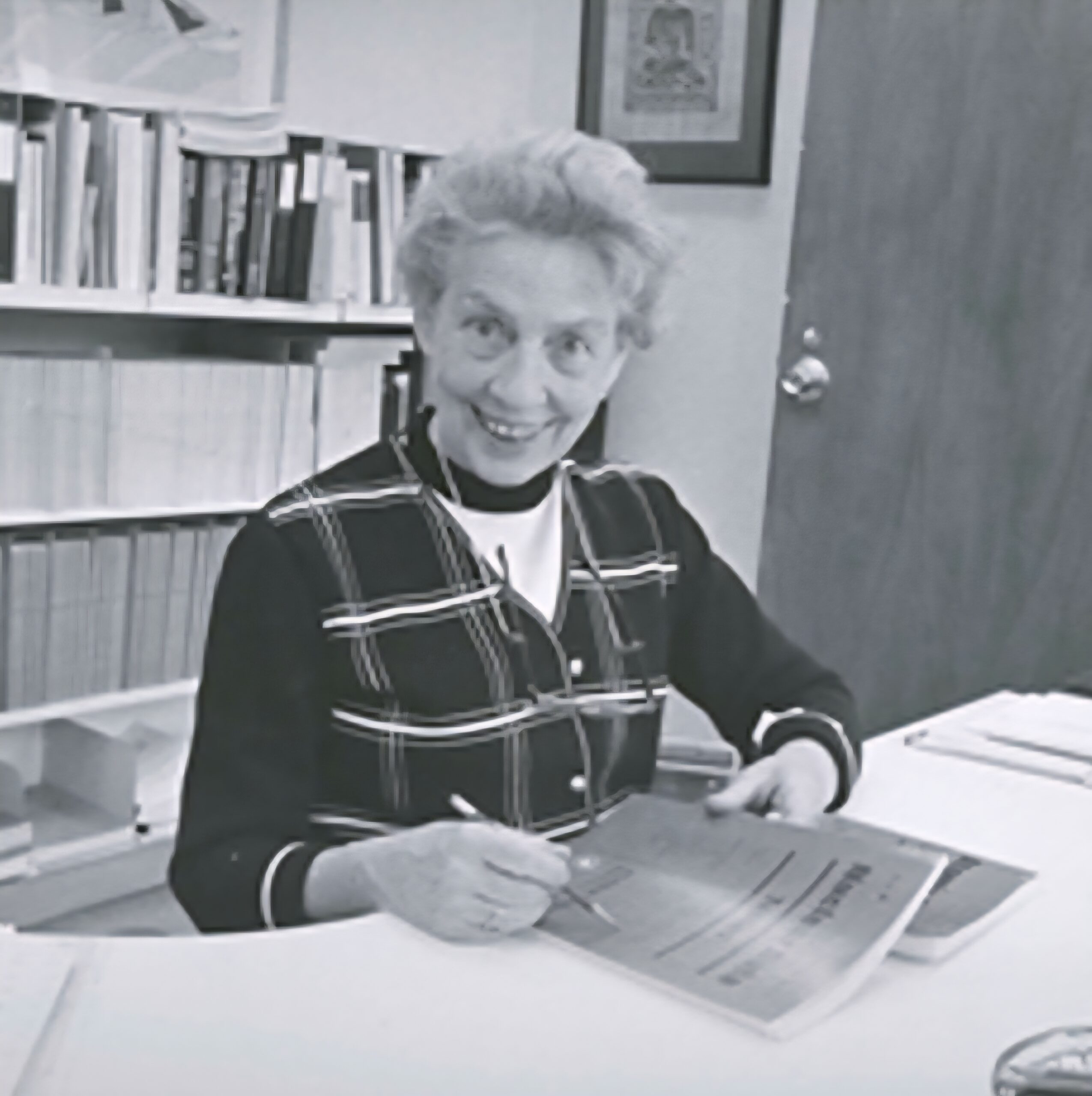
In keeping with the theme of this piece, very little photo documentation exists of Katherine Way. We apologize for the low quality image.
- As (mis)quoted in John Wheeler’s 1983-84 Research Notebook (John A. Wheeler Papers, American Philosophical Society Library, Philadelphia), p. 62. The actual line from Donne’s Go and Catch a Falling Star is “Tell me where all past years are”. ↩︎
- J.A. Wheeler, Geons, Black Holes, and Quantum Foam: A Life in Physics (W. W. Norton & Co. 1998). ↩︎
- ibid., p. 23. ↩︎
- Fission, to put it roughly, is a process in which an atomic nucleus splits into two (or possibly more) smaller nuclei, releasing a huge amount of energy. At the end of 1938, Otto Hahn and Fritz Strassmann, in Berlin, reported the experimental result that barium was detected as a result of bombarding uranium with neutrons. In January 1939, Lise Meitner and Otto Frisch sketched a theoretical explanation of this result; shortly after that, Bohr, while visiting the US, worked with Wheeler to better understand the theory behind fission. All of this was clearly of crucial importance for the feasibility of the Manhattan Project. ↩︎
- Rubenstein Library, Duke University (Biographical Reference Collection, box 26; New Service Biographical Files, box 107). ↩︎
- These problems have been discussed in some detail in a chapter of the recent collective volume on women in the history of quantum physics, published for the centenary of quantum mechanics: S. Furlan, “Excelsior! John Wheeler, Katharine Way, and the role of women in the exploration of the microcosm”, in P. Charbonneau, M. Frank, M. van der Hejiden, & D. Monaldi (eds.), Women in the History of Quantum Physics: Beyond Knabenphysik, pp. 223-249 (Cambridge University Press 2025). ↩︎
- Martin, M., Gove, N., Gove, R., Raman, S., and Merzbacher, E. (1996) “Katharine Way”, Physics Today 49 (12): 75. ↩︎
- Howes R.H., Herzenberg C.L. (1999) Their Day in the Sun: Women of the Manhattan Project, Temple University Press, Philadelphia. Ware S., Braukman S.L. (2004) Notable American Women: A Biographical Dictionary Completing the Twentieth Century, Belknap Press, Cambridge (Massachusetts). ↩︎
- The fact that several online sources list the wrong year for her birth, not to mention the misspelling of her name (which is a less common variant closer to the original Greek etymology), is quite telling about the level of neglect that surrounds her memory, almost lost to the tides of history. ↩︎
- Way to Wheeler, April 27, 1983. John A. Wheeler Papers, American Philosophical Society Library, Philadelphia, box 68. ↩︎
- Wheeler, Geons, Black Holes, and Quantum Foam, cit., p. 150. ↩︎
- Masters, D., Way, K. (eds.) (1946). One World or None: A Report to the Public on the Full Meaning of the Atomic Bomb. New York: McGraw-Hill. ↩︎
- Way, K. (ed.) (1973) Atomic and Nuclear Data Reprints (2 vols.), New York: Academic Press. ↩︎
- Wheeler, J.A. (1979) “Some Men and Moments in the History of Nuclear Physics: The Interplay of Colleagues and Motivations”, in Stuewer, R. (ed.), Nuclear Physics in Retrospect: Proceedings of a Symposium on the 1930s, Minneapolis: University of Minnesota Press, pp. 217-284. The quote is on p. 254. ↩︎
- Wheeler to Henry Motz, August 15, 1978, John A. Wheeler Papers, American Philosophical Society Library, Philadelphia, box 68. ↩︎
- Schweber S.S. (1990) “The Young John Clarke Slater and the Development of Quantum Chemistry”, Historical Studies in the Physical and Biological Sciences 20(2): 339-406. ↩︎
- Ware and Braukman, Notable American Women, cit., p. 671. ↩︎
- Rubenstein Library, Duke University (Biographical Reference Collection, box 26; New Service Biographical Files, box 107). ↩︎
- I wish to thank Michelle Frank for this. The letter is preserved among the C.S. Wu Papers at the Rare Book and Manuscript Library at Columbia University. ↩︎
- Wheeler, Geons, Black Holes, and Quantum Foam, cit., p. 150. ↩︎
- Wheeler J.A., Geons, Black Holes, and Quantum Foam: A Life in Physics (W. W. Norton & Co. 1998), p. 23. ↩︎
- Furlan S. (2024) “The Smile of Mnemosyne: John Wheeler Between the History of Science and Arts”, Scientia, 2 (1), 1-35. Furlan S. (2025) “Wheeler the Storyteller: On the Uses and Drawbacks of History for Life”, The European Physical Journal H, 50, 17. ↩︎
- Furlan S. (2025) “Excelsior! John Wheeler, Katharine Way, and the role of women in the exploration of the microcosm”, cit. ↩︎
- “Years later, reading the works of Marie Sklodowska Curie in preparation for a celebration of her centenary, I was astonished to discover that she had thought about the breakup of a nucleus in just such terms. She referred to Rutherford and Soddy and their 1902 and still standard theory of radioactive decay. She recognized, as they did, that they were dealing with a process that transcended the understanding of the time. At the 1913 Solvay Congress she called attention anew to the mystery of the exponential law. She stressed the experimental evidence that an atom, if it had not yet decayed, had not aged at all, no matter how long it had lived. She proposed ‘to look in the interior of the atom for the element of disorder necessary to explain the application of the law of chance.’ She brought forward the suggestion of Debierne, first, that in the center of the atom there may exist a temperature much higher than the external temperature and second, that the mechanism involved may be identical with that of a monomolecular chemical reaction. She asks us to imagine ‘a molecule which is moving about in the interior of a box endowed with a tiny hole.’ Marie Sklodowska Curie goes on to say, ‘When the molecule in the course of its motion meets the hole it leaves the box and the system is radically changed. If we have a great number of boxes each containing one molecule, and if the initial velocities and positions of the molecules are random, it may happen that the escape phenomenon is governed by the rule of chance, even though the constitution of the system itself is relatively simple.’ Mme. Curie was in advance of her age. She put forward the right idea to describe nuclear fission during an epoch when she had to deal with the leakage of alpha-particles through a potential barrier!” (Wheeler, Some Men and Moments, cit. p. 280). ↩︎
- Stuewer R.H. (1979) Nuclear Physics in Retrospect: Proceedings of a Symposium on the 1930s. University of Minnesota Press, Minneapolis. ↩︎
- “Marie Curie and Fission Before Fission”, John A. Wheeler Papers, American Philosophical Society Library, Philadelphia, folder “Great Men, Great Moments, Great Ideas #1”. Wheeler’s notes also include a rather extensive story of nuclear fission, but there is no mention of Way and Ida Noddack. ↩︎
- “Marie Curie and Fission Before Fission”, John A. Wheeler Papers, American Philosophical Society Library, Philadelphia, folder “Great Men, Great Moments, Great Ideas #1”. Wheeler’s notes also include a rather extensive story of nuclear fission, but there is no mention of Way and Ida Noddack. ↩︎
- Wheeler, Some Men and Moments, cit., p. 266. ↩︎
- Wheeler, Geons, Black Holes, and Quantum Foam, cit., p. 22. ↩︎
- Wheeler, Geons, Black Holes, and Quantum Foam, cit., pp. 22-3. ↩︎
- A Family Gathering, John A. Wheeler Papers, American Philosophical Society Library, Philadelphia, box 43. My emphasis in the text. Janette was Wheeler’s wife. ↩︎
- Way, K. (1939) “The Liquid-Drop Model and Nuclear Moments”, Physical Review 55 (10): 963-965. Actually, it had also been submitted after the news about fission. ↩︎
- This is a rather interesting topic also from the point of view of philosophy of science. Way’s research has been recently mentioned in some work discussing the plurality of models and perspectivalism: Massimi M. (2022) Perspectival Realism, Oxford University Press, Oxford). We can now see, however, that the issue at stake was more complex and, in some way, subtler than that. ↩︎
- Wheeler to Henry Motz, August 15, 1978, John A. Wheeler Papers, American Philosophical Society Library, Philadelphia, box 68. ↩︎
- Rife, P. (1999) Lise Meitner and the Dawn of the Nuclear Age, Birkhäuser, Boston. ↩︎
- Wheeler, Geons, Black Holes, and Quantum Foam, cit., p. 15. ↩︎
- Magalhães Santos, G. (2014) “A Tale of Oblivion: Ida Noddack and the ‘Universal Abundance’ of Matter”, Notes & Records of the Royal Society 68(4): 373-389. ↩︎
- John A. Wheeler Papers, American Philosophical Society Library, Philadelphia, box 189. Moreover, in the same Texas course we mentioned earlier, in a list of possible topics for students’ reports, we can read: “Why Didn’t Germany Get the Atomic Bomb First?” Of course, Wheeler was personally acquainted with Heisenberg and Weizsäcker, and so it would be conceivable that he was referring to the project they were part of, but, as we shall see in a moment, it is very plausible that Wheeler had in mind Noddack too. ↩︎
- Wheeler to Rife, October 6, 1998, John A. Wheeler Papers, American Philosophical Society Library, Philadelphia, box 157. ↩︎
- Wheeler, Geons, Black Holes, and Quantum Foam, cit., pp. 18-19. ↩︎
- I thank Guido Bacciagaluppi and Paul Halpern for such anecdotes. ↩︎
- Wheeler, Geons, Black Holes, and Quantum Foam, cit. ↩︎
- Weart S.R. (1983) “The Discovery of Fission and a Nuclear Physics Paradigm”, in Shea W.R. (ed.), Otto Hahn and the Rise of Nuclear Physics, Dordrecht: Reidel Publishing Company, pp. 91-133. ↩︎
- John A. Wheeler Papers, American Philosophical Society Library, Philadelphia, folder “Transcription of John Archibald Wheeler Interview by Carol A. Mockros – 1992-1993”. ↩︎