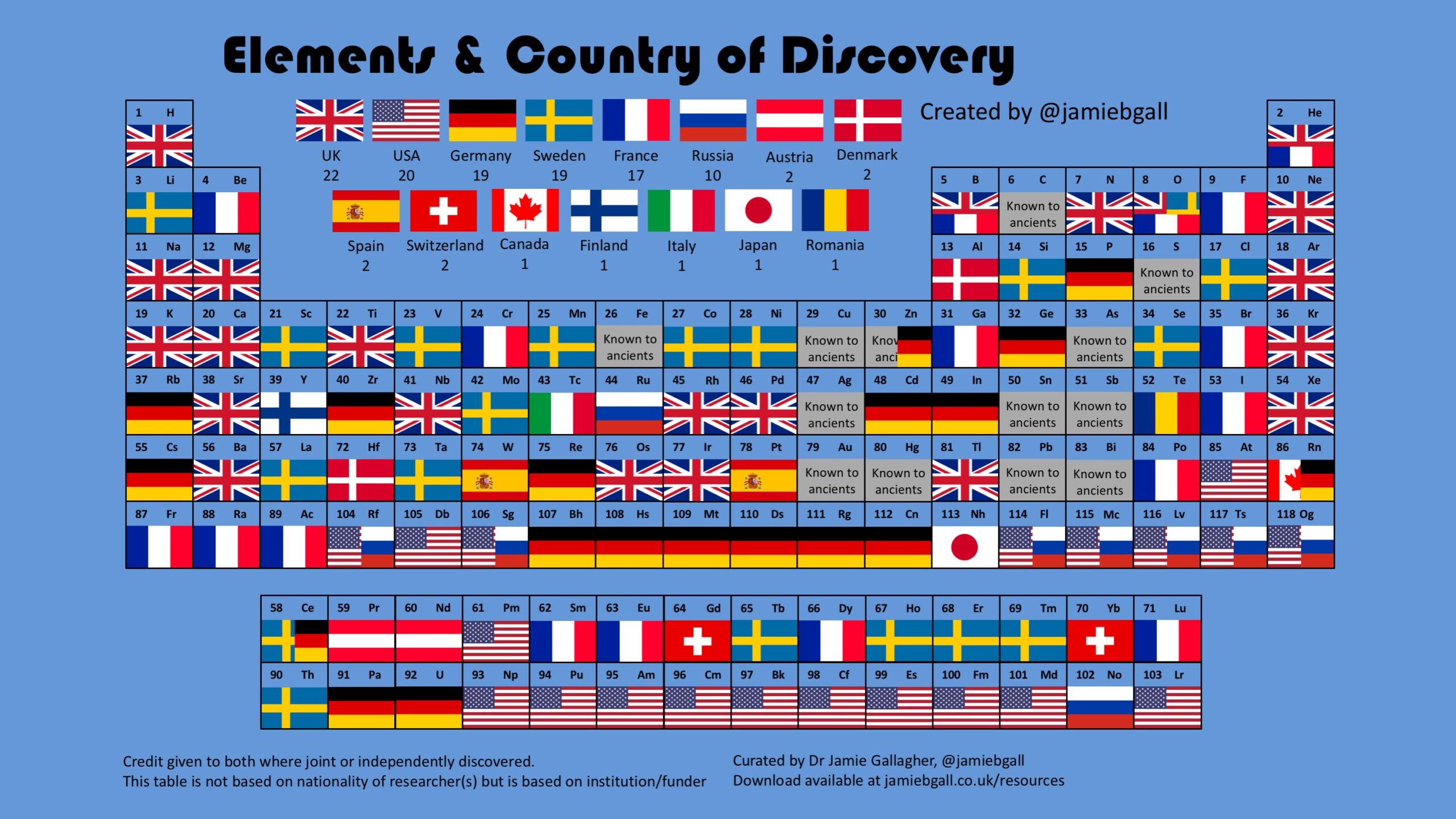
Header image: one version of the “Periodic Table of Flags”. Reproduced by kind permission from Jamie Gallagher.
Discovery histories fascinate. They are filled with “bravery, ingenuity, and insurmountable odds”, with “morality and miracles, science and sacrifice”; they are said to “open new horizons, provide new insights, and create cast fortunes.”1 People may find them compelling because such stories offer glimpses into the exciting world of science, and appear to reveal how scientific work unfolds.
But do they really? This is the question I explore in this article. How do discovery histories actually emerge and develop, and what can they teach us about scientific processes? In addressing these questions, I argue for the use of case studies that are thoroughly researched and grounded in historical scholarship.
As someone who identifies both as a chemistry educator and a historian of science, I feel a strong responsibility to build bridges of knowledge between scientific fields. Accordingly, part of this article is also devoted to illustrating what history of science can contribute — and what it can teach us.
The tension between nuance and simplicity
The historian in me strives to highlight complexity and depth. I often find that the history of science, as presented in popular scientific accounts or in science textbooks, is simplified and superficial. But as teachers, we may worry that adding layers of complexity in our lessons might unnecessarily confuse students. I have also frequently encountered the view that students need compelling stories to remember and be inspired by, and that such narratives are more important than understanding the intricacies of the past.
So why bother with the nuances of those stories? My answer would be that by overlooking what historians have uncovered, we risk missing valuable opportunities to discuss how science actually works and develops, and how scientists arrive at their knowledge. At worst, we might mislead and misinform students, and inadvertently reinforce naïve assumptions about scientific knowledge and practice.
Historian, philosopher of science, and science educator Douglas Allchin highlights another important aspect: narratives about scientific developments often verge on myths. Such distorted accounts — which he terms “pseudohistory” — are marked by the idealization of historical actors and scientific processes. They may, for instance, present scientific progress as linear and straight-forward rather than acknowledging its inherent complexity, or they may exaggerate the roles of particular individuals in order to create more dramatic stories. In doing so, they risk reinforcing misleading stereotypes.2
We sometimes find heroic tales, anecdotes, and simplified portrayals of scientific methods and processes in textbooks. Even when such texts appear rather sober and straight-forward, they nonetheless convey a message. For example, in an otherwise prosaic account of the development of the periodic table in a chemistry textbook for undergraduate students, we are told that “Mendeleev then organized all the known elements in a table consisting of rows in which mass increases from left to right” and that “Mendeleev’s original listing has evolved into the modern periodic table”.3 As only the Russian chemist Dmitri I. Mendeleev is mentioned, the implication is clear: the discovery — or development — of the periodic table is located at a specific moment in time, in a specific place, and credited to a single figure.
It could be worth reflecting on which aspects of the story have been included —and which have been left out. Is the account acceptable merely because we cannot detect any factual mistakes? In descriptions like these, where no information is provided about the process that led to the new knowledge — such as trial and error, intuition, creativity, imagination, collaboration, the nature of the work involved, the time it required, or the various pieces needed to complete the puzzle — the implicit message becomes that a very small number of scientists (often male and white) single-handedly developed science. Allchin argues that such portrayals foster misleading views about the Nature of Science (NOS).
Tables of discoveries and their pitfalls
Another type of “historical overview” of scientific discoveries or accomplishments that we occasionally encounter appears in the form of tables. The Wikipedia Timeline of chemical element discoveries is one such example.4 These overviews make it easy to “look up” when an element was discovered and who was involved in the work. In fact, for discoveries dating from the 1660s onward — considered “modern discoveries” — there is a separate column indicating when the element was first observed and another for when it was isolated. The notes column even allows for added nuance, including the names of multiple contributors. Yet despite these attempts at complexity, we cannot escape the conclusion that tables ultimately serve to pinpoint the discovery at a particular time and place.
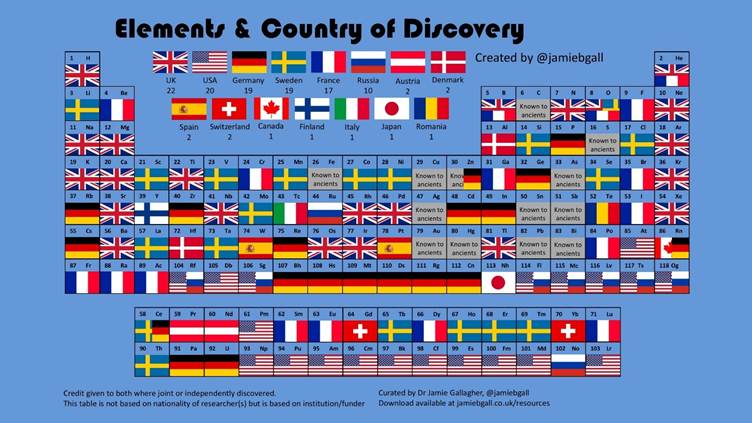
One version of the “Periodic Table of Flags”. Reproduced by kind permission from Jamie Gallagher.
Another, more striking example of the practice of pinning down element discoveries is what might be called the “Periodic Table of Flags” (shown above), which exists in different versions online. While such visual summaries are convenient and offer an immediate overview, they also come with significant limitations. Most importantly, they strip away crucial scientific processes involved in these discoveries. The complexity of discovery — its collaborative nature, the gradual accumulation of evidence, and the often messy, non‑linear trajectory of scientific work — is lost in favor of a simplified, nation‑centered narrative.
What, in fact, does the flag indicate? For example, why is a Danish flag assigned to aluminum? Indeed, the Danish natural philosopher Hans Christian Ørsted presented the first small lump of aluminum to the Danish Academy of Sciences in 1825. But is the story really that simple? Is Ørsted the discoverer of aluminum?
In a chapter recently published in Discovering the Elements: No Simple Stories (edited by Brigitte Van Tiggelen and Annette Lykknes), Sarah Hijmans reflects on what it actually means to “discover” an element.5 She shows that, in 19th-century accounts, the French chemist Henri Sainte-Claire Deville and German chemist Friedrich Wöhler were typically credited jointly with the discovery of aluminum.6 The shift towards crediting Ørsted instead is largely the result of efforts by Danish scientists in the 1920s, who — by preparing a centenary celebration of his work on electromagnetism — also chose to highlight his work on aluminum. In doing so, they contributed to a reframing of the historical narrative, one that was gradually adopted by others and incorporated into newer discovery histories of aluminum.
The story of the discovery of the rare earth metal yttrium offers another instructive example, as described by Charlotte A. Abney Salomon in the volume mentioned above.7 In the “Periodic Table of Flags” displayed here yttrium is associated with a Finnish flag. This reflects the fact that the discovery is commonly attributed to Finnish chemist Johan Gadolin, who in 1794 published an analysis of a black, heavy stone from the Ytterby quarry in Sweden, revealing the presence of an unknown constituent. Gadolin’s interpretation of his findings was grounded in the scientific paradigm of the time, which held that the “earths” represented fundamental types of matter. This conceptual framework of understanding was gradually replaced by the later understanding of elements as substances that could not be decomposed further by chemical means.
Two centuries after his initial findings, however, Gadolin is still presented as the answer to the question “Who discovered yttrium?”, even though the substance he identified changed its scientific identity over time — from an “earth” to an oxide, and eventually to a mix of oxides containing the metal yttrium. As the space devoted to discovery histories in science textbooks diminished and simplifications became unavoidable, Gadolin increasingly emerged as the discoverer of the metal and element yttrium — despite the fact that he never isolated the metal and never claimed to have detected it. As Abney Salomon observes, over time the discovery of yttrium was reduced to a set of “data” with a fixed place, a date and a person, much like in the “Periodic Table of Flags”. The Wikipedia Timeline, in contrast, actually provides many more details.
In our third example, we turn to the discoveries of the radioactive elements radium and polonium.8 For these discovery histories, the central issue is not whether Marie and Pierre Curie were the correct discoverers of those elements — this is well established and thus justifies the French flag assigned in the “Periodic Table of Flags.” Rather, the more interesting question concerns which stage of the discovery process should count as the discovery, and whether it is even possible — or desirable — to assign a specific date to it. Before examining this question, however, let us first consider the chronology of the process as it is currently understood.
In a series of papers published in 1898, Marie and Pierre Curie announced that they might have discovered two new chemical elements in radioactive minerals. These announcements followed months of painstaking work in which they analyzed the minerals, separated their components into fractions, and measured the radioactivity of each fraction. First, they reported the identification of a fraction with an intense level of radioactivity that could not be ascribed to any known radioactive substance. A few months later, they detected a second such fraction. The Curies then put forward the bold hypothesis that these two highly radioactive fractions contained two entirely unknown chemical elements and proposed to name them “polonium”, after Marie Curie’s homeland of Poland, and “radium”, after the term “radioactivity” which they had introduced for the newly observed phenomenon.
However, at this stage, the radioactive materials had not yet been isolated from the minerals, and their identification rested solely on their distinctive radioactivity. No additional physical or chemical evidence could be obtained for polonium. Before long, the existence of radium was supported by spectroscopic data, but no comparable evidence could be obtained for polonium. The Curies therefore chose to focus their continued efforts on radium, which they believed offered a greater chance of success. It took almost four years — and the involvement of additional collaborators as well as industrial partners — to achieve the first separation of a minute quantity of radium salt in 1902. Only then could the most compelling chemical evidence of the time ── the determination of the element’s atomic weight — be provided. Metallic radium would not be produced until 1910.
The difficulty in isolating polonium and providing definite evidence for its existence stemmed from its extremely low natural abundance — it occurs at only about 0.2% of the level of radium in uranium ores. Nevertheless, Marie Curie never abandoned her efforts to characterize the element. Over time, her laboratory built up considerable expertise in working with polonium, and by 1910 a sufficiently large quantity had finally been produced to allow spectroscopic confirmation of its existence.
Large-scale production of polonium did not become possible until the Second World War, when the element came to be regarded as valuable bomb material. Within the framework of the Manhattan project, polonium was required to produce a polonium-beryllium neutron initiator for the implosion-type atomic bomb that was later dropped on the Japanese city of Nagasaki. Industrial-scale manufacture therefore became important — first for radium earlier in the century, and later for the mass production of polonium. It was only in 1949 that polonium was formally included in the atomic-weight table issued by the standards body in chemistry, the International Union of Pure and Applied Chemistry (IUPAC).9
So when were radium and polonium actually discovered? Most accounts state 1898, but as we now see, other plausible dates emerge: for radium, 1902 and 1910; for polonium, 1910 and even 1949, depending on which evidential standard one regards as constitutive of a “discovery.” This illustrates the complexity of the discovery processes and the many steps that intervene between an initial observation and the point at which evidence is robust enough to be accepted by the scientific community. The fact that the stories of radium and polonium are often told together reinforces this point: what began as the detection of two possible new elements soon diverged into two quite different — and differently paced — discovery trajectories.
History of scientific discovery for the people?
Is it really less fascinating to learn about the many “fathers” of aluminum and how their stories have been reshaped over time, than to read about a single heroic figure who discovered the element against all odds? Is the gradual shift from an understanding of matter based on categories of “earths” to a modern conception of elements, any less compelling than a tale of a man who analyzed a stone and found an unknown substance more than 200 years ago? And does the complexity of the long and winding processes that eventually led to the recognition of two new radioactive elements fail to capture the excitement of discovery in the same way that the dramatic story of a single investigation in 1898 supposedly does? Indeed, why shouldn’t the nuanced stories be equally fascinating and compelling?
More than fifty years ago, physicist and historian of science Stephen G. Brush published an article entitled “Should the history of science be rated X?,” in which he examined the role of historical material in science teaching.10 Brush argued that science teachers who wished to present a traditional image of the scientist as a “neutral fact finder” should avoid using history of science, as history would not support this portrayal. On the contrary, he suggested, historical accounts tend to remove heroes of science from their pedestals. Thirty years later, echoing Brush’s 1974 article, Douglas Allchin similarly emphasized that idealized and romanticized portrayals of science amount to a distortion — one that threatens the impersonal and orderly “scientific method” so often described in textbooks.11
This leads me to a dilemma I have often encountered in my work as a chemistry educator and historian of science, engaging with diverse audiences and colleagues from different fields at the intersection of chemistry, education and history: the “history of chemistry” (or history of science more broadly) does not mean the same thing to a chemist, a chemistry educator and a historian of chemistry. In my experience these three groups are not interested in the same kinds of stories. As John Powers has argued, the aims of historians are frequently not aligned with the aims of scientists.12
As I have argued above, historical scholarship can illuminate scientific processes and practices and thereby contribute to a richer understanding of the Nature of Science. That makes the work of historians of science also meaningful for science educators. Case studies of chemical-elements discoveries, for example, can deepen our grasp of what “discovery” itself entails. As historian of science Simon Schaffer reminded us many years ago, “discovery” is a retrospective label — one assigned to mark milestones or celebrated events within a scientific community.13 Historical research invites us to question why we feel compelled to pinpoint such events in time and space in the first place. Drawing on the collection of discovery histories presented in Discovering the Elements: No Simple Stories, Brigitte Van Tiggelen and I further argue that discovery is not only a process that is constructed for particular purposes: it is also deconstructed and then reconstructed each time it is narrated to different audiences.14
History of science has much to offer both to scientific audiences and to students learning about science. But as historians we must be willing to step outside our comfort zones and make a deliberate effort to “translate” historical scholarship into accessible forms. Rather than simply criticizing how history is presented in textbooks and popular accounts, we should strive to write informative, reflective, and illuminating articles about historical cases in venues read by scientists, teachers, and textbook authors. Doing so is one step toward a more historically informed dissemination of history of science.
- The first two quotations are selected descriptions from A. J. Banner, “8 Glorious and triumphant novels of scientific discovery”, cited in Brigitte Van Tiggelen and Annette Lykknes, “Identifying, Interpreting and Disseminating Discoveries of Elements: An Introduction to the Volume” in Discovering the Elements: No Simple Stories, ed. B. Van Tiggelen and A. Lykknes (World Scientific, 2026), 2. The last quotation is from Kendall Haven, 100 Greatest Science Discoveries of All Times (Libraries Unlimited, 2007), xi. ↩︎
- Douglas Allchin, “Scientific Myth-Conceptions,” Science Education 87, 329-351; Douglas Allchin, “Pseudo-history and pseudoscience”, Science & Education 13, 179-195. ↩︎
- Nivaldo J. Tro, Principles of Chemistry. A Molecular Approach (Pearson, 2016), 83. ↩︎
- Timeline of chemical element discoveries – Wikipedia, accessed 29 January 2026. ↩︎
- Brigitte Van Tiggelen and Annette Lykknes, eds. Discovering the Elements: No Simple Stories (World Scientific, 2026). ↩︎
- Sarah N. Hijmans, “The Many Fathers of Aluminium: Collaboration, Credit and the Construction of Discovery” in Discovering the Elements: No Simple Stories, ed. B. Van Tiggelen and A. Lykknes (World Scientific, 2026), 107-136. ↩︎
- Charlotte A. Abney Salomon, “Finding Yttrium: Johan Gadolin and the Development of a Discovery” in Discovering the Elements: No Simple Stories, ed. B. Van Tiggelen and A. Lykknes (World Scientific, 2026), 43-72. ↩︎
- Annette Lykknes, “A Chemistry of the Imponderable? Radium, Polonium and the Discovery of Elements in the Era of Radioactivity” in in Discovering the Elements: No Simple Stories, ed. B. Van Tiggelen and A. Lykknes (World Scientific, 2026), 137-163. ↩︎
- The IUPAC was established in 1919. However, standard atomic weight tables were issued by Deutsche Chemische Gesellschaft and the American Chemical Society since the late 19th century. The International Committee on Atomic Weights (ICAW) issued annual atomic weight tables between 1902 and 1921 (except for 1918). See Norman E. Holden, “Atomic Weights and the International Committee – A Historical Review”, Chemistry International 26(1), January-February 2004, available at: Chemistry International — Newsmagazine for IUPAC. ↩︎
- Stephen S. G. Brush, “Should the history of science be rated X? The way scientists behave (according to historians) might not be a good model for students”, Science 183, 1164-1172. ↩︎
- Douglas Allchin, “Should the sociology of science be rated X?”, Science Education 88, 934-946. ↩︎
- John C. Powers, “The history of chemistry in chemistry education”, Isis 111, 576-581. ↩︎
- Simon Schaffer, “Scientific discoveries and the end of natural philosophy”, Social Studies of Science 16, 387-420. ↩︎
- Brigitte Van Tiggelen and Annette Lykknes, “Identifying, Interpreting and Disseminating Discoveries of Elements: An Introduction to the Volume” in Discovering the Elements: No Simple Stories, ed. B. Van Tiggelen and A. Lykknes (World Scientific, 2026), 1-40. ↩︎
Annette Lykknes is a historian of chemistry and professor of chemistry education at NTNU-Norwegian University of Science and Technology in Trondheim. She is chair of the Division of Chemistry (DHC) of the European Chemical Society (EuChemS), the History of Chemistry group of the Norwegian Chemical Society, and the Norwegian Association for History of Science. Her research interests include the history of 19th- and 20th‑century chemistry, university history, the history of women and couples in science, and approaches to teaching the nature of science to science students. She is Editor-in-Chief of Ambix: the Journal of Society for the History of Alchemy and Chemistry and book series editor (with Brigitte Van Tiggelen) of Analysis: Historical Cases in Chemistry (World Scientific).
Edited by Marieke Gelderblom and Bianca Angelien Aban Claveria