How is one to teach science? The conventional method is that a teacher sets out the received view on a certain topic and hopes that their students will somehow assimilate this view. An obvious drawback of this method is that it leaves students in the rather passive role of reproducing the ready-made knowledge presented to them. One could argue that this hardly qualifies as teaching science, as the conduct of science genuinely involves an active, passionate and often exciting endeavor of finding out something new. Might it not be possible to turn the educational experience of learning science into something more like the real thing, that is, more like doing science? Wouldn’t the didactic benefits of such a change be immense?
Jean-Jacques Rousseau (1712-1778) was the first in the history of western education to be tempted by this seductive idea. Rousseau was a philosopher, composer, writer and pedagogue who was famous (or notorious) for his trenchant criticism of Enlightenment culture. He also engaged in scientific pursuits. His attitude toward science was, however, extremely ambivalent. In his prize-winning Discourse on the Arts and Sciences of 1750 he blamed the sciences (along with the arts) for the corruption of morals and claimed that they owed their birth to such human vices as vanity and avarice. Nonetheless, he was also deeply in awe of scientific geniuses like Descartes and Newton, “those teachers of mankind, [who] had themselves no teachers”.1 In the 1740s Rousseau had seriously dabbled in chemistry when that discipline started to become fashionable in French intellectual circles, taking courses at the King’s Garden in Paris and working as a secretary and research aide to the son of a wealthy family.2 In his later years Rousseau rejected chemistry as laborious, dangerous, unwholesome and vain, and turned his attention instead to botany as a more salutary pastime.3
For Rousseau, learning science was to be an essential part of the education of virtuous citizens, as transpires from his pedagogical treatise Emile, or On Education (1762). At first sight this might seem surprising, given the morally dubious qualities he usually attributed to science and its practitioners, especially their much-incriminated vanity or amour-propre. However, he also held (undoubtedly wrongly) that scientific geniuses like Newton were above the quest for fame and glory and showed little or no concern about their reputation. But the decisive point was that Rousseau took intellectual independence to be a core value of science. Not without reason, as scientists from the 17th century on cherished their independence. A genuine investigator would ideally use his own intellect and rely on his own perceptive powers and not be in thrall to the received tradition or accept anything on authority. This ideal is captured in the Royal Society’s motto Nullius in verba or “Take nobody’s word for it”. Such an attitude was also welcome to Rousseau as it would strengthen the independence of citizens, which he appreciated also for socio-political reasons. His avowed pedagogical ideal was “the natural man living in the state of society”, a fiercely independent adult impervious to social prejudices.4 This also reflected his fantasy image of savages at the dawn of human history as solitary, self-sufficient and essentially pre-social humans roaming the primal forests on their own, which strongly resonated with Rousseau’s self-understanding.5
It might appear that a proper science education runs up against an insurmountable problem. If the practice of science hinges on the autonomous exercise of your own reason and observational powers, how can it be taught at all? Explicit instruction seems to run afoul on the required independence. Rousseau seemingly found an answer to this question. Rejecting the dogmatic approach to teaching science, his solution was to let pupils find out things (almost) all by themselves, with only a minimum of guidance from teachers. In the Emile, Rousseau gave various examples of “discovery learning” involving such diverse fields as physics, geometry, cosmography, and geography. Surprisingly, in the extensive literature on Rousseau’s pedagogy these examples have rarely been subjected to the detailed scrutiny they deserve.6 Most commentators discuss the broader philosophical, pedagogical and political tenets of Rousseau’s views on education while apparently considering his concrete examples too trivial to merit serious examination. That is regrettable because these very examples, when critically examined, allow us to judge the soundness and tenability of Rousseau’s pedagogical approach to science education. We can only discuss in detail one example here, drawn from the special field of dioptrics (the part of optics dealing with refraction), and briefly comment on the example taken from geometry.
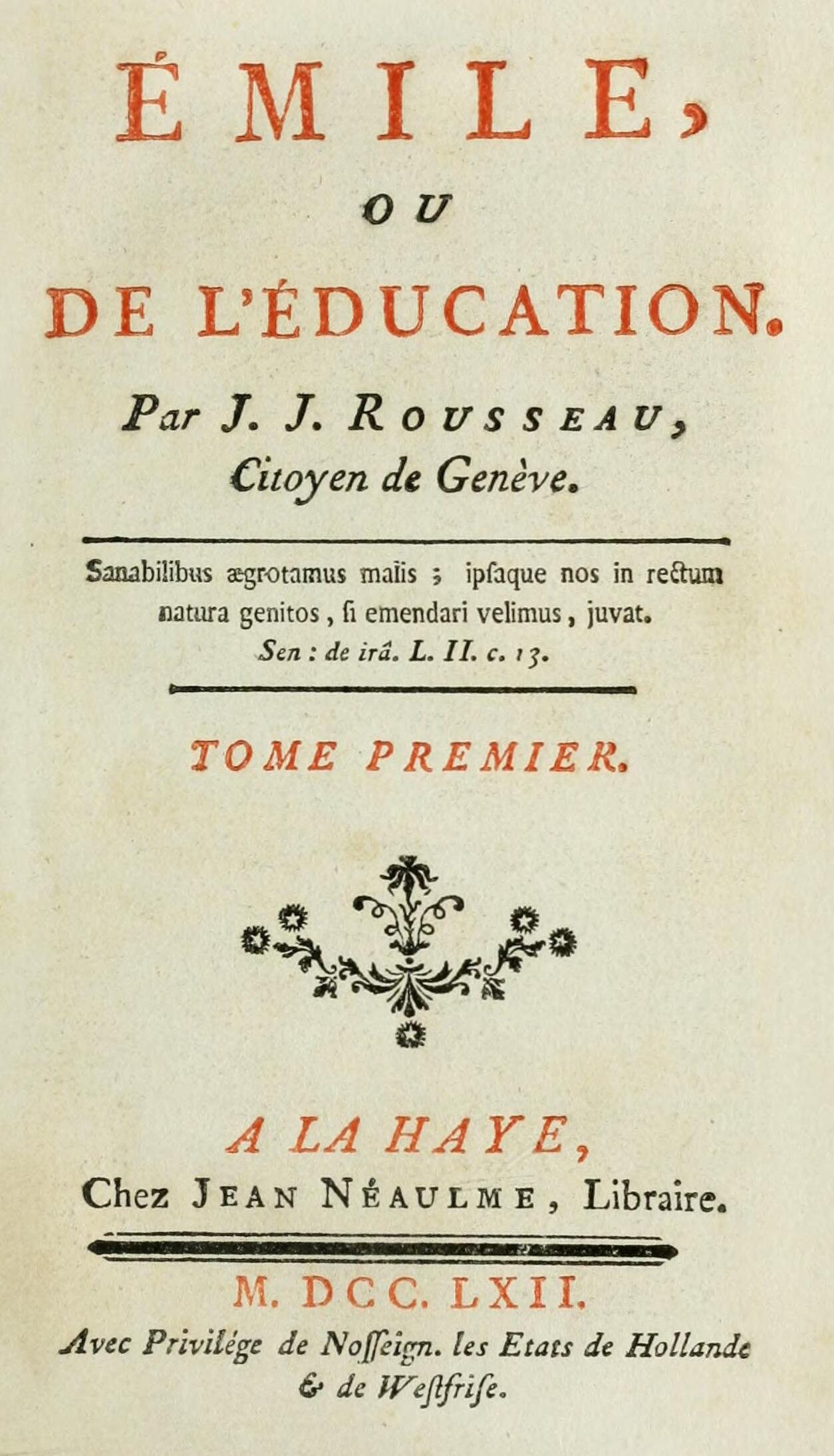
Title page from the first edition of Emile, or Of Education, 1762 (Source: Wikimedia Commons).
The example of the half-immersed stick
The example of discovery learning taken from the field of dioptrics concerns a stick that is half immersed in water and therefore looks broken. This example deserves more detailed examination, as it shows the far-reaching claims Rousseau connects with his system of education.
Rousseau expresses his pedagogical-didactic creed in the following passage:
“Make your pupil attentive to the phenomena of nature. Soon you will make him curious. But to feed his curiosity, never hurry to satisfy it. Put the questions within his reach and leave them to him to resolve. Let him know something not because you told it to him but because he has understood it himself. Let him not learn science but discover it. If ever you substitute in his mind authority for reason, he will no longer reason. He will be nothing more than the plaything of others’ opinion.”7
We meet here with the familiar Enlightenment adage to use one’s own intellect and to accept nothing on authority. But does this adage also apply to children? Using the case of the half-immersed stick, among other examples, Rousseau wants to show that they can indeed find out the relevant science (that is, the science that explains the phenomenon at hand) themselves without relying on other people’s reasonings.
The case seems rather simple: the half-immersed stick looks broken but isn’t. Rousseau assumes that the normal child, when asked whether the stick is really broken, would give an affirmative answer (supposing that he is confronted with such a case for the first time). The child is right that he sees a broken stick, but he jumps to the conclusion that the stick is really broken. He commits an error, according to Rousseau, because he “no longer judges by inspection, but rather by induction, in affirming what he does not sense — that is, that the judgment he receives from one sense would be confirmed by another”.8 If that is the correct diagnosis of the epistemic mistake, one would think that the obvious remedy is to attempt to confirm the judgment suggested by sight by the testimony from another sense, such as touch. When the pupil feels the stick in the water with his hands, he might conclude that it doesn’t feel broken. Yet this is not the procedure Rousseau recommends. He holds instead that “one still has to learn to verify the relations of each sense by itself without need of recourse to another sense”.9 He also objects to the simple procedure of just taking the stick out of the water. That would apparently be an option of last resort. At first sight it is not entirely clear why he takes this view.
Given these self-imposed restrictions, what would be the research procedure performed by an ideal pupil such as Emile? Rousseau gives a description in four steps and ends with a remarkable conclusion:
“The stick, half dipped in water, is fixed in a perpendicular position. To know if it is broken, as it appears to be, how many things must we do before drawing it from the water or putting a hand to it?
- First we walk around the stick, and we see that the break turns as we do. Therefore, it is our eye alone which changes it, and glances do not move bodies.
- We look from straight above at the end of the stick which is out of the water. Then the stick is no longer curved. The end near our eye exactly hides the other end from us. Did our eye straighten out the stick?
- We stir the water’s surface. We see the stick fold up in many pieces, move in zigzags, and follow the undulations of the water. Does the movement we give to this water suffice to break, soften, and thus dissolve the stick?
- We let the water flow out, and we see the stick straighten out little by little as the water goes down.
Is this not more than enough for clarifying the fact and discovering refraction? Then it is not true that sight deceives us, since we need nothing but it alone to rectify the errors we attribute to it.”10
This series of operations and observations look somewhat arbitrary. If the whole point is to establish whether the stick is really broken, why not simply take it out of the water? One may surmise, however, that the not-so-hidden agenda behind the whole procedure is to exculpate the senses from the charge that they sometimes deceive us. Subscribing, like many 18th-century philosophers, to an empiricist epistemology, Rousseau held that our senses never deceive us; we only deceive ourselves by jumping to conclusions. In this case, Rousseau gleefully concludes, Emile has been able to correct a deception suggested by our eyes by making a better and more cautious use of these same organs.
An astonishingly far-reaching claim is suggested by the first rhetorical question Rousseau raised after having outlined the four steps of his procedure. Does he really believe that the whole affair has been cleared up and that his pupil Emile has effectively discovered refraction? All we have obtained is the rather meagre result that the stick halfway in the water looks broken but isn’t. It is still perplexing why the stick looks broken, but no explanation has been given. It would seem, then, that there is still a lot to be clarified.

Refraction: Explaining why the stick appears to be broken (source: Wikimedia Commons)

From our physics lessons at secondary school, we may remember that refraction involves the change of direction of a ray of light when it passes at an angle from one medium to another, e.g., from water to air. A full explanation of why a stick halfway in water looks broken is to be found in dioptrics. It involves tracing rays of light through space and ascertaining how optical images are formed.11 Emile comes nowhere near such an explanation (it would require a big jump from empirical observations to more abstract theoretical notions and a geometrical mode of reasoning). It is hard to see how he could ever arrive at the proper explanation by just making more observations around his stick immersed in water. Rousseau suggests, however, that the results obtained so far, however meagre, might be a modest first step on a very long journey of discovery in which his pupil will finally invent all the relevant science by himself. Polemicizing against the adherents of the established system of education that relies on explicit instruction, Rousseau defiantly states:
“I would prefer that Emile never know dioptrics if he cannot learn it around this stick. He will not have dissected insects; he will not have counted the spots on the sun. He will not know what a microscope and a telescope are. Your learned pupils will make fun of his ignorance. They will not be wrong; forbefore he uses these instruments, I intend him to invent them. And you may well suspect that this will not come so soon”.12
From this passage we may infer that Rousseau was aware after all that, contrary to his previous suggestion, his pupil had not yet discovered refraction after his first series of observations. Instead, he implicitly advances a stunning counterfactual claim here: If we granted Emile enough time, he would in due course discover or invent dioptrics, microscopes and telescopes all by himself. How to judge this claim?
The claim is not very plausible for various reasons. First, it is hard to see how Emile, by simply accumulating observations “around this stick”, could ever make the conceptual leap to the theory of dioptrics. Secondly, much also depends on how much time we are willing to grant Emile to make all the mentioned discoveries and inventions (actually, re-discoveries and re-inventions). The counterfactual assumption of ‘enough’ time runs up against actual time constraints: in practice, Emile would never have ‘enough’ time! Here we almost see a reductio ad absurdum of the obstinate refusal to accept any authority and to use other people’s reason: the need to start afresh from scratch that results from turning down the legacy of previous history. When we must start where Adam and Eve began, we won’t reach much further than they did.13 Unlike Newton, Emile is not allowed to “stand on the shoulders of giants”, because Rousseau holds that this would amount to giving up his intellectual independence and forfeiting his own reason.
Undeterred by these difficulties, Rousseau reiterates his central message as the lesson to be drawn from this example:
“Forced to learn by himself, [Emile] uses his reason and not another’s; for to give nothing to opinion, one must give nothing to authority […]”.14
Rousseau’s educational philosophy appears to have taken the Royal Society’s motto Nullius in verba a little too literally. If science strictly followed this adage, it would come to a grinding halt – as experimental physicist Jon Butterworth incisively argues.15 However much scientists might always want to check the findings of their colleagues, they cannot go all the way without paralysing their own research plans. At some point they must accept the results of others and take them at their word.
The primitivism of radical independence
Although scientists routinely treasure their intellectual independence, most of them would not push this independence so far as to refuse to build on the work of their predecessors or to spurn the contributions of their colleagues. It is characteristic of Rousseau’s radicalism that he drove the ideal of independence to this extreme limit. This leads to the rather weird consequence that a discovery is only acceptable if it is made by oneself. Thus, accepting a demonstration of a geometrical theorem provided by somebody else would amount to forfeiting one’s own reason.16 Rousseau completely discounts the possibility that we might still use our own reason by critically running through the entire proof to see whether all the steps are logically justified and whether taken together they make a compelling argument. In view of the overwhelming difficulty of finding proofs ourselves, Rousseau opts for an alternative, proof-free geometry that is entirely based on the art of seeing (rather than the art of demonstrating) and claims that Emile can find “the whole of elementary geometry” by simply using this art.17 The only problem is that we would no longer recognize it as geometry. Rousseau’s claim that an untutored pupil can discover geometry all by himself isn’t convincing as it is based on surreptitiously changing the goal posts.
Rousseau was, it seems, a victim of the myth of the lonely discoverer.18 Remember that in the Discourse of 1750 he said that Descartes and Newton “had themselves no teachers”. Descartes and Newton themselves knew better, of course. Emile too was to have no teachers, but only a tutor asking probing questions.
The idea of radical independence also helps us to make sense of a peculiar streak of primitivism that runs through Rousseau’s entire pedagogical treatise and that might otherwise not be fully comprehensible. It is partly explained by Rousseau’s empiricist epistemology, which holds that people should learn from direct sensory experience, not from verbal and pictorial representations. But there is more to it. In geometry, even such simple expedients as rulers and compasses are banned. Emile is further supposed to work with simple, improvised, self-constructed instruments (or no instruments at all). When Emile wants to draw, he is not supposed to take any drawings made by others as his example but is only allowed to draw “after nature”. He is furthermore expected to learn geography without the use of maps or a globe, and his physics lessons take place far from a cabinet with intimidating instruments and complicated apparatus. Books are also banned – with one significant exception: Robinson Crusoe. Daniel Defoe’s novel is allowed, precisely because it exemplifies the cherished ideal of living an independent and self-sufficient life.
For Rousseau, there is a compelling reason why Emile and his tutor must avoid the use of existing scientific instruments. Just as Emile is supposed to learn to think for himself and not depend on other people’s reasonings, he is equally not allowed to rely on instruments invented by others. There is therefore no alternative than that he and his tutor themselves construct the instruments they might need during their investigations: “I want us to make all our machines ourselves”.19 The self-constructed instruments may be somewhat clumsy and imperfect, but at least “one’s reason does not get accustomed to a servile submission to authority”.20 The old bogey once again!
Rousseau’s educational legacy
Rousseau modelled the one-to-one relationship between Emile and the tutor on the custom among rich and aristocratic families to delegate the education of their sons to a personal tutor. Yet his pedagogy is often seen as an essential contribution to an education appropriate for democracy.21 It is not difficult to see why Rousseau’s pedagogy is read through this lens. Children are not taught docility and respect for authority but are encouraged to be critical and independent and to act on their own initiative – which arguably should optimally prepare them for taking up an active role as citizens in a democratic polity. Above, however, I have argued that Rousseau’s refusal to accept authority is pushed to absurd extremes and that his claim that a child is always capable of finding things out all by himself is wildly implausible – his own examples of discovery learning serve as a compelling refutation of this claim. We might thus need to rethink what exactly an appropriate education for democracy requires and what part respect for authority could play in such an education.
The idea that science education should be largely based on students’ own efforts to find out about a problem of genuine interest to them – an idea first promoted by Rousseau – is still hugely popular. It is followed in recent educational approaches variously named discovery learning, problem-based learning, inquiry-based learning, experiential learning, and constructivist learning. Despite obvious differences, all these approaches display clear family resemblances. They all involve minimal guidance by a teacher, whose role is usually reduced to that of facilitator. Most modern versions differ from Rousseau’s example in that they encourage students to cooperate in groups to solve problems. We cannot, of course, extrapolate the specific defects of Rousseau’s pedagogy to these more recent approaches. Still, it is significant that the latter, despite their continuing popularity and intuitive appeal, have been declared utter failures by psychologists who subscribe to the so-called Cognitive Load Theory.22 The critics insist that minimally guided instruction is far less effective and efficient than properly guided instruction.
We must of course leave it to the psychological and educational experts to decide on the comparative merits of the different pedagogical-didactic approaches. Greater familiarity with Rousseau’s views on science education, reflecting his empiricist epistemology and his deeply held ideal of intellectual independence, may help us to understand why inquiry-based learning has been such a seductive idea in the first place.
- Jean-Jacques Rousseau, ‘A Discourse on the Arts and Sciences’, The Social Contract and Discourses, London: J.M. Dent & Sons, 1973: 1-26. ↩︎
- Bernadette Bensaude-Vincent and Bruno Bernardi, ‘Pour situer les Institutions chymiques’, Corpus: Revue de Philosophie: Jean-Jacques Rousseau et la chimie 36 (1999): 5-40. ↩︎
- Alexandra Cook, Jean-Jacques Rousseau and Botany: The Salutary Science, Oxford: Voltaire Foundation, 2012. ↩︎
- Jean-Jacques Rousseau, Emile, or On Education, Introduction, Translation and Notes by Allan Bloom, Basic Books, 1979, 205. ↩︎
- Jean-Jacques Rousseau, ‘The Origin of Inequality’, The Social Contract and Discourses, London: J.M. Dent & Sons, 1973: 27-113. ↩︎
- Among the few who pay attention to Rousseau’s examples are two Greek scholars: Georgia Dimopoulos and Renia Gasparatou, ‘Emile’s inquiry-based education’, Journal of Philosophy of Education 58:1 (2024): 58-71; Georgia Dimopoulos and Renia Gasparatou, ‘Dewey and Rousseau on Experience-Based Science Education’, Science & Education 34 (2025): 1509-1521. In my view, both are still insufficiently critical toward Rousseau’s claims. ↩︎
- Rousseau 1979 (note 4), 168. ↩︎
- Ibid., 204. ↩︎
- Ibid., 205. ↩︎
- Ibid., 206 (italics mine). ↩︎
- Cf. Marcel Minnaert, Light and Color in the Outdoors. Springer, 1993, 45 ff. ↩︎
- Rousseau 1979 (note 4), 206 (italics mine). ↩︎
- Cf. Karl Raimund Popper, ‘Towards a rational theory of tradition’, Conjectures and Refutations: The Growth of Scientific Knowledge, London: Routledge and Kegan Paul, 1976: 120-135. ↩︎
- Rousseau 1979 (note 4), 207. ↩︎
- Jon Butterworth, ‘Take nobody’s word for it: evidence and authority in a world of propaganda’, The Guardian, 23 January 2017. ↩︎
- Rousseau 1979 (note 4), 145. ↩︎
- Ibid., 146. ↩︎
- A penetrating analysis of this myth can be found in chapter 18 (titled ‘Solitary geniuses?’) of Hugo Mercier and Dan Sperber, The Enigma of Reason, Penguin Books, 2018. ↩︎
- Ibid., 176. ↩︎
- Ibid., 176. ↩︎
- Avi I. Mintz, ‘Rousseau on Democratic Education’ In Cambridge Handbook on Democratic Education, eds. Julian Culp, Johannes Drerup, and Douglas Yacek, 45-60, Cambridge: Cambridge University Press, 2023. ↩︎
- Paul A. Kirschner, John Sweller, and Richard E. Clark, ‘Why Minimal Guidance During Instruction Does Not Work: An Analysis of the Failure of Constructivist, Discovery, Problem-Based, Experiential, and Inquiry-Based Teaching. Educational Psychologist 41:2 (2006): 75-86. ↩︎
Henk van den Belt taught philosophy at Wageningen University for many years until his retirement in 2019 and subsequent emigration to Australia. He has done research in the broad area of the history, sociology and philosophy of science.
Edited by David Skogerboe and Lisa Vanderheyden
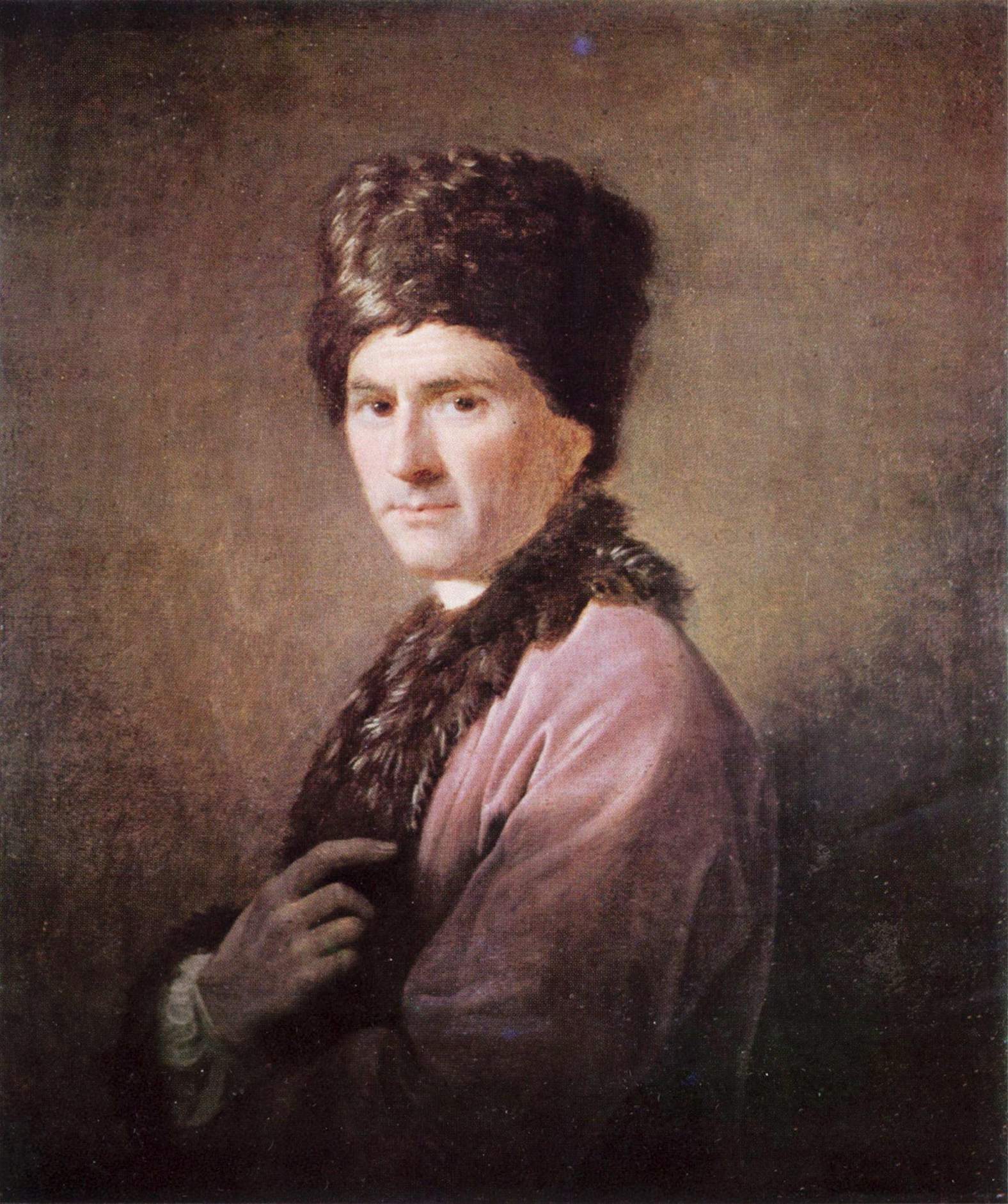
Header image: Rousseau wearing an Armenian sheepskin hat and costume, from a 1766 portrait by Allan Ramsey (Source: Wikimedia Commons)