I used to perform this joke when I was still working the comedy circuit in Amsterdam.1 It was a textbook comparison joke, where the comedian compares something familiar to the audience with something personal, an Other that is humorously introduced through the joke. In this joke, I compared the experience of waking up to birdsong on a crisp Dutch morning to waking up to the sounds of cats mating in the middle of a hot night in Nicosia. The joke ended in a crescendo of me singing while being slowly taken over by cat mating sounds. It was an absurd joke; one fit to translate an equally absurd reality.
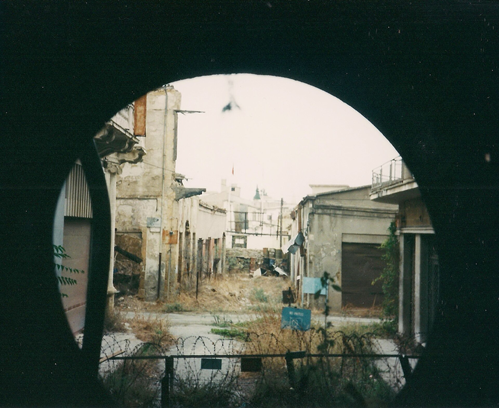
This absurd reality was imprinted on me while growing up in Nicosia. On Saturdays, I would visit my pappous’2 tailoring workshop in the old town. My pappous was a hard-working man that I rarely got to see on weekdays, so the visit to old-town Nicosia was always a treat. The workshop was housed in a long storage unit, a few steps from one of the busiest streets of the walled city, Ledras Street. I vividly remember when I got too bored or antsy, my pappous would hand me a 10-pound note of Cypriot Lira3 and send me off to fetch ice cream for everyone. The ice cream store is still open today, a couple of hundred meters away from the Ledras Str. crossing point.4

Hidro, CC BY-SA 3.0 https://creativecommons.org/licenses/by-sa/3.0, via Wikimedia Commons
My interest in what lies behind the metaphorical fence on Ledras Str. was sparked when I watched the documentary film The Stray Cats of the Dead Zone.5 The film, an audio-visual poem according to its creators, offers a view behind the fence. On a surface level, this is a film about Nicosia’s stray cats and the documentarist’s fascination with photographing them on analog film. Eventually, the curtain is drawn, and cats turn out to be anarchist subjects that, unlike Nicosia’s human inhabitants, can enter and exit the area behind the fence freely. This act of transgression becomes a jumping point for the documentarist to examine his relationship with Nicosia, and the mysterious space the cats so freely pass through: the United Nations Buffer Zone.
Last May, after watching The Stray Cats of the Dead Zone, I spent a few weeks researching the buffer zone. In this article, I present my notes from the time I spent trying to understand the thing in the middle, the other that splits my country, and my home city in half. I will historicize the buffer zone, link it to preexisting technologies of control, and talk about its association with death.
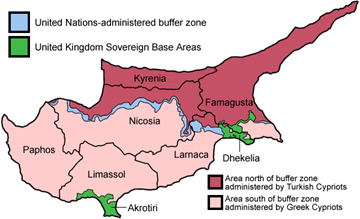
Note #1: What is the United Nations Buffer Zone?
The United Nations Buffer Zone is often (inaccurately) referred to as the Green Line. In fact, the Green line is the predecessor of the buffer zone. The Green Line became necessary after violence broke out between the Turkish Cypriot and Greek Cypriot communities in the streets of Nicosia on the 25th of December 1963. With the killing of multiple civilians, this event came to be known as Bloody Christmas. On the 28th of December 1963, three days after Bloody Christmas, a proposed ceasefire brought representatives of the two communities together to discuss the terms of the ceasefire and seek a more permanent solution.6 During that meeting, the form of the Green Line was proposed and accepted, its name derived from the green chinagraph pencil British Major-General Peter Young used to draw the line on a field map.7 It sat on top of another preceding line, the Mason-Dixon line. The Mason-Dixon line was a line of barriers put in place by British Security Forces, separating the Greek Cypriot from the Turkish Cypriot neighborhoods of Nicosia after riots erupted in Nicosia in June 1958.8
The modern-day United Nations Buffer Zone stands on the lines of a later ceasefire on the 16th of July 1974. The Buffer Zone was put in place after the invasion of Cyprus by Turkey, in response to a coup d’etat orchestrated by the Greek junta. It extends the Green Line, both on paper and in the spirit of maintaining the separation of the Greek Cypriot from Turkish Cypriot communities. The United Nations Buffer Zone is a no-man’s land that runs approximately 180 kilometers horizontally through the island, on land provided to the United Nations by the Republic of Cyprus for their peacekeeping mission. In Nicosia, there are multiple locations where the zone is only a few meters wide, providing a constant reminder of bloody conflict and intercommunal violence between the Turkish Cypriot and Greek Cypriot communities.9
Both the Green Line and the United Nations Buffer Zone that followed it are part of a longer global history of the buffer zone as a technology of control. An early form of the buffer zone is the cordon sanitaire: a strip of land that is constructed to isolate sick populations by establishing a buffer (zone) around them. As retold in the “Impartial Soldier”, General Young had been looking to draw a cordon sanitaire for days before the meeting.10 An example of an even earlier use of a cordon sanitaire can be found in the Belgian Congo.11 In 1903, the Liverpool Mission was sent to the Belgian Congo on orders of King Leopold II of Belgium. King Leopold, alarmed by the magnitude of the sleeping sickness epidemic in neighboring Uganda, ordered the mission to investigate sanitation conditions and continue previous work done on the study of sleeping sickness.12 After investigating mobile populations in the affected areas, the Mission advised colonial authorities to create a cordon sanitaire, isolating sick populations from the rest. Approaching buffer zones from the perspective of political geography, a buffer zone is a space that indicates the failure of a state or other institution to provide access to a public good. This can be public health, as stated in the previous example, or a peacetime order, as is usually the case during armed conflicts.13

Note #2: Is the Buffer Zone dead?
When you approach the United Nations Buffer Zone, on foot or by car, you will most likely be met with a sign written in multiple languages (Greek, English and Turkish). In English, it warns passers-by that they are about to enter the “buffer zone”. In Turkish, it warns passengers that they are about to enter the “intermediate zone” (“ara bölge”). Instead of following a similar theme, in Greek, it warns passers-by that they are about to enter the “dead zone”, “νεκρή ζώνη”. Whether the buffer zone is dead or alive has been deeply rooted in my mind for many years.14 This question, based on a linguistic association, invites us to consider what other life exists in the buffer zone, besides the United Nations officers who walk the patrol line.
Since the ceasefire of the 16th of July 1974, the party responsible for the control of the zone is the United Nations Peacekeeping Force in Cyprus (UNFICYP). The force administers the area and engages in peacebuilding activities. The zone is inhabited by approximately ten thousand human inhabitants, in villages located in so-called Civil Use Areas. Under the mandate of a return to “normal conditions”, the United Nations employs a permit system whereby civilians are allowed to enter the buffer zone for activities such as farming, grazing flocks, and maintenance of public infrastructure. Furthermore, bi-communal biodiversity monitoring projects, sponsored by the UN as peacebuilding activities between the two communities, have shown that multiple species of endemic and/or endangered flora and fauna are present in the zone.15
The unexpected ecological greening, or ecological benefit in a post-conflict area, is referred to by legal and political scholars as ‘collateral conservation.’16 Collateral conservation is a term used to capture the paradoxes of conservation in unintended ecological zones, where clashing interests trying to interpret the zone make direct conservation efforts not feasible. In his essay “Borderland, No Man’s Land, Nature’s Wonderland: Troubled Humanity and Untroubled Earth”, Peter Coates draws on historical examples of buffer zones, demilitarized zones, and abandoned regions to paint a picture of nature appearing through the rubble.17 Upon visiting the post-catastrophe Chernobyl site, Mary Mycio found nature thriving, even discovering birds nesting in the nuclear sarcophagus (the concrete structure that was erected on top of the nuclear site).18 In this case, the absence of humans has created the very conditions in which nature thrives, despite the radiation. How can we consider it a disaster if nature is thriving in it?
The same is true for the buffer zone. Coates presents it as a paradox: human suffering is, at times, beneficial for nature. I find it difficult to wrap my head around this very idea, because the events that led to these conditions are violent and painful. Nonetheless, the reduced (and even complete absence outside the Civil Use Areas) of humans in the buffer zone has created the conditions for moufflons to recover their once endangered population, monk seals to return, and terrapin turtles to find new habitat away from the threat of urbanization.19
Note #3: What do we do with it?
In light of the greening of the United Nations Buffer Zone, viewing it as dead seems myopic. Just like the stories of the two communities on the island are complex and intertwined, so is life in the buffer zone: it is a web of entities that interact with and shape each other and their environment. It is a contingent piece of the long and troublesome history of the island of Cyprus.
Preceded by the Green Line and before that the Mason-Dixon line, a series of technologies meant to control the two communities on the island, the United Nations Buffer Zone is similar but different in a very specific way. The absence of human habitation from a big part of the zone has created a space for more than just humans, mouflons, turtles, monk seals, tulips and everything in between. This space is now a key part of their habitat.
Treating the zone as alive, with more than just humans inhabiting it, reframes the buffer zone as a space of co-existence and cohabitation. It presents opportunities for cooperation and allows human and non-human Cypriots to negotiate their shared experience on the island. I hope that one day, the buffer zone will be fully appreciated for its complexity, and that it serves to inspire future generations of Cypriots and passers-by alike.
Acknowledgments
I would like to thank Robert-Jan Wille for allowing me the space to produce this piece in its first form, for his course “History and Philosophy of the Earth and Climate Sciences”. I would also like to thank the team of Shells and Pebbles for giving someone whose main occupation is explaining science the opportunity to do so under the lens of History of Science, and for editing this piece into its polished final form. Thank you, Elian and Anna.
Biography
Rafail Frixou is a science communicator and stand-up comedian. His greatest aspiration is to pitch a tent in the LHC and live to tell the tale. He is currently working on a documentary about the speed of birds. His research interests include the intersection of comedy and science, and the role of scientists in popular media.
Edited by Elian Schure and Anna Bruins
- Working the circuit is a term used to describe a comedian appearing at comedy venues on a rotating impermanent basis. This usually describes younger, more inexperienced comedians. ↩︎
- Pappous means Grandfather in Greek. ↩︎
- Cypriot lira, or pound, was the currency of the island and later Republic of Cyprus, from 1879 to 2007. In 2008 the euro was officially adopted. ↩︎
- Since 2003 crossing points have been opened to allow crossing between the two sides of the division. Over the years, the process of crossing has become easier and less involved. ↩︎
- Kazanti, “The Stray Cats of the Dead Zone”, audio-visual poem, short documentary, 30th October 2021, by Kazanti Films, https://www.youtube.com/watch?v=g2kgoQR0dwE. ↩︎
- At that point, Cyprus had gained independence from the British Empire only three years prior on August 16 1960, with the agreement that the United Kingdom could retain two areas as sovereign territories, one in Dhekeleia and one in Akrotiri. This explains the presence of British Forces on the island post-independence. ↩︎
- Michael Harbottle, “The Green Line” in The Impartial Soldier (Oxford University Press, 1970), 63-68. ↩︎
- Archive, “Cyprus: Along the Mason-Dixon Line”, Time, June 23rd 1958, https://time.com/archive/6612670/cyprus-along-the-mason-dixon-line. ↩︎
- Offering a simplistic account of the division (e.g. the Greek part and the Turkish part) runs the risk of erasing the rich tapestry of histories that are part of the island’s long history. The histories of the two communities are incredibly intertwined, and the current situation is representative of only the last fifty years of political and historical events. ↩︎
- Michael Harbottle, “The Green Line” in The Impartial Soldier (Oxford University Press, 1970), 63-68. ↩︎
- Lyons, Maryinez. “From ‘Death Camps’ to Cordon Sanitaire: The Development of Sleeping Sickness Policy in the Uele District of the Belgian Congo, 1903–1914”, The Journal of African History 26, no. 1 (1985): 69–91. https://doi.org/10.1017/S0021853700023094. ↩︎
- Lyons, Maryinez. “From ‘Death Camps’ to Cordon Sanitaire: The Development of Sleeping Sickness Policy in the Uele District of the Belgian Congo, 1903–1914”, The Journal of African History 26, no. 1 (1985): 69–91. https://doi.org/10.1017/S0021853700023094. ↩︎
- Lionel Beehner and Gustav Meibauer, “The Futility of Buffer Zones in International Politics”, Orbis 60, no. 2 (2016): 248-265, https://doi.org/10.1016/j.orbis.2016.01.004. ↩︎
- This also explains the title of the documentary that inspired this essay, The Stray Cats of the Dead Zone. ↩︎
- Gücel, S., I. Charalambidou, B. Göçmen, A. Karatas, Ö. Özden, A. Soyumert, and W. Fuller. “Monitoring biodiversity of the buffer zone in Cyprus.” In Poster presented at the “Monitoring biodiversity in Europe. Volunteers, efficiency and cost” congress (Leipzig, Germany, 28–30 January 2008). 2008. ↩︎
- Costas M. Constantinou, Maria Hadjimichael, and Evi Eftychiou. 2020. “Ambivalent Greenings, Collateral Conservation: Negotiating Ecology in a United Nations Buffer Zone.” Political Geography 77 (March): 102096. https://doi.org/10.1016/j.polgeo.2019.102096. ↩︎
- Peter Coates, “Borderland, No-Man’s Land, Nature’s Wonderland: Troubled Humanity and Untroubled Earth.” Environment and History 20, no. 4 (2014): 499–516. http://www.jstor.org/stable/43299702. ↩︎
- Interview with Mary Mycio, ‘Back to the Wild’, IAEA Bulletin 47/2 (Feb. 2006): 8-9. IAEA stands for International Atomic Energy Agency. ↩︎
- Constantinou, Hadjimichael and Eftychiou’s analysis concludes with a reminder that nuance is important when dealing with issues of ecological conservation. ↩︎