It is a cold, grey November day in Uppsala, Sweden. I am walking underneath the enormous columns of the Linneanum (Fig. 1), the stately building commissioned with funds donated to the University by King Gustav III in 1787. It is the centerpiece of Uppsala University’s Botanical Garden (Botaniska trädgården), established in the same year by Linnaeus’s disciple Carl Peter Thunberg.1
The Linneanum Orangery and Visual Botanical Display
This structure houses the reception room Linnésalen (Linnaeus Room) and Thunbergsalen (Thunberg Room) which once held the University’s herbarium. But I am here for its Orangery, the last one in Sweden still used for its original purpose, preserving potted citrus, Mediterranean and other sub-tropical plants, all unsuited to the rigors of Swedish winter. In Sweden, orangeries reached the height of their popularity between the late 17th and early 19th centuries, before gradually giving way to greenhouses made entirely of glass.
Through red-framed glass doors, I make my way into the Frigidarium, the cool section of the Orangery, where a young potted Monkey Puzzle Tree (Araucaria araucana), figs, oranges, olives, laurustinus, and century-old agaves line the walls. A triplet of laurels (Laurus nobilis) catches my eye, neatly potted and modest in size, yet knobby and rather venerable in appearance. Two white tags inform me that these laurels are over 250 years old, dating them back to the last years of Linnaeus, who died in 1778, and after whom the botanical garden is named. The air is dry and pleasantly warm, the building silent but for my steps. I saunter across the room, observing a stocky specimen of Canary Island date palm (Phoenix canariensis) up close, then wander into the cacti room. I notice ample empty spaces between the pots (Fig. 2) and scattered descriptive tags providing not just names, but also ecological and historical information about the plants’ origin, as well as age of the most preeminent specimens. The impression is that of specimens arranged orderly for visual inspection, a feature that the Linneanum Orangery seems to share with traditional natural history museums.2
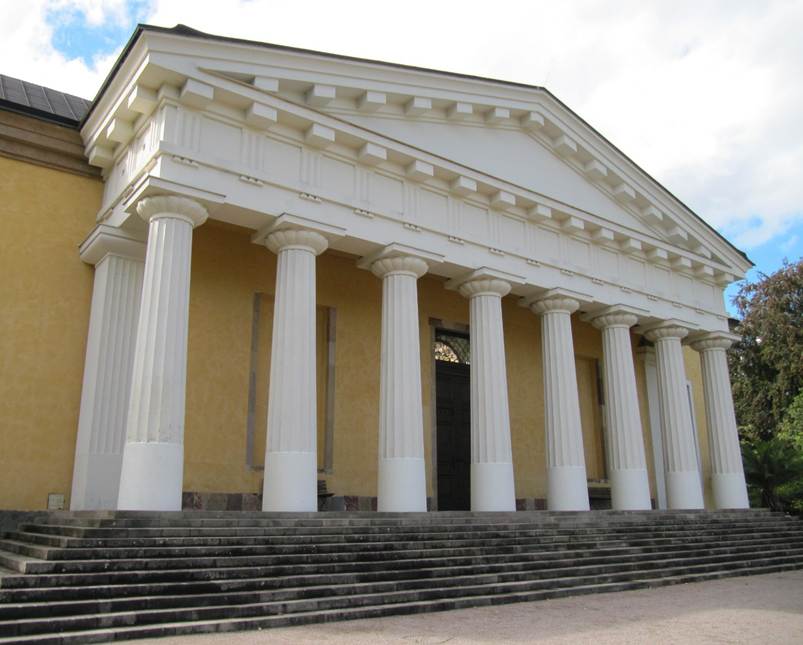
Fig. 1. Uppsala’s Linneanum. Photo by author.
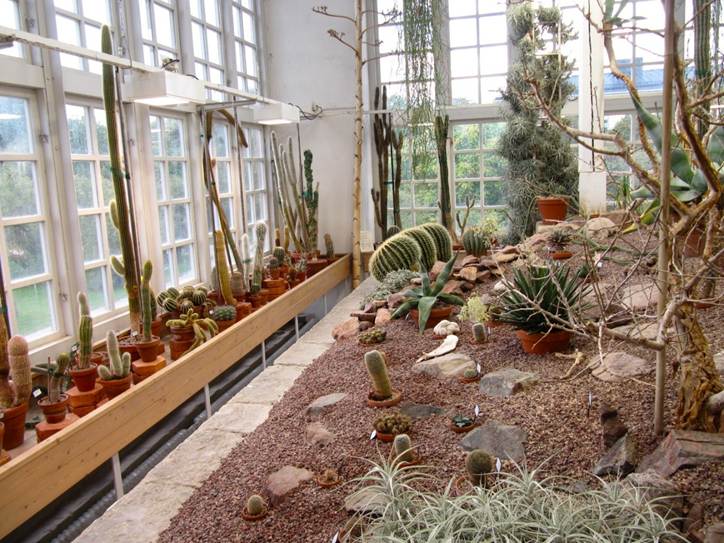
Fig. 2. Individual potted displays in the cacti room, or Tepidarium, the hot and dry department of the Linneanum Orangery. Photo by author.
Not accidentally, the Linneanum building historically served as museum apt to display life’s great diversity. Carl Peter Thunberg traveled to southern Africa, Java, Japan and Ceylon between 1770 and 1779, bringing thousands of herbarium specimens, seeds, living plants, ethnographic objects, as well as thousands of zoological specimens back to Uppsala.3 Thunberg named and described about 1,900 new plant species, many of them from the Cape and Japan, whose specimens were exhibited in dried form alongside approximately 15,000 other species, represented by 23,510 specimens, in the Linneanum’s rooms, including the Orangery and Thunbergsalen.4 The continuity between the historical living collections now and then is particularly evident in the old bay laurels, brought to the Linneanum Orangery from Linnaeus’ own garden in 1804.5
The scale of Uppsala’s herbariums and plant collections is a testimony to the extraordinary enthusiasm for plant collecting and botanical knowledge that swept across Europe during the 18th century. This “Botanophilia”, as some scholars have termed it, or “obsession”, was fueled by the influx of exotic plants through expanding imperial networks and by new techniques for cultivating and acclimatizing them in Europe, while in turn helping to drive the continued global transfer of plants.6 During this period, European botanical gardens became research centers, seed distribution hubs, and plant nurseries. In Uppsala, in an attempt to reduce Sweden’s dependence on imported plants and spices commercialized by Asian states and colonial powers, Linnaeus and his disciples grew and trialed economically valuable plants such as coffee, cinnamon, cotton, rhubarb, opium, ginseng, and mulberry (trees for silkworms).7 European colonial powers sponsored vast plant collecting efforts, often for their economic and medicinal values, as well as to favor their insertion in profitable plantation systems overseas.
As a historical museum space, the Linneanum Orangery is imbued with the 18th and 19th century tradition of taxonomic display, in which collected specimens are understood through identification, classification, and the establishment of relationships among them (systematics). Naturalists of the time considered museums as spaces for applied sciences, which provided visual instruction and information about the natural world.8 The overarching importance of visualization was manifested through labels identifying objects and specimens, providing a means of mass communication, while object-based displays opened up the world to the general public.9 The Linneanum Orangery carries this tradition to the present day (Fig. 3). Here plants are made legible through detailed labels and their position within the taxonomic framework, while the spatial separation between vases and individually demarcated displays facilitates visual comparison.

Fig. 3. Above: detailed plant tags. Below: Plants exhibited outside the Linneanum Orangery (September 2026), before being moved inside for the winter months. Photos by author.
Uppsala’s Tropical Greenhouse and Multisensory Experience
The great influx of sub-tropical and tropical plants arriving from colonial outposts spanning the globe created new demands on plant houses, particularly for greater overhead light and warmer air temperatures. The solution to this challenge was glass. Glass panes had been used in European hothouses since the 17th century, though only in combination with masonry walls and wooden structures, which especially covered the roof and the north side. Glass was expensive to produce, and only the shift from family firms to industrial production, which brought the price of glass within general reach, made fully glazed structures possible.10
Industrialized glass production was accompanied by the development of metallurgical innovations such as mass-produced cast iron, and new machines like the rolling mill. Glass panes were now held together by factory-made cast iron filigrees, replacing wooden framing that often rotted in the damp interiors. Simultaneously, at the start of the 19th century, novel climate control technologies were established. Iron and tile-covered stoves, connected from the outside through ducts, gave way to newly integrated hot-water and steam heating systems.11 They granted uniform and steady temperatures to all sections of the glasshouse, and helped offset the cooling effect of its vast glass surface. This enabled the growth of more tropical species, as well as ultimately influenced the sensory experience of visitors.12
“The orangery is the green-house of the last century”, stated the Scottish garden designer J.C. Loudon in 1826. Several scholars underline the continuity and transition between the two structures.13 Orangeries took on mainly ceremonial roles for banquets and fêtes, while continuing to host citrus trees, camellias, and evergreen coriaceous-leaved plants, less susceptible to humidity and warmth requirements.14 Uppsala’s Tropical Greenhouse was built in the 1930s, and drew on the staggering technical developments of thepreceding century. It shares a common plant house genealogy with the orangery of the 18th century, but presents visitors with a different spatial arrangement and sensory experience. Since then, heating systems, and other technologies have evolved, but the multisensory experience of the glasshouse remained, and what itentails is best experienced first-hand.
After visiting the Linneanum Orangery, I continue my visit by strolling through the frosty air towards the Tropical Greenhouse, where, upon arrival, I feel a pleasant warmth and moisture enter my lungs. While my limbs start feeling mellow and my hands warmer, I intently observe the movement of a group of koi fish in a pond. My elucubrations about fish life are interrupted by a sharp trill in the air. It reminds me of the chirping of crickets, but it’s much longer and louder. There must be some huge insects here, I think. Intrigued, I walk into the rainforest room. Here, my mind is completely refreshed by the novelty of sensations, given by the luxuriant greenery and the damp and earthy smell, in stark contrast with the exterior.
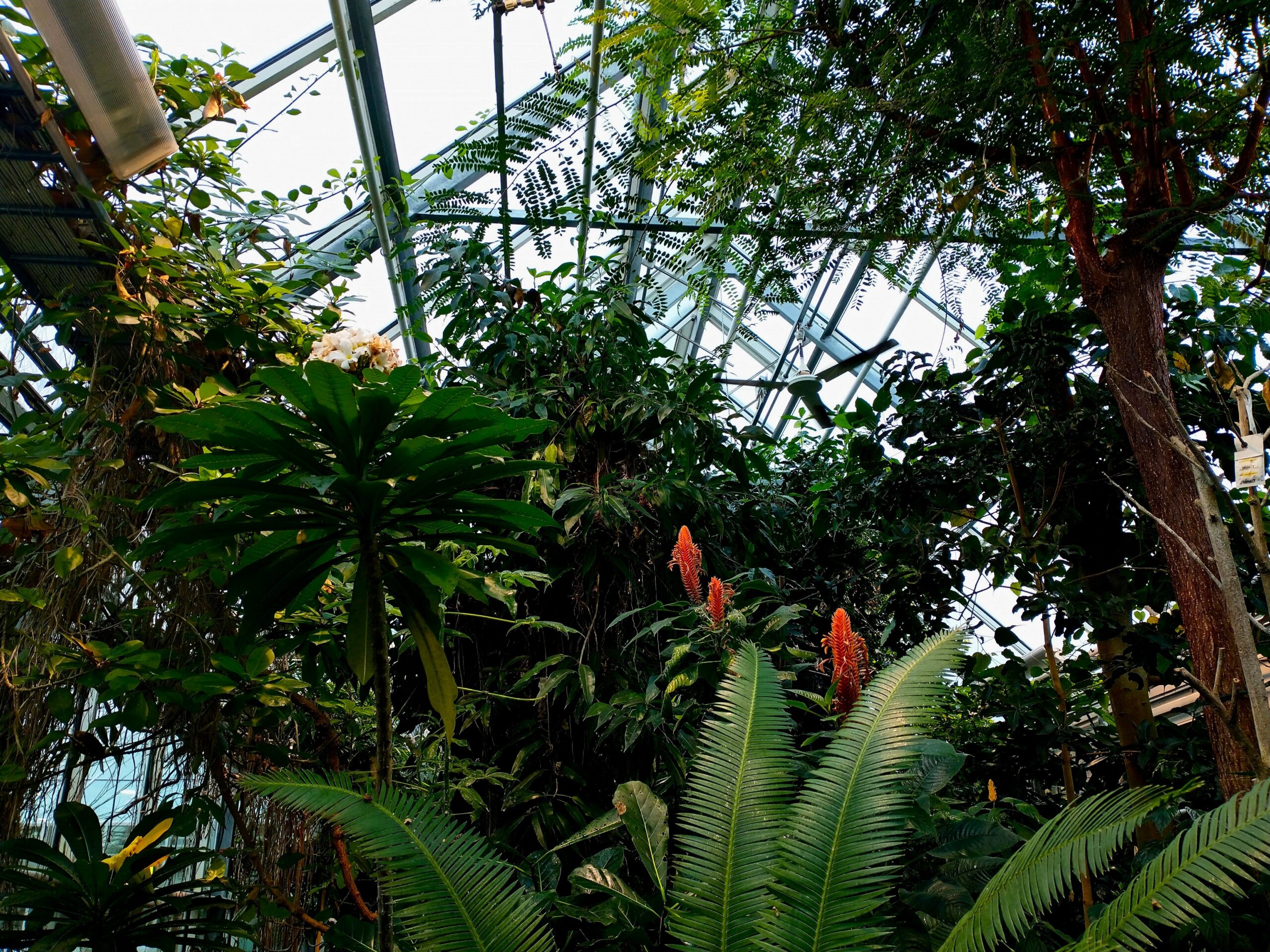
My eyes meet the silhouette of trees, dense vegetation, suspended vines with aerial roots, and moss-covered branches. At first, I am baffled by the variety of forms and colors. Water in the room is pervasive. I feel it with my hands by touching the soggy moss; inhale it through my nose in the hot air saturated with water particles; hear it in the loud babbling sounds of a small stream flowing beneath a little bridge. Unlike a conventional museum setting, where objects are displayed individually and spatially distanced from the visitor — similarly to the Linneanum Orangery — here I feel free to interact with the plants surrounding me. I gently browse the foliage to observe and touch single leaves up close, like those of a jungle velvet calathea (Goeppertia warscewiczii), soft and velvety, dark green on top, and burgundy on the undersides. Again, a sharp trill catches my attention, but this time I spot the singer: a small poison dart frog (Epipedobates), striped in red and white, resting in the shaded undergrowth (Fig. 4). The taller trees of weeping fig (Ficus benjamina) and Manila hemp (Musa textilis) completely fill the space and obscure the glass walls, making small details less discernible in the penumbra of the room (see cover image).

Fig. 4. Poison dart frogs are the greatly appreciated songsters of the Rainforest Room. Photo by author.
Sauntering in the humid atmosphere, I make out different sounds, including the recorded rumbling sounds of thunder evoking a tropical rainforest downpour, and most noticeably, loud bird songs and calls. Being aware that glasshouses often host tropical birds, I stop and try to catch a glimpse of feathers in the canopy above, but to no avail. Only after moments of perplexity do I understand that the bird sounds are too, part of the recorded soundscape. The experience of a tropical biome is thus formed from the biodiversity that is factually present — the plants, the poison dart frogs — as well as from the biodiversity that is apprehended through hearing, which not necessarily reflects reality. The illusion in this case is aural rather than optical, and the intent is making the rainforest come fully alive in our minds, enlisting multiple senses at once.
Different to the Linneanum Orangery, the plant tags of the Rainforest Room provide only the scientific names of plants.15 My botanical experience is thus not mediated by texts detailing the origins of plants and providing ecological information. Instead, it is stimulated by a full sensory immersion that engages sight, smell, hearing, and touch. In doing so, the Tropical Greenhouse unintentionally calls into question the historically privileged position of vision in Western epistemology. Western thought, in fact, has long tended to rank vision and hearing above the “lower” senses of touch, taste, and smell, associating the former with more objective forms of knowledge, an inheritance that still persists today.16
From the Hegemony of Vision to the Sensory Turn
The dominion of vision traces back to Aristotle, Plato and the classical Greek world.17 It is reflected in words of Greek origin such as theory, from θεωρία (contemplatively seeing), itself built, following the most common reading,onθεωρός (spectator). The same visual root underlies the etymology of idea, (ἰδέα, notion or pattern), stemming from εἴδω (to see). Because vision operates at a distance, it came to be regarded as the most objective means of knowing.18 Spanning the classical, medieval and early modern period, including the Scientific Revolution, this association hardened into vision’s status as the privileged foundation of knowledge.19 Contemporary languages, too, bear Western culture’s emphasis on the epistemological power of sight: in English, to see can mean to understand, as in the expressions I see what you mean, I see the point, to see reason, to see through something. The dominance of the eye as the primary vehicle of knowledge has been termed “ocularcentrism”.20
Since the early 1980s, several anthropological studies have undermined the Western presumption that visuality constitutes the pivotal mode for creating knowledge about the world. To sensory anthropologists, the epistemology of human cultures is not always organized around the eye. Because sensory experiences are linguistically encoded in most human societies, the scholarship has examined how emphasis on different sensory modalities—such as sight, smell, hearing, and touch—is reflected in the terminology and vocabulary associated with them. For example, English speakers commonly exhibit only a thin vocabulary for smells, whereas the Jahai—a hunter-gatherer people of the Malay Peninsula rainforest—describe odors as fluently as they do colors and visual entities.21 Studying the Siwu language of Ghana, Mark Dingemanse found its speakers to be among the most efficient in the world at communicating about texture, a facility he linked to a rich culture of handiwork and food preparation.22 Sensory hierarchies, according to this scholarship, are thus shaped by cultural concerns, and the Western equation of knowledge with vision reflects a cultural inheritance, instead of a logical necessity.23 In this light, Uppsala’s Tropical Greenhouse, engaging scent, warmth, and sound as much as sight, does not privilege vision in the way a Western ocularcentric inheritance would predict.
Based on similar studies came the so-called “sensory turn”, a major shift in the humanities and social sciences. Starting around 1990 in anthropology and history, the turn placed all five senses, with similar weight, at the center of cultural analysis.24 The repositioning of long-neglected senses in the sensory hierarchy expanded over the following decades to other academic fields, including geography, sociology, museology, and architecture. In architectural theory, Juhani Pallasmaa’s The Eyes of the Skin became among the most cited critiques of contemporary architecture, arguing that only one element of perception—vision— is considered in its designs, transforming buildings into “image products detached from existential depth and sincerity”.25 He points out that the most striking memories of a place are given by the intermingling of their sounds and smells, their different temperatures, lights and shadows. On this basis, he advocates for architectural or urban works and interventions that are designed to evoke sensations and emotions, thus facilitating a deeper connection between people and places. Applied to botanical exhibitions, this argument resonates particularly strongly with my experience of Uppsala’s Tropical Greenhouse, whose display engages the senses well beyond sight.
Conclusion
The painstaking endeavor of recreating tropical climates produced a layered multisensory atmosphere of heat, humidity, and earthy smells that historically set greenhouses apart from traditional museum exhibits, where visuality dominated the mode of display. Uppsala’s Tropical Greenhouse extends this singularity further, deepening the visitor’s multisensory immersion through an atmospheric recorded soundscape, installed in recent decades. The Linneanum Orangery, a collection of living specimens, is inherently multisensory too, but remains closer, in its history and presentation, to an ocularcentric culture of reading and looking: in this instance, not case per case as in a museum cabinet, but pot per pot.
A traditional museum space often conveys the impression that one should adhere to an orderly, sequenced, and starkly visual, fruition of the objects on display. While looking for the singing poison dart frogs in the Rainforest Room (Fig. 4), I interacted with plants, smelled the delicate scent of bright yellow allamanda flowers (Allamanda cathartica), ogled leafy patterns up close, and peered at my reflection in tiny dewdrops. I immersed myself in the room, sharing the tropical climate with plants and animals, human and non-human alike. And in so doing I became aware of my senses, and of them as an extension of me, continuously exceeding my body, “mingling” with the world, and with each other, as Michel Serres suggested in The Five Senses.26
Both the Linneanum Orangery and the Tropical Greenhouse structures are starkly connected to the history of botanical collection and visual display, and its colonial history too.27 They represent equally valuable, if different, modalities of experiencing plants. One rooted in the history and taxonomy of botanical collections, and the other entwined with multisensory immersion, which is at once historical and the fruit of a recent shift in academic studies and museum design.
- Carl Nilsson Linnaeus (1707–1778), Swedish naturalist and physician, is considered the father of modern taxonomy. He devised the binomial system of naming organisms still used today, simplifying and standardizing earlier lengthy naming practices. Naturalist Carl Peter Thunberg was among his most accomplished pupils. ↩︎
- Jovanovic-Kruspel, S. (2019). ‘Visual Histories’ Science Visualization in Nineteenth-Century Natural History Museums. Museum and Society, 17(3), 404–421.
Omedes, A., & Páramo, E. (2018). The evolution of natural history museums and science centers: From cabinets to museums to… In E. Dorfman (Ed.), The future of natural history museums. Routledge: 168–183. ↩︎ - Nordenstam, B. (1994). CARL PETER THUNBERG (1743–1828): “The Father of South African Botany”, His Contribution and Legacy. Transactions of the Royal Society of South Africa, 49(2): 161–174. ↩︎
- Nordenstam, B. (2013). Carl Peter Thunberg and Japanese Natural History. Asian Journal of Natural & Applied Sciences, 2(2): 1–7.
Juel, H. O. (1918). Plantae Thunbergianae: Ein Verzeichnis der von C. P. Thunberg in Südafrika, Indien und Japan gesammelten und der in seinen Schriften beschriebenen oder erwähnten Pflanzen, sowie von den Exemplaren derselben, die im Herbarium Thunbergianum in Upsala aufbewahrt sind. Almqvist & Wiksell. ↩︎ - See Uppsala University’s website for the Orangery Linnaenum here. ↩︎
- Williams, R. L. (2001). Botanophilia in eighteenth-century France: The spirit of the Enlightenment. International Archives of the History of Ideas, Springer (179). https://doi.org/10.1007/978-94-015-9849-1
Wulf, A. (2008). The Brother Gardeners: Botany, Empire and the Birth of an Obsession. William Heinemann. ↩︎ - Koerner, L. (1999). Linnaeus: Nature and nation. Harvard University Press. ↩︎
- Carlins, C. L. (2015). A natural curiosity: Evolution in the display of natural history museums. Journal of Natural Science Collections, 2: 13–21. ↩︎
- Bennett, T. (1988). The exhibitionary complex. New Formations, 4: 73–102. ↩︎
- Kohlmaier, G., & von Sartory, B. (1990). Houses of glass: A nineteenth-century building type (J. C. Harvey, Trans.). MIT Press, p. 46.
Holmér, G., Koivisto, K., Outzen, S., & Bruun, M. B. (2020). Scandinavian glass from Sweden, Finland, and Denmark: From the early modern period to industrial glass production. Journal of Glass Studies, 62, 167–183. ↩︎ - Ibid. p. 53. ↩︎
- Historically, the terms glasshouse, greenhouse, conservatory, and hothouse were often used synonymously. Some authors attempted to distinguish among them. Garden designer J. C. Loudon (1826), for instance, graded the structures by heat and by whether plants sat in pots or in “free ground” (pages 773 and 814). Such attempts were largely inconsistent, and the terms are used interchangeably across most of the literature. ↩︎
- Woods, M., & Warren, A. S. (1988). Glass houses: A history of greenhouses, orangeries and conservatories. Aurum Press;
Hix, J. (1974). The glass house. Phaidon. ↩︎ - Loudon, J. C. (1826). An encyclopaedia of gardening; comprising the theory and practice of horticulture, floriculture, arboriculture, and landscape-gardening (4th ed.). Longman, Rees, Orme, Brown, and Green, p. 813. ↩︎
- The only exception is a cultural note regarding the sacred fig (Ficus religiosa) displayed in the Rainforest room. ↩︎
- Classen, C. (1993). Worlds of sense: Exploring the senses in history and across cultures. Routledge. ↩︎
- Kavanagh, D. (2004). Ocularcentrism and its Others: A Framework for Metatheoretical Analysis. Organization Studies, 25(3): 445–464. ↩︎
- Aristotle’s’ Metaphysics opens by citing sight as the most prized sense. Aristotle, Metaphysics 1.1: 980a21 ↩︎
- Kambaskovic, D., & Wolfe, C. T. (2014). The senses in philosophy and science: From the nobility of sight to the materialism of touch. In H. Roodenburg (Ed.), A cultural history of the senses in the Renaissance. Bloomsbury Academic: 107–125.
Daston, L., & Galison, P. (2007). Objectivity. Zone Books. ↩︎ - Levin, D. M. (Ed.). (1993). Modernity and the hegemony of vision. University of California Press. ↩︎
- Majid, A., & Burenhult, N. (2014). Odors are expressible in language, as long as you speak the right language. Cognition, 130(2): 266–270. https://doi.org/10.1016/j.cognition.2013.11.004 ↩︎
- Majid, A., Roberts, S. G., Cilissen, L., Emmorey, K., Nicodemus, B., O’Grady, L., Woll, B., LeLan, B., de Sousa, H., Cansler, B. L., Shayan, S., de Vos, C., Senft, G., Enfield, N. J., Razak, R. A., Fedden, S., Tufvesson, S., Dingemanse, M., Ozturk, O., . . . Levinson, S. C. (2018). Differential coding of perception in the world’s languages. Proceedings of the National Academy of Sciences, 115(45): 11369–11376. https://doi.org/10.1073/pnas.1720419115 ↩︎
- Ibid. ↩︎
- Bull, M., & Howes, D. (2026). Sensory studies 2026: A state-of-the-art review. The Senses and Society, 21(1): 1–18. ↩︎
- Pallasmaa, J. (2005). The eyes of the skin: Architecture and the senses (2nd ed.). Wiley-Academy, p. 31. ↩︎
- Serres, M. (2008). The five senses: A philosophy of mingled bodies (M. Sankey & P. Cowley, Trans.). Continuum. (Original work published 1985) p. 307. ↩︎
- The Linneanum Orangery, built in 1787, is a direct product of the colonial era of botanical collection. Uppsala’s Tropical Greenhouse, by contrast, was built in the 1930s and therefore does not derive directly from the same colonial context. Nonetheless, greenhouses in Europe and in the colonies were sites where knowledge, empire, and commerce converged, allowing European visitors to experience the damp heat and lush vegetation of the colonies, without even boarding a ship.
For reference: Nielsen, V. (2023). The colonial roots of botany – Legacies of empire in the botanic gardens of Oxford and Kew. Museum Management and Curatorship, 38(6), 696–712. ↩︎
Cover Image: The Rainforest Room in Uppsala’s Tropical Greenhouse. Photo by author.
About the author
Luca Leon Canonico Johnson is an independent researcher with an MA in Global Environmental History from Uppsala University. His work sits at the intersection of history of science, feminist philosophy of science, and environmental history, with a focus on how gender norms and colonial ideologies shaped the production of scientific knowledge about the natural world. He has presented research on the entanglement of invasion biology with right-wing populist rhetoric in Italy at the University of Helsinki’s Research Hub on Emotions, Populism, and Polarisation, and has written for Eurac Research’s “Gender Matters” blog.
Edited by Anna Bruins and David Skogerboe.