
Introduction
Nearly 80 years since India gained independence from the British Raj in 1947, the country is still viewed by the Western world through the lens of colonialism.1 It was recently evident when India’s Mars Orbiter Mission (unofficially known as Mangalyaan2) had reached Martian orbit on the 24th of September 2014. It was the first Asian nation, and just the fourth country to achieve such a feat.3 It was celebrated throughout India, with it appearing on its currency (Figure 1), and throughout Asia, with China referring to it as the Pride of Asia.4
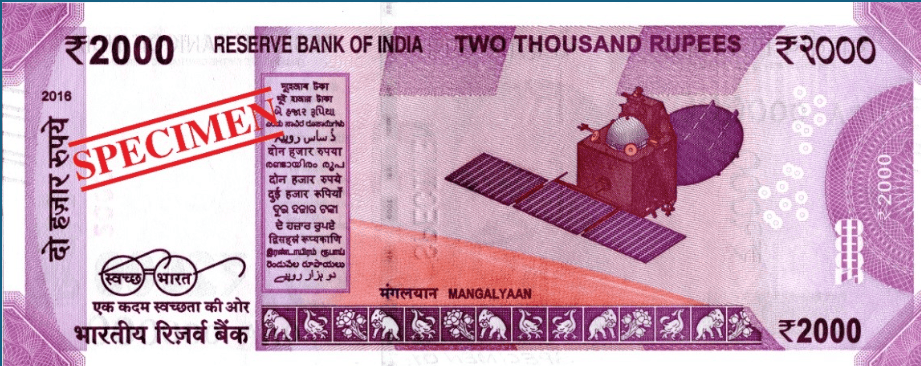
Fig. 1: The Indian 2000 note featuring the Mangalyaan on the reverse. Source: Wikimedia Commons.
The Western world, on the other hand, did not take to this achievement as enthusiastically. An article in the New York Times referred to it as a mission “On a Shoestring Budget.”5 Later, in an opinion piece titled “India’s Budget Mission to Mars” on the 28th of September 2014, a mocking cartoon was featured regarding the Indian space program (see Figure 2).6 In the cartoon, India is depicted as a man wearing a dhoti (a traditional Indian garment), holding a cow, and knocking at the door of the Elite Space Club, represented by suit and bowtie clad members. The very title of the piece directs the reader to the idea of the mission being on a “shoestring budget,” indicating that the amount spent on the mission was far less compared to what other countries have spent on similar missions.7 The cartoon depicts how the Western world viewed, and still views, India in the realm of space.

Fig. 2: ‘India’s Budget Mission to Mars’ cartoon by Heng Kim Soon in New York Times on the 28th of September 2014. Source: The New York Times.
This image of India, as decolonial thinker Aníbal Quijano has argued, reflects the “coloniality of power,” which is “based upon ‘racial’ social classification of the world population under Eurocentered world power.”8 As Quijano puts it, it is “still the most general form of domination in the world today, once colonialism as an explicit political order was destroyed.”9
Furthermore, Quijano describes that one of the axes of domination in the coloniality of power is the Eurocentric domain of knowledge production, or the “coloniality of knowledge.”10 Thus, “coloniality of power means that all dominated populations… were subjected to the hegemony of Eurocentrism understood as a way of conceiving of and organizing knowledge…”11 Coloniality stresses that the current world order continues to be influenced by European colonialism, which can be seen in present day power structures and knowledge production.
Through coloniality, the validity of western or Eurocentric knowledge systems is elevated, while that of the postcolony is rendered as less than modern.12 The trope of the former colonies being seen as less than modern has been noted by Dipesh Chakrabarty, who explains that Indian history is often rendered in terms of a lack or an absence of modernity.13 This trope of lack and absence can be seen in the New York Times cartoon as well, where the traditional dhoti stands for their perceived relative primitiveness as compared to the modern Space Club members.
As a case study to illustrate the coloniality of knowledge and power, this essay looks at India’s indigenous missile programme in the late 1980s, under the directorship of Dr. Abdul Kalam, an early subaltern14 voice and leader in the history of Indian rocketry and missile technology. Kalam was an Indian-Muslim technologist from the southernmost tip of India, who worked on India’s satellite, missile and nuclear programmes from the late 60s to the late 90s, following which he became the President of India in 2002.15 The missile programme, as Kalam had envisioned it, was a driver of Indian technological independence.16 Technoscience has been shown as crucial to the postcolonial nation, and Kalam was an important figure in representing these ideals.17 As the head of the missile programme, Kalam’s writing and views will help contextualise how the missile programme was seen by the Indian government, and what role it played for postcolonial India overall. His writings will also shed light on how the Western world perceived of India and its achievements in the realm of space and missile technology, and how the coloniality of power was expressed when the Western powers resisted India’s missile programme.
Missile Technology Control Regime (MTCR) and India
Throughout the 1970s, India had successfully developed an indigenous Satellite Launch Vehicle, the SLV-III.18 The man in charge of leading that programme, Abdul Kalam, was entrusted in 1980 with the next step in India’s postcolonial scientific endeavour—developing an indigenous missile programme. Kalam had considered the satellite and missile programme to be cousins, referring to the dual use nature of the satellite launcher as also a launcher of missiles. He felt it would be the natural next step for the country’s mission of technological development, and eventual technological independence.19
The Indian Defence Research and Development Laboratory (DRDL) had attempted (and failed) to indigenously develop missiles in India since the 1960s.20 Placed under the management of Kalam, they set up the Integrated Missile Development Programme (IGMDP), planning to develop four missiles. Between the testing of the first two missiles in 1985 and 1988, the Missile Technology Control Regime (MTCR) was set up in 1987 as an informal group of seven countries– Canada, France Germany, Italy, Japan, United Kingdom and United States.21 All former colonial and imperial powers, these countries carried with them the baggage of colonialism and thus can be seen as reminders of existing colonial power structures. The MTCR can be seen as a manifestation of the coloniality of power.
The MTCR was set up in light of growing concerns regarding potential nuclear capable missiles during the Cold War.22 After the missile tests in India, the Western powers had feared that these missiles may be used by India to deploy nuclear armaments. To maintain control, the MTCR decided to restrict the sale of any technology that could be used for Indian missile development, and any other countries that were attempting to develop missiles.23 News reports from that time carried the news of sanctions and embargoes placed on India, as well as Iran, Pakistan, and Brazil, among others, who were all aiming to be self-sufficient in missile technology.24 The MTCR wanted to curb that spread through an ability to control supply chains and trade networks.
Kalam noted in his 1999 autobiography that, “[t]he response of the Western bloc was initially one of shock and then of anger. A seven-nation technology embargo was clamped, making it impossible for India to buy anything even remotely connected with the development of guided missiles. The emergence of India as a self-reliant country in the field of guided missiles upset all the developed nations of the world.”25
Necessity being the mother of invention, many crucial technologies that the missile development programme required now needed to be developed indigenously, because no external power would sell them to India. India’s space programme and earlier failed attempts at developing missiles had been facilitated through international co-operation and technology acquired from other countries.26 However, now that it was clear India wanted to be self-sufficient in their missile capabilities, and not under the control of any other superpower, the long-held cooperation was upended.
After the MTCR and its restrictions, India began ramping up indigenous development. For example, when a wind tunnel was needed to test the missiles, the technology was instead developed within India, by scientists at the Indian Institute of Science.27
Kalam suggested that had they asked the US for access to the technology to run the tests, India “would have been aspiring to something [the US] considered their exclusive privilege. Even if they consented to co-operate, they would be certain to quote a price for their wind tunnel greater than [IGMDP’s] entire budget.”28 Through this we can see an expression of the coloniality of power, by trying to control India’s development through these restrictions and gatekeeping access.
The MTCR was essentially a colonial coalition that sought to control the spread of missiles and potential nuclear armaments by dictating who they deemed worthy, and trustworthy, to possess such powers. The MTCR was enacting their coloniality of power and knowledge, by controlling technological access, and thus having dominion over technological development in the Global South.
Despite the MTCR and its restrictions, India succeeded in developing several technologies for the missile programme indigenously, such as guidance systems, propulsions systems and even re-entry technologies.29 This led to India’s Agni missile being predominantly indigenously produced. The Agni missile ended up being a crown jewel in India’s missile arsenal and a representation of the failure of the MTCR to suppress Indian missile development.
Weapons of Peace
When the Agni was tested in 1989, it was seen as a major achievement for India (Figure 3). It was viewed as a sign of the strength of India’s scientific and defensive capabilities, especially against Pakistan, with whom India had long been embroiled in a bitter rivalry and tense standoff.30 In a post-launch interview, Kalam was asked if the missile was nuclear capable, to which he replied:
It can carry conventional warheads. It can also carry flowers to offer as a symbol of peace (laughs). It can also carry nuclear warheads. In India we are not making nuclear warheads. We provide the carrier and the policy makers decide how to use it.31
That answer perfectly encapsulates rhetoric seen in India at the time when it came to such technologies – weapons of peace. Kalam had suggested that it would be foolish to think of Agni as anything other than a weapon. The Indian government had the capability, and it was up to them to use it as they see fit. Kalam had directly connected India’s missile programme with the idea of weapons of peace.
At the face of it, weapons of peace is a very oxymoronic or paradoxical term – how could a weapon be seen as peaceful? But to Kalam, and the Indian government at the time, it was an ideology to which they had subscribed. Though, this weapons of peace rhetoric was not unique to India or to Kalam. It had been used earlier in the decade by science fiction author and space advocate Arthur C. Clarke to counter negative press of space militarization sparked by US President Reagan’s Strategic Defence Initiative (SDI), or Star Wars project.32 Clarke relayed weapons of peace rhetoric as a means to quell fears of the dual-use of space technology by downplaying the destructive capabilities and emphasizing the positives.33
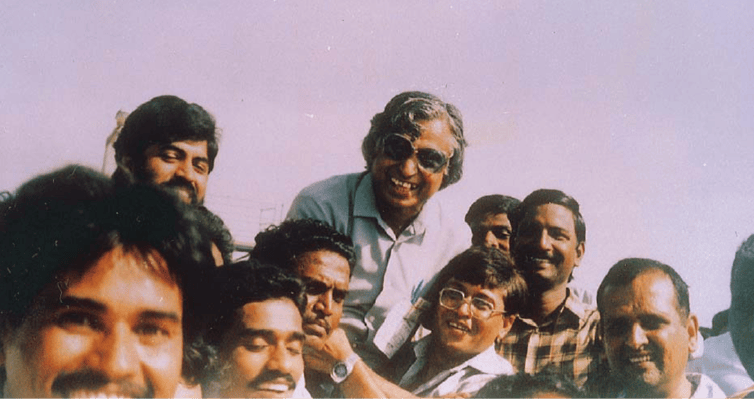
Fig. 3: Dr. Abdul Kalam being carried on a crowd’s shoulders after the launch of Agni in 1989. Image source: Wings of Fire: An Autobiography by Dr. A.P.J. Abdul Kalam and Arun Tiwari. Copyright © Universities Press.
In the introduction to his book, Weapons of Peace, Raj Chengappa, a journalist covering India’s nuclear history extensively for several decades, attributed the title of his book to an interview with Kalam. In that 1994 interview, Chenappa asked Kalam about having the unique option of choosing between “peaceful” space technology and developing “weapons of war” for the Defence Ministry. “Why did you choose the latter when you know it is capable of so much destruction,” Chengappa had asked.34 Kalam replied:
I had no qualms. By building such arsenal I actually ensure peace for my country. Now no nation dare attack us. These are truly weapons of peace.35
After the test of Agni in 1989, Prime Minister Rajiv Gandhi congratulated the project’s scientists and engineers, and said that it was “a feather in the cap of the scientific achievements of India.”36 Furthermore, a member of Parliament went on to address the house:
This is in consonance with our attempts to safeguard our independence and security by self-dependent means. The technology demonstration indicates our undiluted commitment to the indigenous development of advanced technologies for the defence of our country. Agni is the symbol of our efforts to develop and demonstrate advanced missile technologies.
It is our fundamental duty to protect our national independence from all types of foreign threats. It is also our duty to ensure the safety of our frontier. We believe in a world free of nuclear weapons.37
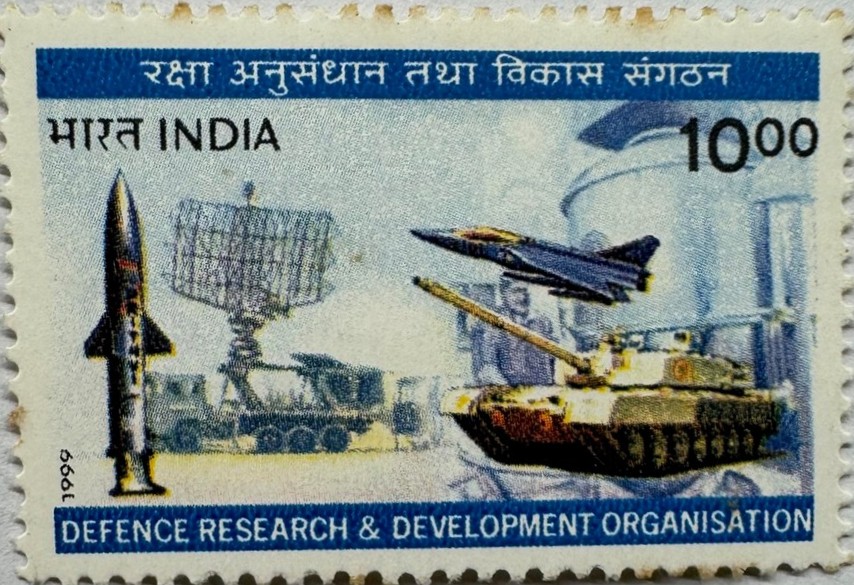
The narratives that Kalam and the political establishment had relayed regarding the missile programme reflected a larger political ideology that peace could be achieved through displays of strength. The missiles, the Defence Research and Development Organisation (DRDO) within which the missile programme was housed, alongside other technologies of war were depicted on a stamp in 1999 (Figure 4). This stamp served as a way to represent these “weapons of peace” to the people of India, as well a global audience.38 An image that says that India was now powerful enough to deter attacks before they happened.
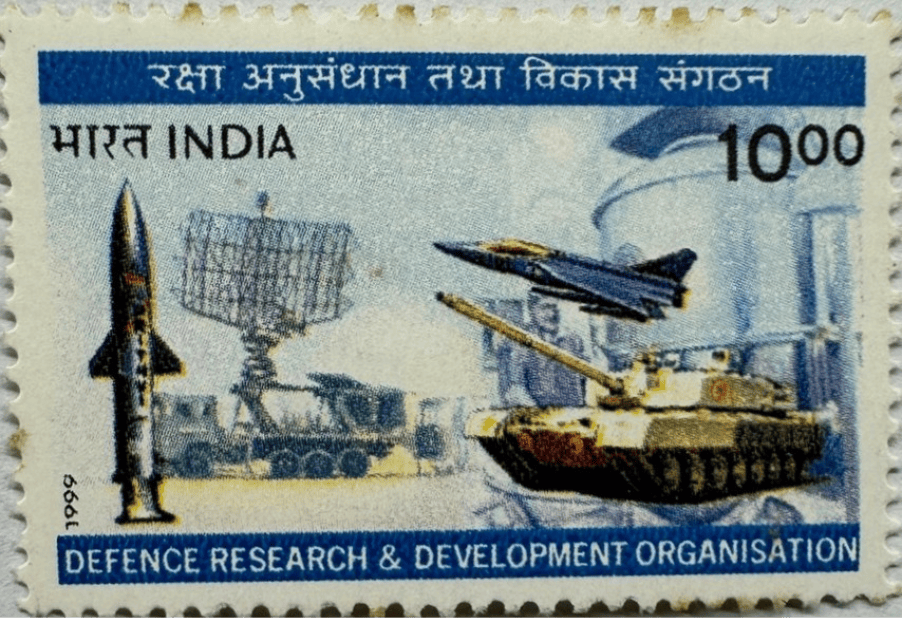
Fig. 4: A stamp issued in 1999 by India featuring the Defence Research and Development Organisation (the organisation within which the Research Laboratory exists) and one of the missiles that was developed by the missile development programme. Source: Personal stamp collection.
Read through Quijano’s framework, the rhetoric of weapons of peace can be seen as a postcolonial bid by India to contest and resist the authority and coercion that is prevalent in the sphere of coloniality. It seeks peace through the same means that coloniality made desirable: strength and development of the nation. The rhetoric of weapons of peace, then, can be seen as a means of resistance and subversion against coloniality.39
India and the CIA: International reactions to Agni
The international reaction to the launch of Agni in 1989 can be seen in the light of the coloniality of power, where the West continued viewing India’s achievements with distrust. An American journalist, Gary Milhollin, suggested in a Bulletin of the Atomic Scientists article titled “India’s Missiles – with a Little Help from Our Friends,” that the missile must have been made with the assistance of either NASA or West Germany.40 These claims suggested Milhollin did not think India was capable of such feats without western assistance.
The supposed unauthorized international collaboration was also a topic of a Central Intelligence Agency (CIA) investigation. Declassified correspondence about the investigation suggested that “U.S. cooperation in space technology, defence technology or dual use technology should not extend to any firm that may be contributing to the spread of ballistic missiles.”41 The CIA investigation was coloniality in action, where the production of knowledge and technology by the postcolony was subsumed with the knowledge systems of Western world.42
At the heart of the matter is the issue of dual use technology.43 By the 1980s, India had already proved itself capable in space technology, by indigenously developing a Satellite launch vehicle. The United States had long opposed the development of launch vehicles in other countries, partly to keep them dependent on the US for launches, and in part to prevent any future dual usage of the launch vehicle as a missile launcher.44
By the time India had successfully developed not only a satellite launcher but also multiple missiles, the dissonance between the US’s view of India and what India had achieved at that point was tinged with coloniality. How could such a seemingly poor country be capable of missile technology, and that too, without external assistance? The powers that be were suspicious of India’s achievements, as evidenced by the CIA investigation. The investigation, though, suggested that the suspected technology transfer took place over twenty-five years before these missiles were developed, when Indian scientists and engineers had visited NASA in the early 60s.45 Later recollections of these early NASA visits revealed that Indian scientists were not allowed anywhere near those kinds of technologies.46 So loose was the basis of information the West had needed to come to their conclusions.
When Kalam was asked about the Milhollin article in an interview in 1994 for India Today, he said that “[it was] deliberately communicated because of racial prejudice where one group of people believes only they can do it.”47 Unknowingly, Kalam was articulating the element at the heart of the coloniality of power: race.48 He suggested that it was the West’s racial prejudice that did not allow them to view India as capable, and that knowledge production was best placed in the hands of the Eurocentric West.
The launch of Agni, despite the restrictions placed by the MTCR, had surprised the US. While the fears of the dual use nature of launchers can be seen as valid, the hypocritical nature of the US and MTCR to control development of such technologies in other countries, while they themselves are nuclear armed, is a clear display of the coloniality of power, to maintain the status quo of those in power, thus remaining in power.49
Conclusion
In the above two instances – the MTCR restrictions and the US questioning India’s achievements – the similarities are clear. The structures of power in the West had sought to exert control on the Global South through the control of access to knowledge and technology.
The restrictions, though, had little effect on India’s missile programme. This is largely due to India’s experience with space technology, gained through its role in postcolonial nation-building. The early days of India’s space programme were marked by collaborations and technology transfer from the West.50 This created a base to foster indigenous development in India, and that was then leveraged for military pursuits, namely the missile and later nuclear programmes.
Despite having been challenged by the MTCR in its past, India joined the regime in 2016, becoming its 35th member. India had been granted entry into the same structures of control that had tried to prevent its technological development. This represents the seductive nature of the coloniality of power. Quijano suggests that the act of joining the very same structures of power, “was a way of participating and later to reach the same material benefits and the same power as the [West]: namely, to conquer nature, in short for ‘development.’”51
Despite being a leading figure in both the space and missile technology since the 1970s, the western impression of India has been coloured by the continued presence of coloniality. This coloniality of power has exerted its influence through racist cartoons, embargoes, and even CIA investigations. However, India has resisted and transcended these pressures, even becoming a part of the matrix of power. Despite that, the spectre of colonialism continues to haunt the postcolonial state.
- By “the West” and “Western world,” I refer to Western Europe, North America, and Australia. The former colonial powers and white settler countries. But, more narrowly, I refer to the superpowers in space, such as the United States with NASA and the countries involved with ESA, that have largely dominated the conversation surrounding space technologies. For more details on the usage of “The West,” see Stuart Hall, “The West and the Rest: Discourse and Power,” Race and Racialization: Essential Readings 56 (2007). ↩︎
- “Mangal” in Sanskrit means Mars and “yaan” means craft, or vehicle. So, “Mangalyaan” translates to a vehicle to mars. ↩︎
- Rama Laksmi, “India Becomes First Asian Nation to Reach Mars Orbit, Joins Elite Global Space Club – The Washington Post,” The Washington Post, The Washington Post, September 24, 2014. ↩︎
- Vasudevan Sridharan, “China Heralds India’s Mars Mission Mangalyaan as ‘Pride of Asia,’” International Business Times UK, September 24, 2014. ↩︎
- Harris Gardiner, “On a Shoestring, India Sends Orbiter to Mars on Its First Try,” The New York Times, September 24, 2014. ↩︎
- Heng Kim Soon, “Opinion | India’s Budget Mission to Mars,” The New York Times, September 28, 2014. ↩︎
- India’s Mars orbiter cost around $74 million in 2013, as compared to NASA’s Maven orbiter (also launched in 1013), which was around $582 million; nearly 7.8 times more than India’s Mangalyaan. See, “Chandrayaan, Mangalyaan: Why It Costs India so Little to Reach the Moon and Mars,” November 4, 2024. ↩︎
- Aníbal Quijano, “Coloniality and Modernity/Rationality,” Cultural Studies 21, nos. 2–3 (2007): 171. ↩︎
- Quijano, “Coloniality and Modernity/Rationality,” 170. ↩︎
- Anibal Quijano, “Coloniality of Power, Eurocentrism, and Latin America,” Neplantla 1, no. 3 (2000): 540–42, 549–50. ↩︎
- Translated from Spanish by Walter Mignolo in: Walter D. Mignolo, “The Geopolitics of Knowledge and the Colonial Difference,” South Atlantic Quarterly 101, no. 1 (2002): 84. ↩︎
- Quijano, “Coloniality of Power, Eurocentrism, and Latin America,” 542. ↩︎
- Dipesh Chakrabarty, “Postcoloniality and the Artifice of History: Who Speaks for ‘Indian’ Pasts?,” Representations, no. 37 (1992): 5. ↩︎
- In postcolonial theory, subalterns are those that are excluded from the dominant power structures, and are denied a voice or any kind of representation in society. See, for example: Gayatri Chakravorty Spivak, “Can the Subaltern Speak?,” in Marxism and the Interpretation of Culture, ed. Cary Nelson and Lawrence Grossberg (Urbana, IL: University of Illinois Press, 1988), 271–313. ↩︎
- For more details on Abdul Kalam and his role in Postcolonial Science in India from the 70s to the late 90s and early 200s, see: Girish Kumar, “A Portrait of India’s Missile Man: The Persona of Abdul Kalam through Subaltern Science and Nation Building” (Master’s thesis, Utrecht Unviersity, 2026) https://studenttheses.uu.nl/handle/20.500.12932/51796. ↩︎
- APJ Abdul Kalam and Yagnaswami S. Rajan, India 2020: A Vision for the New Millennium (Penguin Books, 1998), 21–22. ↩︎
- Warwick Anderson, “Introduction: Postcolonial Technoscience,” Social Studies of Science 32, nos. 5–6 (2002): 643–58; Itty Abraham, “The Contradictory Spaces of Postcolonial Techno-Science,” Economic and Political Weekly, 2006, 210–17. ↩︎
- For more details on India’s Satellite Programme, see Girish Kumar, “A Portrait of India’s Missile Man: The Persona of Abdul Kalam through Subaltern Science and Nation Building”; For Kalam speaking about the SLV-III programme in his own words, see A. P. J. Abdul Kalam and Arun Tiwari, Wings of Fire: An Autobiography (Hyderabad, A.P., India: Universities Press: Orient Longman, 1999). ↩︎
- Abdul Kalam and Tiwari, Wings of Fire, 61. ↩︎
- For details on India’s failed programme to develop missiles before Abdul Kalam took charge, see Chapters 10, 11 and 12 of: Raj Chengappa, Weapons of Peace: The Secret Story of India’s Quest to Be a Nuclear Power (New Delhi, India: HarperCollins, 2000). ↩︎
- “Missile Technology Control Regime (MTCR),” U.S. Department of State, 2009. 2009-2017.state.gov/t/isn/rls/fs/120017.htm. ↩︎
- US Dep. State, “Missile Technology Control Regime (MTCR)”; T. S. Subramanian, “Missile Shield,” Frontline, India, February 2009. ↩︎
- Brahma Chellaney, “India Shoots for Military Self-Sufficiency,” Christian Science Monitor, 1988, 9–10. ↩︎
- Aaron Karp, “The Frantic Third World Quest for Ballistic Missiles,” Bulletin of the Atomic Scientists 44, no. 5 (1988): 14–20; Chellaney, “India Shoots for Military Self-Sufficiency.” ↩︎
- Abdul Kalam and Tiwari, Wings of Fire, 145–46. ↩︎
- For the setting up of India’s space programme and its international collaboration, see Asif A. Siddiqi, “Science, Geography, and Nation: The Global Creation of Thumba,” History and Technology 31, no. 4 (2015): 420–51; For earlier failed attempts at the developing missiles in India, see, Chapters 10, 11 and 12 of: Chengappa, Weapons of Peace: The Secret Story of India’s Quest to Be a Nuclear Power. ↩︎
- S. Deshpande et al., “3-Dimensional Upwind Euler Solver Using Kinetic Flux Vector Splitting Method,” Thirteenth International Conference on Numerical Methods in Fluid Dynamics: Proceedings of the Conference Held at the Consiglio Nazionale Delle Ricerche Rome, Italy, 6–10 July 1992, 2005, 105–9; S. Sekar et al., “3-D KFVS Euler Code ‘BHEEMA’ as Aerodynamic Design and Analysis Tool for Complex Configurations,” Fourteenth International Conference on Numerical Methods in Fluid Dynamics: Proceedings of the Conference Held in Bangalore, India, 11–15 July 1994, 2005, 525–29. ↩︎
- Abdul Kalam and Tiwari, Wings of Fire, 138. ↩︎
- See: A. Baskaran, “The Impact of Export Controls on Indigenous Technology Development in India’s Space Programme,” International Studies 38, no. 2 (2001): 155–71. ↩︎
- See: Sumit Ganguly, Conflict Unending: India-Pakistan Tensions Since 1947 (New York: Columbia University Press, 2002). ↩︎
- Amaranth K. Mennon, “We Are Now Self-Sufficient Both in Design and Missile Technology: Abdul Kalam,” India Today, India Today, June 15, 1989. ↩︎
- The SDI was a 1983 proposal for a space-based defence system capable of shooting down any nuclear missiles launched at the US. For more on the project, see Peter J. Westwick, “From the Club of Rome to Star Wars: The Era of Limits, Space Colonization and the Origins of SDI,” in Limiting Outer Space: Astroculture After Apollo (Springer, 2018), 283–302. ↩︎
- See David Skogerboe, “The Godfather of Satellites: Arthur C. Clarke and the Battle for Narrative Space in the Popular Culture of Spaceflight, 1945-1995” (Master’s thesis, Utrecht University, 2020), https://studenttheses.uu.nl/server/api/core/bitstreams/8f2e7a9e-4364-4cbb-b2ff-e1033ed65d57/content. ↩︎
- Raj Chengappa, “India’s Missile Programme Guided by Abdul Kalam Gains in Maturity and Stature.,” India Today, April 15, 1994; Chengappa, Weapons of Peace: The Secret Story of India’s Quest to Be a Nuclear Power, xi. ↩︎
- Chengappa, Weapons of Peace: The Secret Story of India’s Quest to Be a Nuclear Power, xi. (Emphasis Added). ↩︎
- Lok Sabha Secretariat, “Successful Launching of ‘Agni,’” Lok Sabha Secretariat (eLibrary Sansad), India, August 2, 1989. ↩︎
- “Succesful Launching of ‘Agni.’” ↩︎
- Stanley D. Brunn, “Stamps as Iconography: Celebrating the Independence of New European and Central Asian States,” GeoJournal 52, no. 4 (2000): 315–23. ↩︎
- Aníbal Quijano, Foundational Essays on the Coloniality of Power, ed. Walter D. Mignolo et al. (New York, USA: Duke University Press, 2024), 368–69. ↩︎
- Gary Milhollin, “India’s Missiles- with a Little Help from Our Friends,” Bulletin of the Atomic Scientists 45, no. 9 (1989): 31–35. ↩︎
- United States Senate, “Letter To James A. Baker From Jeff Bingham | CIA FOIA (Foia.Cia.Gov),” CIA Reading Room, Washington D.C.: United States Senate, July 20, 1989. ↩︎
- Quijano, “Coloniality of Power, Eurocentrism, and Latin America,” 541. ↩︎
- See, for example, the discussion on dual-use technologies in: John Krige et al., NASA in the World: Fifty Years of International Collaboration in Space (Springer, 2013), 17–18. ↩︎
- Although this represents the European side, see: Lorenza Sebesta, The Availability of American Launchers and Europe’s Decision “to Go It Alone” (Noordwijk, Netherlands: ESA Publications Division, 1996). ↩︎
- “Letter To James A. Baker From Jeff Bingham | CIA FOIA (Foia.Cia.Gov).” ↩︎
- R. Aravamudan and Gita Aravamudan, ISRO: A Personal History (HarperCollins, 2017), 10–12; Abdul Kalam and Tiwari, Wings of Fire, 153. ↩︎
- George Perkovich, India’s Nuclear Bomb: The Impact on Global Proliferation (Univ of California Press, 2001), 344; Chengappa, “India’s Missile Programme Guided by Abdul Kalam Gains in Maturity and Stature.” ↩︎
- Quijano, “Coloniality and Modernity/Rationality,” 171. ↩︎
- Quijano, “Coloniality of Power, Eurocentrism, and Latin America”; David Arnold, “Europe, Technology, and Colonialism in the 20th Century,” History and Technology 21, no. 1 (2005): 85–106. ↩︎
- Siddiqi, “Science, Geography, and Nation: The Global Creation of Thumba.” ↩︎
- Quijano, “Coloniality and Modernity/Rationality,” 169. ↩︎
Edited by David Skogerboe and Elian Schure