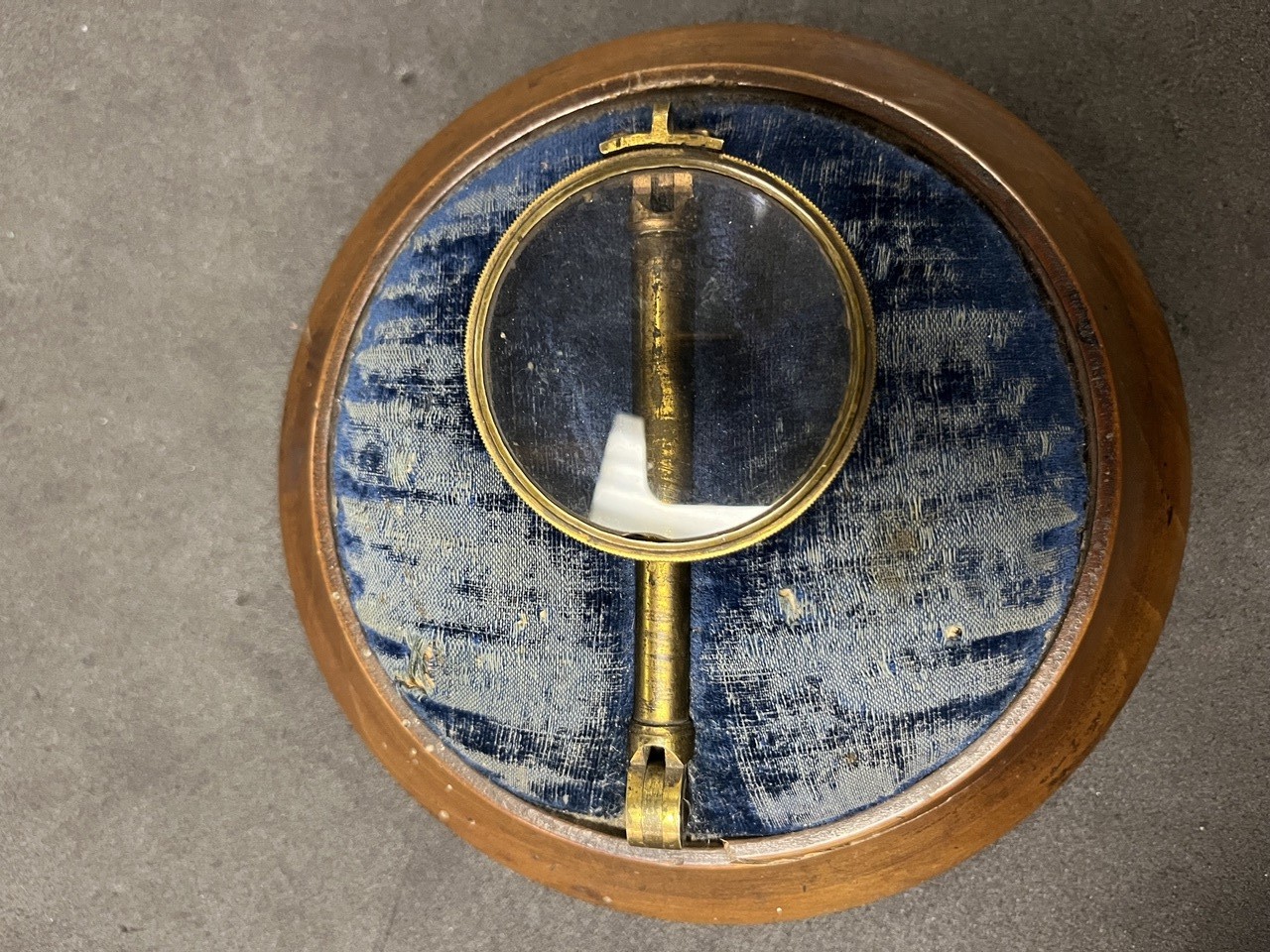
A small object in the Whipple Museum for the History of Science at Cambridge University grants a unique insight into the world of Victorian domestic technology. The Lady’s Companion to the Worktable consists of a magnifying glass attached to a pincushion. At the base of the pincushion, a paper label states that the object was ‘invented by Mrs. Garnham’ (Figure 1&2). Apart from the label and a letter advertising the object in 1864, no textual evidence for the object or its maker exists. The Whipple Museum holds the only known surviving specimen of the Companion.
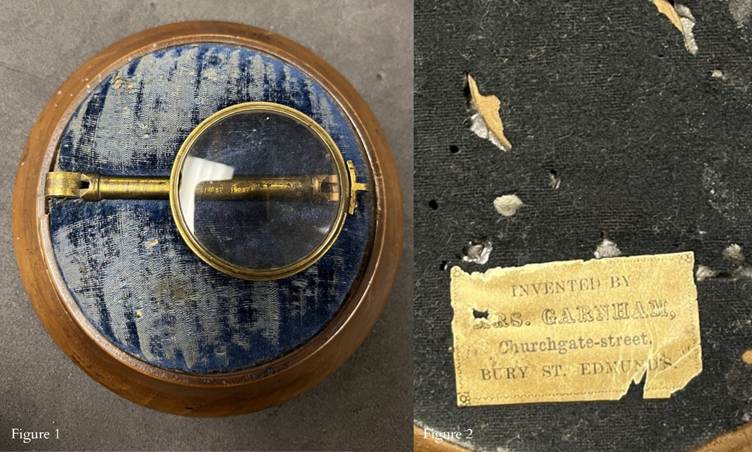
Fig. 2: the sticker at the bottom of the Companion, author’s picture, Accession No 6826, Whipple Museum of the History of Science.
Writing women back into the ‘Age of Invention,’ historians of science and technology have excavated women’s central role in the scientific instrument trade and female contributions to patented inventions.1 At the same time, scholars of gender have emphasised how societal norms restricted women’s use of various technologies and how gendered expectations shaped the design and use of household tools.2 These strands of scholarship highlight women’s important yet overlooked place in the Victorian patent and business system. Yet, as both bodies of literature acknowledge, scholars face the problem of accessing evidence for women’s engagement with technology outside this male-dominated ‘public sphere.’3 Textual sources are scarce as women either did not document or hid their interaction with technology, while predominantly male writers largely ignored women-specific domestic technologies.
Invented by a woman and designed for women’s use, the Companion literally and figuratively acts as a magnifying glass, rendering visible a woman’s engagement with technology in the ‘domestic sphere.’ Throughout this post (and the next one on invention and Victorian domesticity!), I suggest that, especially in cases where no textual record like a patent application exists, the concept of ‘invention’ invites us to interrogate how gender may have shaped the use of an item, or how this allowed to perceive of an ordinary tool in an ‘innovative’ way. Overall, I argue that the object, as an invention by a woman, for women, was designed to fill a market niche for women-specific visual aids.
A lady and her companion
Mrs. Elisabeth High Garnham (née Payne) was about fifty years old when the Companion was advertised in 1864. At the time, she was a widow living with her elderly mother Pleasance Payne, her older widowed sister Catherine Payne and her twenty-four years old daughter Annie Garnham, at 62 Churchgate Street in Bury St Edmunds, a small market-town in East Anglia.4 She was the daughter of John Harvey Payne, a gentleman and member of Bury’s Masonic lodge.5 Based on the scant evidence of the Garnhams in the local newspapers and legal documents in the Suffolk archives, Elisabeth Garnham’s husband, George, was a well-to-do farmer.6 On 9 March 1851, George Garnham was declared bankrupt and died two days later.7 This event changed Elisabeth Garnham’s and her daughter Annie’s lives. Several announcements in the local gazettes document that Elisabeth had to sell the estate, livestock and furniture by auction.8 Consequently, the women moved to Bury St Edmunds and lived with Pleasance Payne in 1869.9 As the sole heir to her husband who had bequeathed her ‘all [his] Estate,’ Pleasance likely held sufficient financial means to sustain herself.10 However, the inheritance unlikely covered all the living expenses nor afforded the same standard of living previously enjoyed by the Garnham women.11
It can be assumed that it was in this context that craftwork and a pincushion became of primary importance in Garnham’s life. According to Linda Cluckie, in 1872, roughly fifty per cent of the six million women in Britain “had to support themselves, and their dependants.”12 Needlework was the most widespread and socially accepted occupation due to its longstanding cultural association with domestic virtues.13 Talia Schaffer stresses the social acceptability of needlework as a source of income, especially for ‘indigent gentlewomen.’14
Garnham fits this description. In the censuses, she never registered as having an occupation – meaning that she was a housewife – which was women’s most common occupation in the census at the time and accorded to the middle-class ideal of the domestic woman.15 Furthermore, the area near Bury St Edmund’s was known for silk manufacture and fine embroidery.16 Her father’s title of ‘gentleman’ and his membership in the Masonic lodge point to her family’s ties to other middle-class social circles in the town.17 Despite her loss of financial security, her class background provided Garnham with important social ties and knowledge of middle-class women’s culture that informed the design of the Companion.
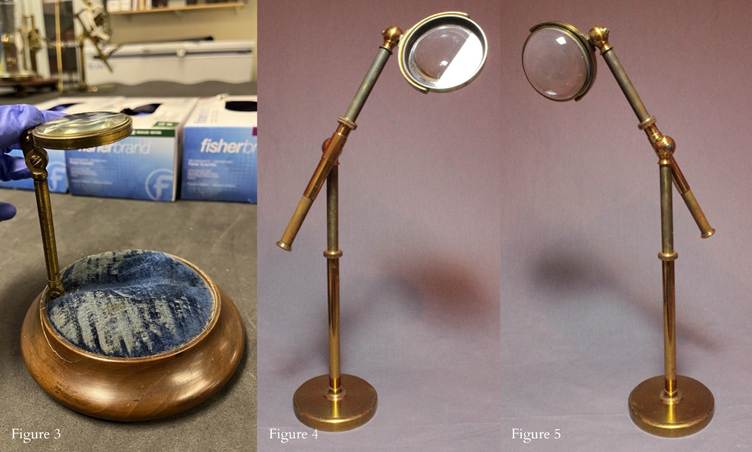
Fig. 4 en 5: magnifying glasses with telescopic arms on brass stands, The Swift Specialty Stand Condenser, c.1877, https://www.microscope-antiques.com/swiftpressbenchcond.html.
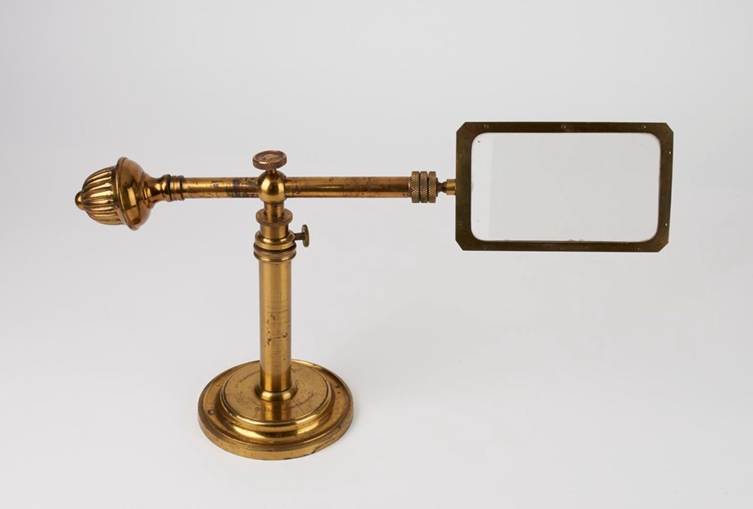
The Companion was probably produced by fixing the upper parts of a standing magnifying glass onto a pincushion.18 Figures 3 – 6 show the similarity between the telescopic arm of a standard mass-produced standing magnifying glass and Garnham’s construction. The pincushion base is similar in shape, material and weight to plain pincushions and the top part of sewing clamps dating from the nineteenth century (e.g., figures 7-10).19
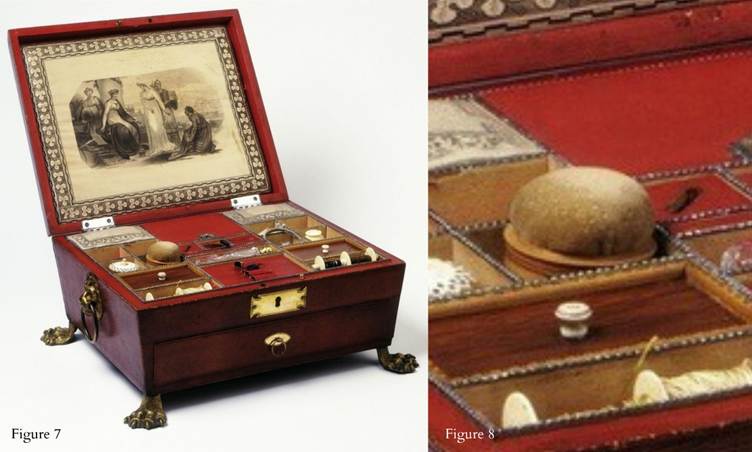
Fig. 8: pincushion (detail figure 7).
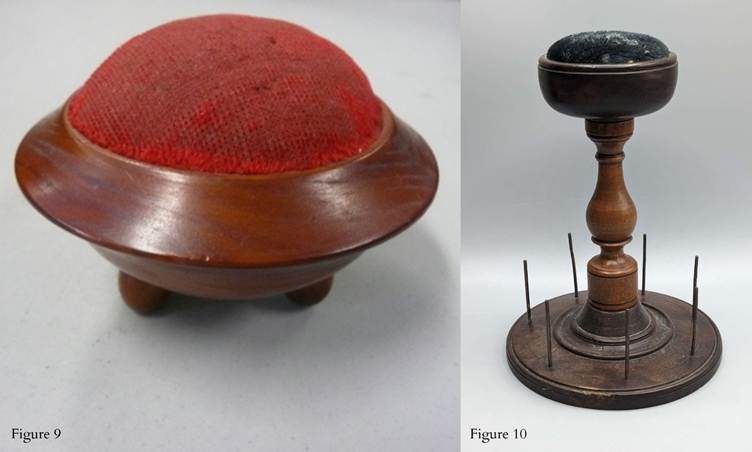
Fig. 10: Victorian rosewood sewing stand with pincushion and cotton reel holders, British, ca. 1850,’ Taliesin Antiques, https://www.antiquesboutique.com/antique-desk-accessories/victorian-rosewood-sewing-stand-with-pin-cushion-and-cotton-reel-holders-british-c-1850/itm198149.
Lacking further sources on Garnham’s life, it is impossible to reconstruct whether she initially combined the pincushion and magnifying glass herself to support her own craftwork. She likely encountered both parts of her object in a domestic setting, as her family did not run any scientific instrument or optical trade. On Churchgate Street, she lived in the vicinity of different businesses which used and traded with magnification devices. Her next-door neighbour ran a photography studio; across the street was a jeweller and watchmaker; and two opticians in the town regularly advertised “an extensive assortment of spectacles and eyeglasses.”20 She plausibly acquired the magnifying glass from one of these nearby vendors. It is possible that she contracted them to put together the magnifier and pincushion based on her instructions.
Invention and the domestic sphere
The paper label at the base of the object and an 1864 letter indicate that Garnham intended to sell the Companion. To reconstruct the intended use and user of the object, one must consider how the Companion was publicised and in what context potential users would have first encountered it. The first (and only) advertisement was written by a friend of Garnham, Y.S.N., and it was published as a letter to the editor in the March 1864 issue of the English Women’s Journal (EWJ), a monthly journal for middle-class women who took an interest in the early emancipation movement:
“Madam, I trust that you will allow me to introduce to the notice of your readers a simple invention by a friend of mine, who cannot afford the expenses of advertising or taking out a patent. It is called “The Lady’s Companion to the Worktable,” and consists of a circular leaden cushion, fixed in a wooden frame, to which is attached a powerful magnifying glass, on a metal stand, which doubles down compactly on the velvet cushion, and can be screwed to a convenient height for needle-threading, or any fine work requiring the temporary aid of glasses. For those whose sight is failing, it would really be a very useful “Companion;” and also to the colourer of photographs or the miniature painter. The magnifier can always be fixed steadily at a sufficient distance above the work, to prevent the necessity of constant interruption in its progress when minute examination is required. The price of the invention is 10s. and the inventor’s name and address is Mrs. Garnham, Churchgate Street, Bury St Edmund’s. I am, Madam, faithfully yours, Y.S.N.”21
The EWJ was an unusual choice for the promotion of the Companion. The journal was not a craftwork publication, and Garnham had other free-of-charge advertisement opportunities.22 In fact, Y.S.N.’s letter is the only letter advertising a purchasable good in the seventy-nine issues of the journal running from March 1858 to September 1864.23 To reconstruct the reasons for the choice of publication venue and the unusual framing of ‘invention,’ one must turn to women’s opportunities and struggles in marketing and protecting their inventions in the 1860s. The political and editorial context of the EWJ suggests that Y.S.N.’s letter presented a unique opportunity for Garnham to claim inventorship for a domestic technology and to reach her intended customers without losing her social status as a non-working middle-class woman.
In her position as a widowed middle-class woman with no familial ties to the technological instrument or craft trade, Garnham had four major opportunities to publicise her invention: patenting, entering the prize competition of the Royal Society of Arts (RSA), setting up a business or submitting the object to a local competition or fair. The letter claims that she could not ‘afford advertising or taking out a patent’, and Garnham also did not submit her invention to the RSA competition nor register as a private business.24 At the cost of £25 upwards, patenting remained too expensive for most people until the Patent Reform Act in 1883.25 At £10, copyright on technology design was often treated as the ‘cheaper’ version of a patent, but it would still have been too costly for Garnham.26 However, the other opportunities were free of charge. It was the combination of Garnham as a woman claiming inventorship over a woman-specific technology that plausibly discouraged her from pursuing these. Garnham would have faced low chances of recognition in the RSA competition, and she would have had to choose between compromising her status as a middle-class woman or as a recognised inventor by registering her own business. In this situation, the EWJ provided a unique venue that promised to reach the intended female middle-class audience beyond the local realm.
The EWJ was an ideational forerunner of the suffragist movement, and it concentrated on political topics rather than domestic craftwork.27 It was published and edited by the leaders of the early emancipatory Langham Place Group. The journal ‘never exceed a thousand copies per month,’ and authorship and readership were primarily drawn from the Group and their acquaintances – all were (upper) middle-class women.28 In the words of Teja Varma Pusapati, the society and journal’s “[…] overriding concern [lay] with making single women self-sufficient” and needlework was deemed the most promising field of employment for women.29 Besides their maternalistic activism for the betterment of working women’s conditions, the Group supported women’s access to secondary education and frequently featured reports about women who had succeeded at sustaining themselves independently.30
The letter advertising the Companion got published under ‘Open Council,’ a rubric that featured select letters from readers in every issue.31 Most letters were replies by readers or updates about ongoing events and foremost about charity work.32 Garnham and Y.S.N. both only appear in the March 1864 issue of the journal, indicating that Garnham was not one of the well-known members of the readership.33 On this background, rather than relating Garnham’s personal story of loss, Y.S.N.’s emphasis on Garnham’s innovativeness but financial restrictions assimilated the letter to the general style and content of the EWJ. Stressing the inability to take out a patent created an appeal to charity. And more than suggesting credibility of business, ‘invention’ foregrounded Garnham’s personality as an independent woman entrepreneur, likening her story to other stories of women inventors in the EWJ.34 In summary, the framing of invention made the story interesting to the editors, and the letter was selected for publication.
It remains unclear whether Garnham personally supported the EWJ’s early emancipatory agenda or if it was her friend Y.S.N. who initiated the letter. No further specimen exists, and the Companion resided in Bury St Edmunds before a Cornish antiques dealer bought it and sold it to the Whipple Museum in 2024.35 Thus, it is possible that the Companion was Garnham’s ‘one-off’ invention – maybe submitted to a local fair where Y.S.N. took notice of it – and that the letter in the EWJ did not seriously capture her intention to commercialise, or that Y.S.N.’s advertisement did not bear fruit. This remains up to speculation. Notwithstanding, the unique framing of Garnham as the inventor allows for a new perspective on women’s domestic technologies. It allows us to move beyond the recognition that women faced gender-based obstacles within the official patent and prize system to consider where and how women had to frame their domestic inventions to reach female audiences. Within the domestic context and speaking to an audience of middle-class women, addressing precisely the gender norms that discouraged Garnham from professionalising created the Companion’s appeal and made it innovative. As we will explore in the next post on Elisabeth Garnham’s invention and Victorian domestic needlework, the difficulties that Garnham faced in marketing her invention were also tied to the kind of innovation that the Lady’s Companion represented. By asking “what made Garnham’s Companion innovative?” the following post will question the boundaries between design and innovation in Victorian domestic technology.
- Desborough, Jane, and Gloria Clifton. 2021. ‘Science and the City: The Role of Women in the Science City: London 1650–1800’. Science Museum Group Journal (Spring 2021), https://dx.doi.org/10.15180/211502; Khan, Zorina. 2024. “A New Way by Her Invented”: Women Inventors and Technological Innovation in Britain, 1800–1930’. The Economic History Review 77 (3): 928–52; Benjamin, Marina, ed. 1991. Science and Sensibility : Gender and Scientific Enquiry, 1780-1945. Oxford: Basil Blackwell. ↩︎
- See, e.g.: Jungnickel, Kat. 2018. Bikes and Bloomers : Victorian Women Inventors and Their Extraordinary Cycle Wear. Goldsmiths, University London; 2023. ‘Clothing Inventions as Acts of Citizenship? The Politics of Material Participation, Wearable Technologies, and Women Patentees in Late Victorian Britain’. Science, Technology, & Human Values 48 (1): 9–33. ↩︎
- Khan 2024, 949; Chanteux, Anne. 2024. ‘Images of Female Inventors: Women and Patents in Nineteenth-Century France’. Artefact. Techniques, Histoire et Sciences Humaines, no. 21 (November): 21. ↩︎
- Census Returns of England and Wales, 1871, 1871, 24, RG10/1727/172, 24, The National Archives of the UK, Kew, England; Census Returns of England and Wales, 1841, 1841, HO107/1036/17, 4, ibid. ↩︎
- Church of England Parish Registers, FL619/4/14, Suffolk Archives; Suffolk, England; Freemasonry Membership Registers (Register of Admissions: Country and Foreign, vol II, Fols 1-649), Library and Museum of Freemasonry; London, England. ↩︎
- E.g., Bury and Norwich Post 1844; Beckett 1983; Census Returns of England and Wales, 1851, 1851, HO107/1791/44, 14, The National Archives of the UK, Kew, England; Suffolk Federation of Women’s Institutes 1991, 195. ↩︎
- Examiner. 1851. ‘FROM THE LONDON GAZETTE’. March 29. ↩︎
- Bury and Norwich Post. 1851. ‘Multiple Classified Ads’. March 5. ↩︎
- Neither of the Garnhams appears in the 1861 census but ‘Mrs. Garnham’ is listed as head of the household of 62 Churchgate Street in the 1869 postal directory. See: Kelly 1869, 960;Bury and Norwich Post. 1871. ‘Births, Deaths, Marriages and Obituaries’. March 21. ↩︎
- Prerogative Court of Canterbury and Related Probate Jurisdictions: Will Registers, PROB 11/ 2245, The National Archives of the UK, Kew, England; This court mainly dealt with the testaments of wealthy individuals, see: Holland, Lynda. 2018. ‘An Investigation into the Testamentary Content of Stafford Wills 1761–1860*’. Family & Community History 21 (1): 31. ↩︎
- Harley, Joseph and Vicky Holmes, eds. 2025. Objects of Poverty : Material Culture in Britain from 1700. London: Bloomsbury Academic, 268-270; Capuano, Peter. 2015. Changing Hands: Industry, Evolution, and the Reconfiguration of the Victorian Body. Michigan: University of Michigan Press, 70. ↩︎
- Cluckie, Linda. 2008. The Rise and Fall of Art Needlework: Its Socio-Economic and Cultural Aspects. Bury St Edmunds: Arena books, 1. ↩︎
- Parker, Rozsika. 2010. The Subversive Stitch: Embroidery and the Making of the Feminine. [new edition]. London: I.B. Tauris. ↩︎
- Schaffer, Talia. 2011. Novel Craft: Victorian Domestic Handicraft and Nineteenth-Century Fiction. Oxford: Oxford University Press, 6-13. ↩︎
- Beaudry, Mary Carolyn. 2006. Findings : The Material Culture of Needlework and Sewing. 1st ed. New Haven: Yale University Press, 154; Khan 2024, 941; Higgs, Edward, and Amanda Wilkinson. 2016. ‘Women, Occupations and Work in the Victorian Censuses Revisited’. History Workshop Journal 81: 17–38. ↩︎
- This holds particularly true for Bury St Edmunds as the county town of the otherwise agricultural area which had a railway link to the fashionable metropole London since 1847. Warner, Frank. 1921. The Silk Industry of the United Kingdom : Its Origin and Development. With Robarts – University of Toronto. London : Drane’s, 74-76; Addy, David. 2004. ‘St Edmundsbury Local History – St Edmundsbury from 1813 to 1899’. St Edmundsbury Local History Project. http://www.stedmundsburychronicle.co.uk/Chronicle/1813-1899.htm#cornex (last accessed: 21 September 2026); Meeres, Frank. 2010. A History of Bury St Edmunds. Andover: Phillimore, 153, 168. The 1869 postal directory for Bury St Edmunds lists multiple women working in the fine craft business or as dressmakers. Kelly, E.R. 1869. Post Office Directory of Cambridge, Norfolk &Suffolk (Part 3: Suffolk). London: Kelly’s Directories, 436-438. ↩︎
- Freemasonry Membership Registers (Register of Admissions: Country and Foreign, vol II, Fols 1-649), Library and Museum of Freemasonry; London, England. ↩︎
- Standing magnifying glasses were also used as condenser lenses in microscopy, which became a popular pastime for middle-class Victorians, see: Forsberg, Laura. 2021. Worlds beyond : Miniatures and Victorian Fiction. New Haven: Yale University Press, 4, 88-91. ↩︎
- Groves, Sylvia. 1966. The History of Needlework Tools and Accessories. London: Country Life Limited, 24-27; Beaudry 2006, 32. ↩︎
- See: Addy 2004. ↩︎
- Y.S.N. 1864. ‘Open Council’. The English Woman’s Journal 13 (73): 71. ↩︎
- Letters to the editor were free-of-charge and frequently used for advertisement. Garnham does not appear in the indexes of the popular needlework-specific Belle Assemblée, Englishwoman’s Domestic Magazine or the local newspaper. ↩︎
- Compare: Mussell, Jim. 2024. ‘English Woman’s Journal (1858-1864)’. Ncse Nineteenth-Century Serials Edition. https://ncse.ac.uk/headnotes/ewj.html (last accessed: 21 September 2026). ↩︎
- Y.S.N. 1864, 71; ‘Garnham,’ ‘Lady’s Companion to the Worktable,’ or ‘pincushion and magnifying glass’ do not appear in the documentation on the prizes, see: Examinations: general, including RSA Examination Board (1860-1990), RSA/PR/ED/100, Royal Society of Arts Archive, London, England. ↩︎
- Khan 2024, 931; MacLeod, Christine. 2007. Heroes of Invention: Technology, Liberalism and British Identity, 1750-1914. Cambridge Studies in Economic History. Cambridge: Cambridge University Press, 249-252. ↩︎
- Halls, Julie. 2014. Inventions That Didn’t Change the World. London: Thames & Hudson. ↩︎
- Dredge, Sarah. 2005. ‘Opportunism and Accommodation: The English Woman’s Journal and the British Mid-Nineteenth-Century Women’s Movement’. Women’s Studies 34 (2): 133. ↩︎
- Varma Pusapati 2019, 121 in Easley, Alexis, Clare Gill, and Beth Rodgers, eds. 2019. Women, Periodicals and Print Culture in Britain, 1830s–1900s: The Victorian Period. Edinburgh History of Women’s Periodical Culture. Edinburgh: Edinburgh University Press. ↩︎
- Ibid, 123; Rogers, Helen. 1997. ‘“The Good Are Not Always Powerful, nor the Powerful Always Good”: The Politics of Women’s Needlework in Mid-Victorian London’. Victorian Studies 40 (4): 613. ↩︎
- Ibid. ↩︎
- See: Anonymous. 1863. ‘Open Council’. English Woman’s Journal 1 (1): 430. ↩︎
- Anonymous. 1864. ‘Open Council’. English Woman’s Journal 1 (73): 68-71. ↩︎
- ‘Mrs. Garnham’ appears only once in the index of the fully digitised journal. ↩︎
- Varma Pusapati 2019. ↩︎
- Anonymous. 2024. ‘An early 19th century Suffolk pin cushion’. Bonhams. https://www.bonhams.com/auction/18021/lot/530/an-early-19th-century-suffolk-pin-cushioninvented-by-mrs-garnham-churchgate-street-bury-st-edmunds-labelled-to-base/ (last accessed: 21 September 2026); Whipple Museum. 2024. ‘Accession No 6826’. Whipple Museum of the History of Science. https://collections.whipplemuseum.cam.ac.uk/objects/15740/ (last accessed: 21 September 2026). ↩︎
About the author
Emma Kühnelt is a PhD candidate at the History and Philosophy of Science Department at the University of Cambridge. She usually works on the history of twentieth-century agricultural science, particularly poultry. During her previous MPhil degree, the small object in the Whipple museum caught her attention, not least because little oval stones, called ‘darning eggs’ kept appearing in the sources. This peculiar connection sparked her interest in women-specific use and perception of technology more generally. To connect, look here (LinkedIn) or email ek659@cam.ac.uk.
Edited by Anna Bruins and Elian Schure