As the previous post on Elisabeth Garnham and her Lady’s Companion to the Worktable has explored, the individual origin story of the Companion remains opaque. Nevertheless, Garnham’s biography, representative of a provincial middle-class woman, brings the place and use of visual technology in domestic women’s craftwork into focus. Garnham’s storyprobes us to ask: ‘What made looking through a lens onto a pincushion innovative and for whom and how was this relevant?’ This post focuses on the magnifying glass in needlework as the most representative form of fine craft that women from different class backgrounds engaged with in Victorian Britain.1 The material design of the Companion supports this focus.
Garnham’s design choices illustrate how merging two existing technologies amounted to creating a new, innovative object in the gender- and class-sensitive culture of Victorian women’s needlework. Garnham did not hold any documented expertise in the design of visual aids. But she would have been intimately knowledgeable about needlework and social expectations of middle-class women. While this combination reduced the chances for her success in the established patent and prize system, it allowed her to address a niche in the market created by the lack of optical aids deemed appropriate for women. Adding to the emerging history of visual technology, Garnham’s object highlights the potential of gender-performative practices next to beauty and fashion standards in acculturating visual aids, and it brings into focus the sociocultural context of domestic women.
The design of the Companion
The Lady’s Companion was advertised in the early emancipatory English Women’s Journal (EWJ), which strikes as unusual because the journal focused on issues of women’s emancipation rather than domestic craftwork (for more, see previous post). The letter in the EWJ advertised the object’s utility for a range of crafts. Yet this appears more of a marketing move than a genuine practical feature of the object. Photograph colouring and miniature painting were often-pursued domestic female occupations during the period, but the height of the magnifying lens and the softness and round shape of the pincushion do not accord to the standard instruments used in these crafts at the time.2 Brushes were usually longer than the distance between the lens and the pincushion. For photograph colouring, a regular magnifying glass doubling down on an even plate was more convenient.3 This is not to say that the object verifiably was not used for such undertakings or that it was only used in needlework. As Thad Logan points out in The Victorian Parlour: A Cultural Study, many domestic objects were designed to be displayed rather than actually used.4 However, the advertisement in the EWJ and the weight as well as practical features of the object make it unlikely that the Companion was intended be a purely decorative object.
Garnham’s needlework-specific (and thereby culturally coded gender-specific) design of the Companion acted as an assurance for the social acceptability of its use. It presented the magnifying glass in a way that did not clash with Victorian norms of domestic female beauty, and that avoided a medicalised appeal to failing eyesight. Visual aids like spectacles could indicate a woman’s bookishness, they remained associated with old age, and they implied a reduced suitability for marriage or for work due to visual ‘disability’.5 In her detailed study Spectacles and the Victorians, Gemma Almond-Brown traces how such stigmatisation stimulated the non-medical optical trade to design feminine or ‘invisible’ frames for women.6 Garnham’s object offers another angle onto the relationship between women and the acceptability and design of visual aids – that of gender-specific use. By stylistically and lexically assimilating her object to women’s craft culture, Garnham presented her object not as a medical aid that contrasted female beauty norms but as an item that invoked femininity. The Companion rendered the magnifying glass culturally ‘invisible’: it was specifically advertised as assisting with the meticulous work that was highly popular and excessively practiced by women in domestic settings.
From Visual Aid to Lady’s Companion
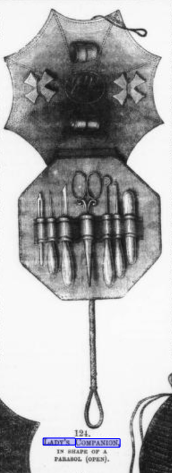
The full name of the tool, Lady’s Companion to the Worktable, unmistakably connected the object to crafting culture and to middle-class women’s liking for needlework gadgets.7 Many needlework items were sold as Lady’s Companions. These included needle baskets, sewing tools, pattern books and a women’s magazine (figure 1).8
The pervasive use of the phrase in the needlework context and Garnham’s middle-class upbringing suggest that she consciously aligned her invention with it. On top of this, the Companion’s features materialise its user. The object could only be perceived as a useful and suitable addition to other needlework tools for women who already had access to a table, fine threads and a high-quality source of light.9 Contemporary accounts of needlewomen’s poor eyesight repeatedly stressed the lack of these resources for working-class needlewomen.10 Additionally, as Mary C. Beaudry details in her archaeological study of the evolution of domestic needlework, nineteenth-century working-class women and children conducted fine work like embroidery or lace making while sitting on the floor, placing their piecework in their laps.11 In this working environment, Garnham’s object would have been more obstructive than useful, as the leaden base of the pincushion would have felt heavy and would have constantly moved on the needlewoman’s lap.
The Companion was intended to appeal to wealthier women, as evident in the use of mahogany and velvet, and the requested price. Imported from the colonies, mahogany was a highly valued wood, both for its durability and smooth dark appearance. Despite greater availability, it remained an expensive wood in the 1860s.12 Mahogany pieces on display in the parlour signified a family’s financial stability and belonging to the petite bourgeoisie.13 Velvet held a similar social and financial reputation.14 Announcements in the local gazettes following the bankruptcy and death of Garnham’s husband advertised the various mahogany pieces that the family had owned.15 This, together with the requested price of ten shillings, suggests that Garnham was aware of the performative value of the wood. She designed an object that promised high quality and a fashionable lady’s accessory. Simple microscopes for middle-class families were sold at a similar price but were technologically far more advanced than the Companion.16 General brass magnifying glasses or inexpensive spectacle more similar to Garnham’s object in terms of technology commanded a price between one and five shillings.17 Thus, if at all affordable, the Companion would have been a significant investment for lower-class women.18
Addressing the select audience of domestic middle-class women, the anthropomorphic term ‘companion’ made clear that the magnifying glass was not a necessary medical aid but that it, in the literal sense, accompanied a lady in her leisurely work. The attached pincushion materialised this feminine and de-medicalised look. While the division of the pincushion into two halves would have made it less practical compared to undivided sewing clamps, the fact that you could fold up the magnifier so that it was easier and safer to store made Garnham’s invention compatible with other popular needlework tools. The folding arm allowed the object to be stored in a needle-basket or in a drawer of the worktable (Figures 2&3).
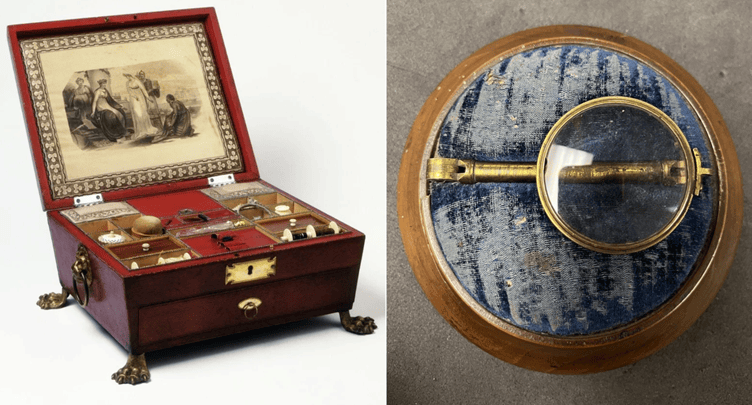
Fig.3 (right): Elisabeth Garnham’s Lady’s Companion, with foldable arm retracted. Author’s picture, Accession No 6826, Whipple Museum of the History of Science.
Needle-baskets along with versatile and decorative worktables were very popular during the time. Needle-baskets allowed the domestic woman to take her work elsewhere or to store the many small crafting tools in one place while attending to other domestic tasks, while worktables performed a similar function, but were reserved for wealthier women (Figure 4).19
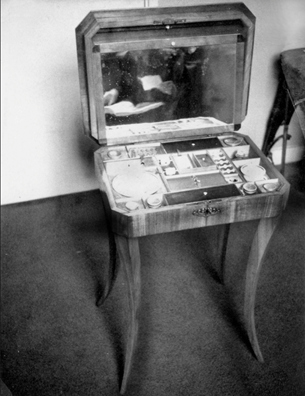
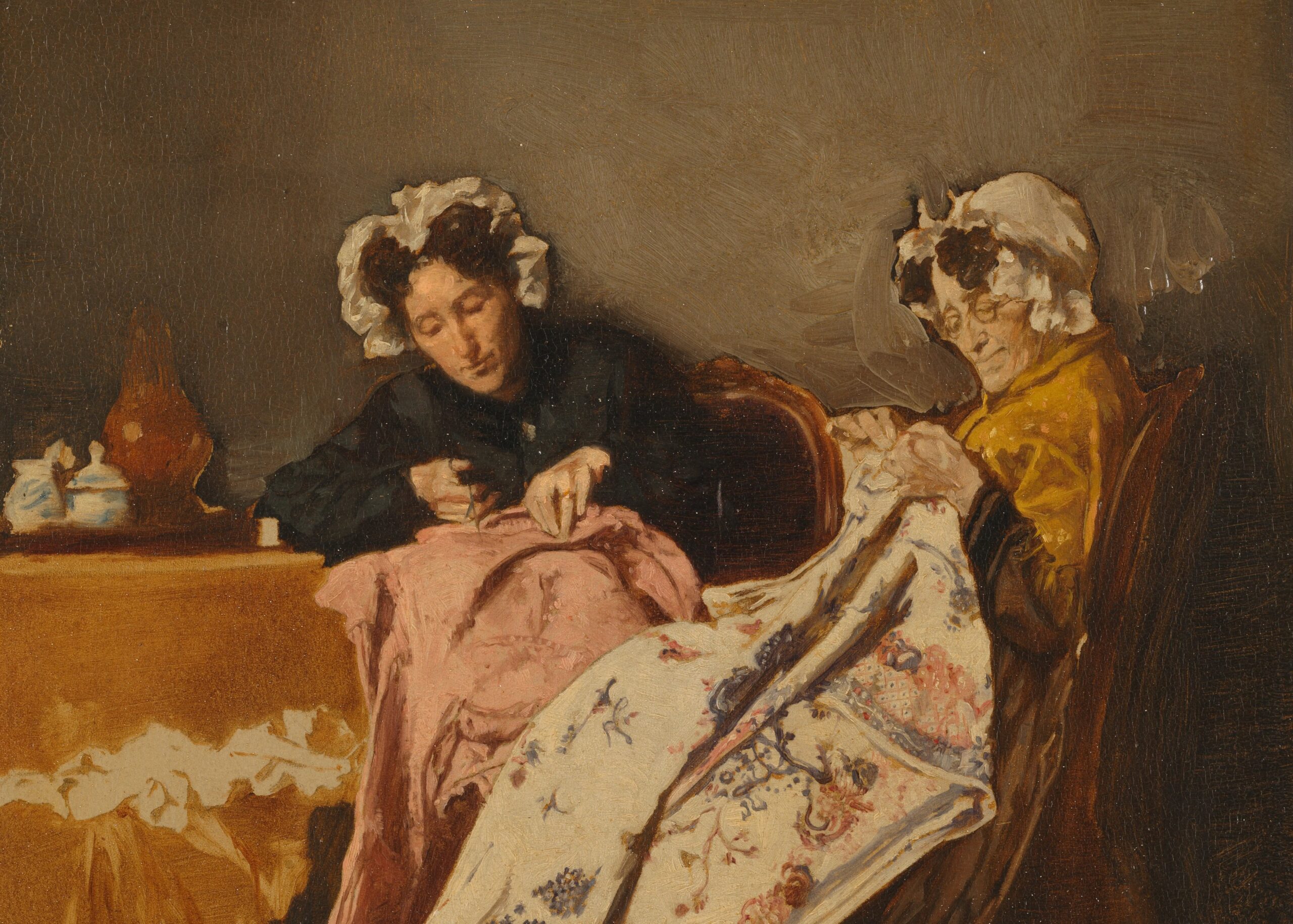
Worktables could be folded up for individual use, or they could be expanded to receive guests and play games.20 As Victorian images, paintings, and literature capture, middle-class women would gather to collectively attend to their sewing, both for leisure and paid work, or attend to their needlework when receiving guests (Figure 5).21
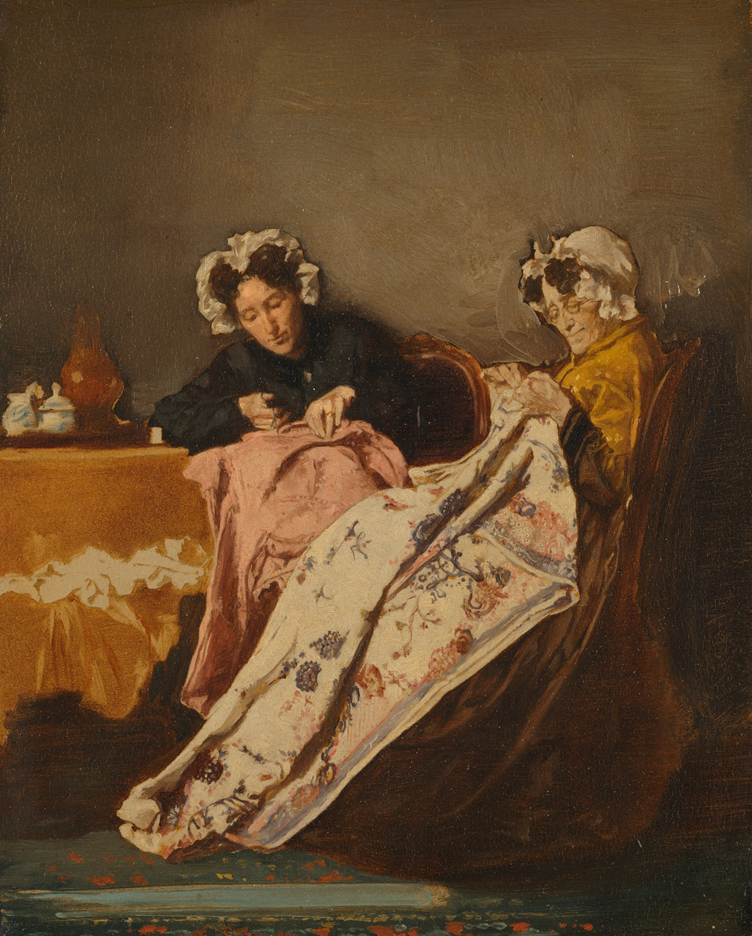
In these settings, besides being practically useful, needlework tools held performative aesthetic value, and they showed off a woman’s skill and time for needlework.22 Because of this, fancy, decorative tools were a popular gift among women.23 Although the advertisement in the EWJ (see previous post) focuses on the object’s practical merit, the design and the referral to it as ‘companion’ rather than ‘aid’ speak to a similar intent. The Companion acts as a reminder of the performative value of technology design. The situational fitting of the object to its female user speaks to the reciprocal relationship between technological change and sociocultural norms. In the Victorian period, both magnifying glasses and pincushions were widely available, but they were laden with conflicting gender-specific values such as women’s bookishness and their domestic care and obedience. In combining the two tools, Garnham’s object did not offer a novel technology, but the combination reframed both technologies and made them appeal to a new audience. Because of the magnifier, the otherwise ordinary pincushion became special – a ‘companion’ – something worth adding to one’s collection of needlework gadgets. Thanks to the pincushion, the standing magnifier was destigmatised, and its use by ladies was rendered more acceptable. Despite lacking information on the reception, the recommendation in the EWJ and the fact that the object was publicised beyond the local realm points to women’s perception of the Companion as more than a fashionable accessory. In a society that was concerned with the nation’s deteriorating eyesight, the object was a reaction to the need for visual aid in women’s domestic needlework.24
Women inventors inventing for women
Elisabeth Garnham’s unusual case points to the ‘cracks’ in archival documentation and scholarly knowledge on women’s domestic inventions and their use of visual technologies. Next to Garnham’s financial difficulties, provincial residency and middle-class upbringing, it was her gender that foremost shaped how she put together, designed and marketed her invention. As an aging woman, she likely knew the aching of her eyes after a day of stitching from personal experience. Living in a society that was obsessed with ocular health, she also knew of the medical perspective on needlework as detrimental. While these factors explain her individual gendered use of visual technology, it was her positionality as a middle-class woman knowledgeable of societal gender norms and women’s needs in needlework that informed the design of her object. Finally, an unusual constellation of gender-related factors and an explicit interest in needlework as women’s work resulted in the brief letter in the emancipatory EWJ, highlighting the complex relationship between women’s domestic and print subcultures, the male-dominated patent business and early emancipatory efforts for women’s independence.
Linking this letter back to the use and perception of the Companion, the framing of ‘invention’ can serve as a starting point for thinking about women’s engagement with technology more broadly. Combining a magnifying glass and a pincushion can be viewed as mere use, adaptation, design or acculturation of a technology. This approach renders sources like women’s magazines, domestic artefacts and needlework samples of new interest to the historian of technology. Studying such sources through the lens of ‘invention’ can help trace the ways women publicised and shared their ideas outside of the patent system, and it contributes to understanding the ‘domestic sphere’ as a space of invention.
- Johnson, Laura. 2024. ‘Editor’s Introduction: Needlework and Identity’. Winterthur Portfolio 58 (1): 1–8. ↩︎
- Ourdan, J. P. 1880. The Art of Retouching. London: E. & H. T. Anthony, 36-40 specifies flat plates under magnifiers for photograph colouring. ↩︎
- Ibid., 36. ↩︎
- Logan, Thad. 2001. The Victorian Parlour: A Cultural Study. Cambridge: Cambridge University Press, 25-27. ↩︎
- Almond-Brown, Gemma. 2023. Spectacles and the Victorians: Measuring, Defining and Shaping Visual Capacity. Manchester: Manchester University Press, 231-237; Withey, A. 2016. Technology, Self- Fashioning and Politeness in Eighteenth Century Britain: Refined Bodies. Houndsmill, Basingstoke: Palgrave Macmillan. ↩︎
- Almond-Brown, Gemma. 2016. ‘The Victorian Perspective on Spectacles’. Wellcome Collection Library Blog. https://wellcomecollection.org/stories/the-victorian-perspective-on-spectacles (last accessed: 21 September 2026); 2023, 207-237. ↩︎
- O’Gorman, Francis, ed. 2010. The Cambridge Companion to Victorian Culture, Cambridge Companions to Culture. Cambridge: Cambridge University Press, 226. ↩︎
- ‘Needle-Basket’. 1869. The Englishwoman’s Domestic Magazine 6 (105): 124; Newcastle Guardian and Tyne Mercury. 1867. ‘The Magazines of the Month’. October 12; Caulfeild, S. F. A, and Blanche C. Saward. 1882. The Dictionary of Needlework : An Encyclopædia of Artistic, Plain, and Fancy Needlework. London: L. Upcott Gill. ↩︎
- Harvey, Karen, ed. 2009. History and Material Culture. London: Routledge; Graves-Brown, Paul, ed. 2012. Matter, Materiality and Modern Culture. London: Routledge, 22. ↩︎
- Chambers, TK et al. 1854. The Journal of the Society of Arts 3 (112):119-120. ↩︎
- Beaudry, Mary Carolyn. 2006. Findings: The Material Culture of Needlework and Sewing. 1st ed. New Haven: Yale University Press, 158-167. ↩︎
- Freedgood, Elaine. 2006. The Ideas in Things. Chicago: University of Chicago Press, 24. ↩︎
- Ibid. ↩︎
- Hartzell, Freyja. 2009. ‘The Velvet Touch: Fashion, Furniture, and the Fabric of the Interior’. Fashion Theory 13 (1): 57. ↩︎
- Bury and Norwich Post. 1851. ‘Multiple Classified Ads’. March 5. ↩︎
- Morrison-Low, A. D, Sara J. Sechner and Paolo Brenni, eds. 2017. How Scientific Instruments Have Changed Hands. London: Brill, 43-56;1999, 202. ↩︎
- Almond-Brown 2023, 51-54. ↩︎
- For average wages in mid-nineteenth century London, see: Porter, Dale H. 1998. The Thames Embankment: Environment, Technology, and Society in Victorian London. Technology and the Environment. Akron, Ohio: University of Akon Press, 176. ↩︎
- Groves, Sylvia. 1966. The History of Needlework Tools and Accessories. London: Country Life Limited, 64-68. ↩︎
- Ibid, 66-68. ↩︎
- Ledbetter, Kathryn. 2012. Victorian Needlework. Victorian Life and Times. New York: Praeger; Mitchell, Rosemary. 1996. ‘A Stitch in Time? Women, Needlework, and the Making of History in Victorian Britain’. Journal of Victorian Culture 1 (2): 185. ↩︎
- Remer, Ashley E. 2019. ‘Lesson Object as Object Lesson: The Embroidery Sampler’. The Journal of the History of Childhood and Youth 12 (3): 346-349. ↩︎
- Ledbetter 2012; Schaffer, Talia. 2011. Novel Craft: Victorian Domestic Handicraft and Nineteenth-Century Fiction. Oxford: Oxford University Press, 67. ↩︎
- Almond-Brown, Gemma. 2022. ‘Vision Testing in Late Nineteenth- and Early Twentieth-Century Britain: Opticians, Medical Practitioners and the Battle for Professional Authority’. Social History of Medicine 35 (1): 237–58. ↩︎
About the author
Emma Kühnelt is a PhD candidate at the History and Philosophy of Science Department at the University of Cambridge. She usually works on the history of twentieth-century agricultural science, particularly poultry. During her previous MPhil degree, the small object in the Whipple museum caught her attention, not least because little oval stones, called ‘darning eggs’ kept appearing in the sources. This peculiar connection sparked her interest in women-specific use and perception of technology more generally. To connect, look here (LinkedIn) or email ek659@cam.ac.uk.
Edited by Anna Bruins and Elian Schure