“Godzilla vs. Kong. Why was this movie chosen to entertain the ferry passengers? Was the movie a personal favorite, or was it the only movie available?” I asked myself, as I craned my neck and shifted uncomfortably on my seat to get a better view of the medium-sized television screen mounted on the wall several rows in front of me. It had been over an hour since our ferry left the port of Coron (a municipality in Palawan, Philippines), and I was anxious to reach our destination of the neighboring island of Culion. I had planned a full three-day fieldwork schedule at the Culion Museum & Archives, and a day tour around the island that was hailed in the past as “the world’s largest leper colony”.1
The loud battle cries of either Godzilla or King Kong were muted by the cacophony of thoughts in my mind. Before that trip, I had only read about Culion and its history in journals and books. The existence of leprosy in the Philippines and the treatment of its sufferers could be traced back to the Spanish colonial period (1571-1898). Spanish Catholic missionaries and religious orders like the Franciscans and the Jesuits provided shelter, spiritual guidance, and other “bare necessities” for lepers in their care.2 However, their hospitals and leprosariums fell short in discovering modern medical treatments for the disease.3 Moreover, the Spanish colonial government did not attempt to systematically segregate or isolate the lepers (albeit at that time, the prevailing etiology of the disease was that leprosy was hereditary), ensuring fertile soil for the disease to take root and spread.4 The systematic collection, compulsory segregation, and medical treatment of lepers in Culion are legacies of America’s supposedly benevolent “civilizing” mission of the 20th century.5 Using the Hawai’i Molokai leper colony as a template, the Culion leper colony was established in 1907. Everything the “inmates” (as the patients were often referred to in colonial sources) needed to live and hopefully overcome the Mycobacterium leprae’s wrath was provided to them, like food, housing, employment, and medical treatment. They had their own currency, and their own advisory board. Furthermore, their spiritual well-being was sustained by religious missionaries. Quoting then Director of the Bureau of Health of the Philippines, Dr. Victor Heiser: “We want the leprosarium to be a cheerful village, happy, full of hygiene and even a certain beauty.”6
However, there was more to the legacy of Culion than just this curated image of “a certain beauty” and of its pivotal role in the prevention and treatment of leprosy in the American Colonial Philippines. Distorted faces and rotting flesh. Broken limbs and broken families. A disease without a cure, and a patient without a name.7 Beauty and horror: these were contrasting images of Culion that I was preparing myself to engage with at the island’s museum and archives. Would I be able to recognize these depictions of Culion and its people, or would I be fortunate enough to witness something else?
Nakikita ko na siya! (“I can see it!”), a passenger in front of me suddenly exclaimed in Tagalog, waking me from my mittyesque trances. She was standing next to the ferry’s railings, pointing towards the direction of Culion. I struggled to find my sea legs as I made my way towards the railings, my hands slightly shaking as I prepared my camera. Point and shoot. Etched on the hillside was the seal of the Philippine Health Service (PHS), accompanied with a marker of the island’s name. The eagle on the PHS seal had its wings outstretched, seemingly beckoning and calling out to ships sailing nearby. Was it a symbol of “welcome”, or was it a warning to “stay out” of the island? I made a mental note to ask these questions during my fieldwork.

I collected my bags and made my way out of the ferry. I noticed that Godzilla vs. Kong was still playing on the television screen. I made an addendum to my earlier mental note: Will they play the same movie during the return ferry trip?

In the Culion Museum & Archives’ collections, I found the usual materials such as newspaper articles, official reports, and annual bulletins. But I also encountered more intimate sources, such as personal correspondences, individual patient clinical charts and case files, and patient photographs. In those intimate moments, I remembered my encounter with young Ms. A’s clinical records, months before my visit to the archives. “Ms. A” was born to leprous parents in 1920, and she knew no other place to call home than Culion. Her patient case file indicated that she was “well developed and well nourished”. With the exception of indurations on her left buttock cheek (possibly due to the weekly injections she received as treatment), most of her body was free from skin ulcerations. The negative results from her medical screening confirmed that she was “probably [a] non-leper”, therefore warranting her release from the colony. With the confirmation of the chief physician and his assistant, and the file’s accompanying adoption papers, she was to be entrusted to the care of a woman living in Manila.
I remembered seeing Ms. A’s photo, with her hair pulled back, wearing plain white clothing, eyes stoic, lips frowned.8 Often, an unsettling feeling arises after reading patient case files and accounts, particularly involving vulnerable children from Culion like Ms. A. Personally, it was challenging for me to read their experiences impassively. During those three days of wading through the archive, I caught myself thinking about Ms. A and being confronted with ethical dilemmas. I weighed my desire to write about these sources on the one hand, and my respect for the private lives of these patients (and their surviving families) on the other. There is clearly no one way of balancing the scales, as each historian would be burdened by their respective positionality and partiality. But with every patient record I pulled out from the archive, I pondered: How could we write a more conscientious and “human” patient history?
Moreover, I was struck by the apparent imbalance in information available on the patients. I encountered patients with thick bundles of records, brimming with detailed information, from the patient’s date of admission to date of death, with the exact locations of their lesions identified, and changes to their medical treatments chronologically written down. But there were also numerous lean patient records, with meager to no information on the patient or their medical status, as well as dozens of photos, unnamed and undated. Unknown.
I have gradually come to appreciate the opinion that often, the most promising historical sources are those that are “silent” or “incomplete”. There is so much that is “said”, when the sources do not say anything at all. These are the sources that compel historians to seek for answers, to scour the archives, and to find fulfillment in their work, even if it means getting their hands caked in dust.
At one moment during our walking day tour of Culion, I stared at my hand and contemplated how we often underestimate our sense of touch. It is the sense that lets us feel pain and pleasure, and lets us feel each other’s presence. It can both build and break relationships. It was the sense of touch that the leprous patients of Culion unfortunately lost. As I continued to stare at my hand, the Tagalog word mapalad came to mind, with its root word palad meaning “palm of the hand”. Mapalad means “fortunate” or “lucky”. Suffering from a disease which was incurable at the time, forcibly segregated from the rest of society, and subjected to a variety of clinical experiments and medical treatments, the patients in Culion initially seemed to me to have been anything but mapalad. But I was jumping to conclusions. As Ma. Cristina V. Rodriguez wrote: “To come to Culion is to hurt oneself, but to heal oneself as well.”9
In the archives, I encountered clinical records of pain experienced by the patients, but I also read letters of hope from their relatives. There were medical journals that scientifically articulated methods on treating the disease, and yet there were also accounts of Culion patients actively deciding on what treatment they wanted to receive. With the ability to take matters into their own hands, perhaps the patients of Culion were more mapalad than I had originally thought. Following the discovery of a permanent cure (Multidrug Therapy or MDT) in the 1980s, the number of cases in Culion significantly decreased. In 1992, nearly a century after the island’s establishment as a leper colony, it became a full-fledged municipality.10 Through the years, Culion has proven itself to have changed from a colony for the lepers, to a community by the lepers.
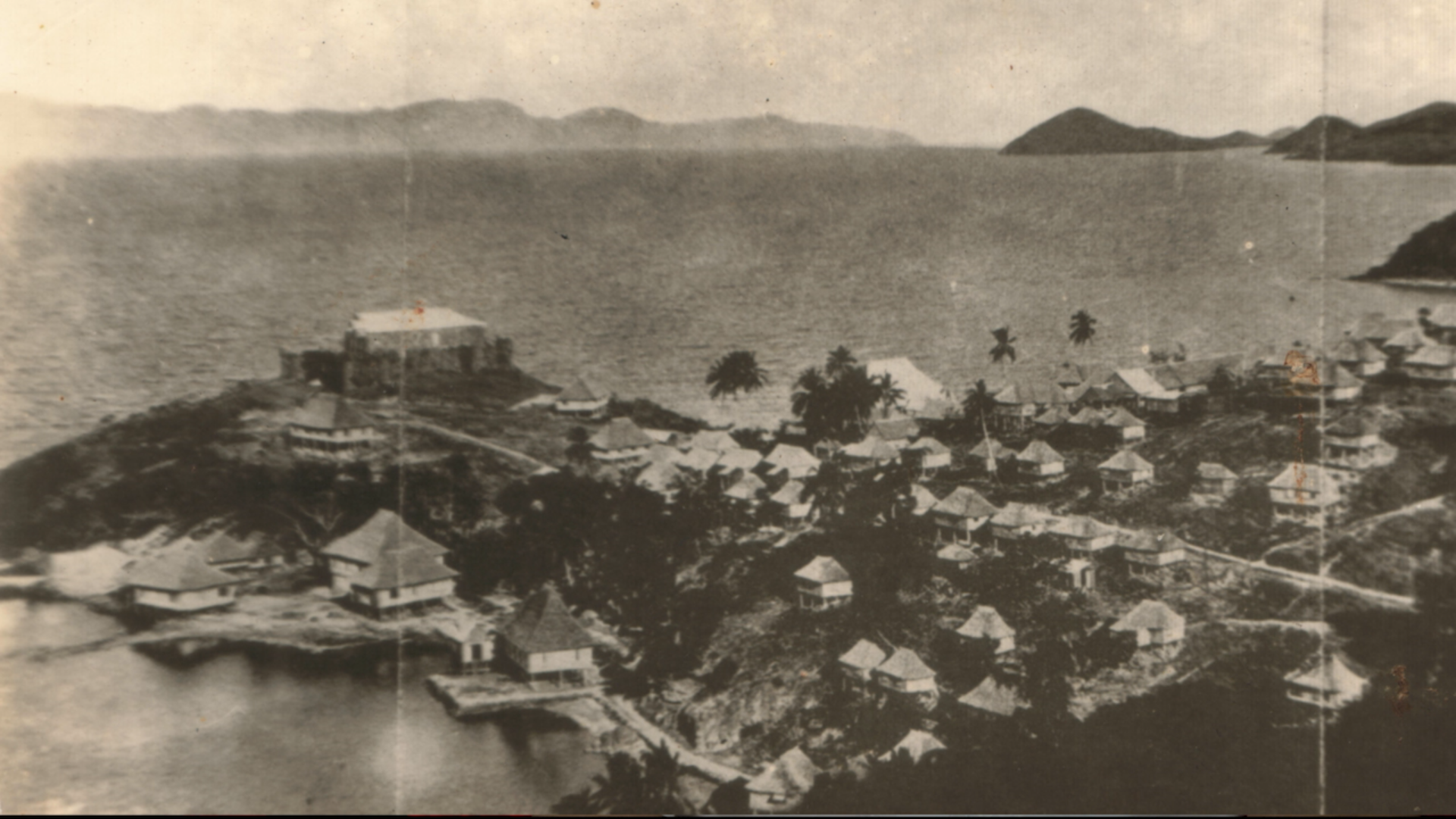
I was jolted from my ruminations when our local tour guide invited us to take in the beautiful view of Culion from the hill we were trekking. The view was breathtaking, but also familiar, as I had previously encountered a photo in the archives that had most likely been taken from our very spot.

It was also during our day tour when light was shed on the story behind the etched PHS seal that had welcomed us when we arrived. Apparently, the seal was voluntarily created by the patients in the 1920s as a way of thanking the physicians and nurses of Culion for their services. Whenever the health authorities would leave and sail away from the island, the patients wanted them to have something to look back to. Upon their return, the etched seal was the first thing they would see, and it was the patients’ way of welcoming them back.
Aboard the ferry back to Coron, I looked back at the island and the PHS seal one last time. I reflected on my fieldwork over the past days. I considered myself mapalad to have had this research experience and to be able to write about it. I was mapalad to have met the warm and welcoming locals of Culion, who proudly wear their island’s history and legacies as badges of honor and hope. I was mapalad to have heard their family histories, their experiences with the disease and its accompanying stigma, and how they had risen in defiance against it as a community. For me, these were the new depictions of Culion that I had hoped to see. I would like to believe that the modern-day people of Culion having cultivated and sustained a strong sense of belonging and appreciation for this past, feel equally mapalad.
As I settled in my seat, I gave out a deep sigh of relief and contentment. I looked up to see what movie they picked to entertain us during our return trip, and lo and behold, it was Godzilla vs. Kong, again. I guess I was not mapalad on this one. I chuckled lightly and resigned to just watching the movie.
It would still be a long journey back to Manila.
Acknowledgements
This fieldwork is part of a broader project on human subject research and medical ethics in colonial Southeast Asia, led by my supervisor Dr. Fenneke Sysling of the Institute for History, Leiden University, and funded by the European Research Council (ERC).
I am very grateful to my family, for their unwavering support during my fieldwork in the Philippines. I would also like to extend my warmest thanks to the administrators and staff of the following institutions, archives, and communities in the Philippines, for their time and generous accommodation:
- Archives of the Philippine Province of the Society of Jesus (Ateneo de Manila University)
- American Historical Collection (Ateneo de Manila University)
- College of Public Health Library (University of the Philippines, Manila)
- Culion Heritage Town Tour Plus
- Culion Museum & Archives
- Culion Sanitarium and General Hospital
- Department of History(Ateneo de Manila University)
- F.B. Herrera, Jr. Medical Library (University of the Philippines, Manila)
- Filipinas Heritage Library
- Heritage Library, Miguel de Benavides Library (University of Sto. Tomas, Manila)
- Loyola College of Culion
- University Archives (Ateneo de Manila University)
Edited by Luca Forgiarini and Anna Bruins
- Apol Lejano. “The World’s Largest Leper Colony,” In Culion Island: A Leper Colony’s 100-Year Journey Toward Healing, edited by Ma. Cristina Verzola Rodriguez (Makati City and Bilbao: Culion Foundation, Inc and Fundacion ANESVAD, 2003), 74-87. ↩︎
- [1] In careful consideration of their often negative connotations, this essay mainly used the terms “leprosy” and “leper” in their historical sense (i.e. how historical sources used them, and how the disease and its sufferers were perceived during the Spanish and American colonial periods). Refer to Maria Serena I. Diokno’s introduction in the edited volume Hidden Lives, Concealed Narratives: A History of Leprosy in the Philippines, on nuances in the discourse of leprosy. Maria Serena I. Diokno. “ Introduction, Fear of Contagion, Punishment, and Hope,” In Hidden Lives, Concealed Narratives: A History of Leprosy in the Philippines, edited by Maria Serena I. Diokno (Manila: National Historical Commission of the Philippines, 2016),12-25. ↩︎
- C.B. Lara. “Brief History of Leprosy Work in the Philippines,” In Culion: A Record of Fifty Years Work with the Victims of Leprosy at the Culion Sanitarium, edited by H.W. Wade (Manila: Bureau of Printing, 1956),1; Jose S. Arcilla, S.J. “The Culion Leper Colony, 1900s-1970s,” Philippine Studies 57, no.2 (2009), 308-309. ↩︎
- Warwick Anderson. “Leprosy and Citizenship,” Positions 6, no.3 (1998):711-712; Arcilla, “The Culion Leper Colony, 1900s-1970s,” 309. ↩︎
- Warwick Anderson. “States of Hygiene: Race “Improvement” and Biomedical Citizenship in Australia and the Colonial Philippines,” In Haunted by Empire: Geographies of Intimacy in North American History edited by Ann Laura Stoler (Durham: Duke University Press, 2006), 110; Anderson, “Leprosy and Citizenship,” 710-712. ↩︎
- Veronica A. Dado. “Spaces and Boundaries in Culion: Mobility Amidst Segregation,”; Ma. Florina Y. Orillos-Juan. “Landscapes of Isolation: Selected Leprosaria in Luzon and the Visayas,”; Francis A. Gealogo and Antonio C. Galang, Jr. “From Collection to Release: Segregated Lives in the Culion Colony, 1906-1935,” In Hidden Lives, Concealed Narratives: A History of Leprosy in the Philippines, 94-112; 114-127;129-147. ↩︎
- Ma. Cristina V. Rodriguez. “Island of Despair,” In Culion Island: A Leper Colony’s 100-Year Journey Toward Healing, 50-73. ↩︎
- “Featured Collection: The Culion Museum and Archives, the Philippines.” International Leprosy Association History of Leprosy, accessed August 12, 2025, https://leprosyhistory.org/blog/cotton/980.html. ↩︎
- Ma. Cristina V. Rodriguez. “Editor’s Preface,” In Culion Island: A Leper Colony’s 100-Year Journey Toward Healing, 9-10. ↩︎
- Culion Foundation, Inc. and Fundacion ANESVAD. “Introduction,”; Pennie Azarcon dela Cruz. “Into the World,”; Arturo C. Cunanan, Jr., MD. “The Quest for a Cure,” In Culion Island: A Leper Colony’s 100-Year Journey Toward Healing, 7-8; 134-144; 148-158. ↩︎