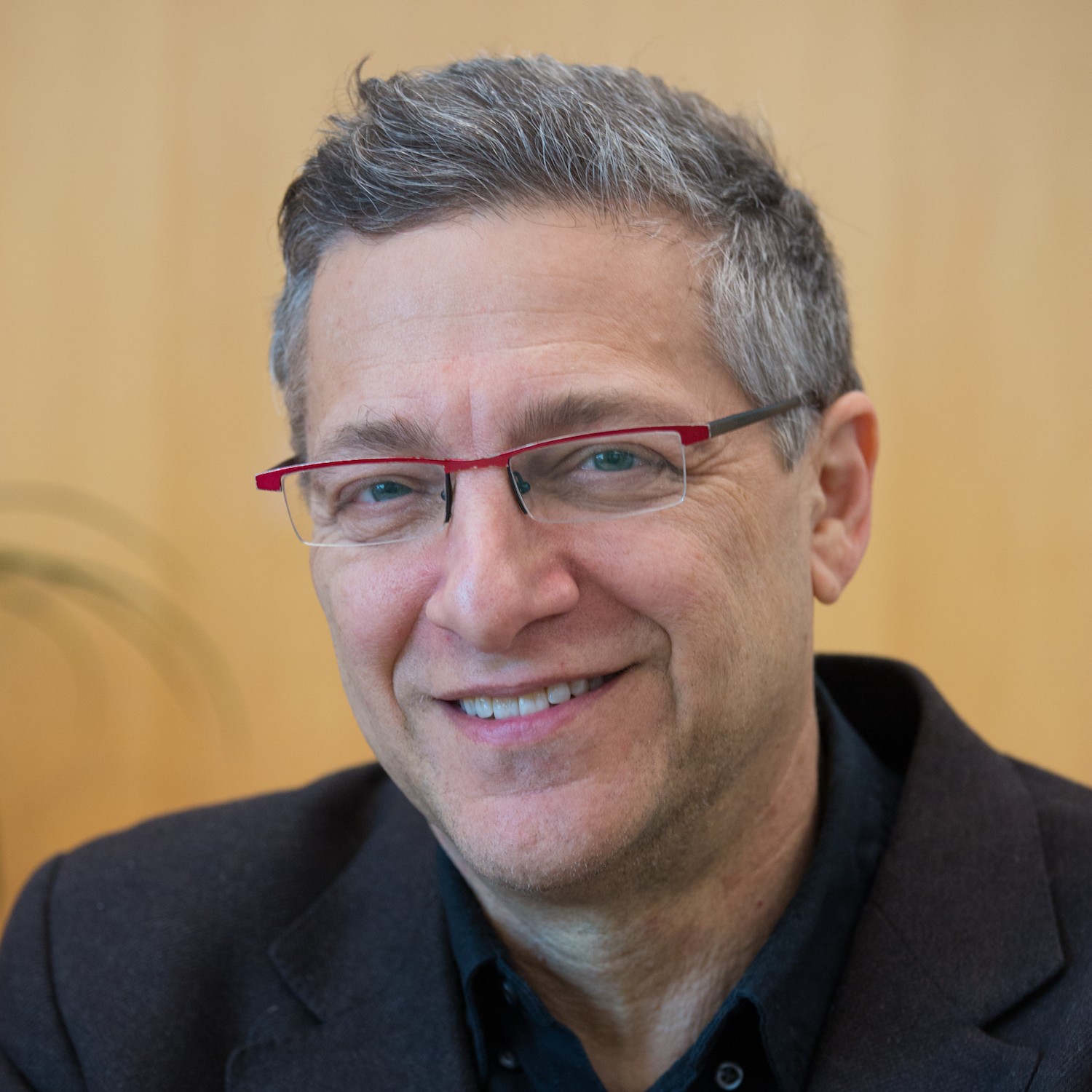
Peter Galison: I’m Peter Galison. I am a professor at Harvard University, where I’ve been for quite a while, and before that I taught at Stanford for about ten years. I grew up in New York City, and spent a year at École Polytechnique in Paris in a physics lab before I went to college. I was interested in the relationship of art and science, particularly in sculpture and mathematics. I thought that was something that I wanted to pursue. The art department thought this was a great idea, but the mathematicians thought it was the worst idea they’d ever heard. I had to choose a major right away since I was starting as a second-year student, and in the aftermath of my defunct math-sculpture idea I stumbled into history of science. I had read Gerald Holton’s book, Thematic Origins of Scientific Thought and Thomas Kuhn’s, The Structure of Scientific Revolutions, and I found both of them very interesting. So, I studied a combination of physics and European intellectual history as an undergraduate. Then I spent a year at the University of Cambridge, studying history and philosophy of science working mainly with Mary Hesse, a great philosopher of science, and with Gerd Buchdahl, with whom I studied, mainly, Kant’s Critique of Pure Reason for a year. I had some other courses, but those were the two parts were the most central to what I was doing and extraordinarily exciting.
I went to graduate school at Harvard, first in the history of science. My dissertation was called How Experiments End, which became a book. Then I had a postdoctoral fellowship for three years. Steven Weinberg suggested I do a second, physics PhD. I had done all the coursework already, so I worked on the thesis over the course of 1981-83, before I went to Stanford. I was split between philosophy and physics there, because history of science was just getting started there I was trying to help build up the program and the history department at that time was a bit ambivalent about history of science. It was later relayed to me that one of the people there said, ‘Why would we want history of science? That’s like a history of toys, and we certainly don’t want that.’ I actually think the history of toys is a great subject (think of the Wright brothers’ kites), but he didn’t mean it as a compliment.
Eventually I got to be very close to the historians, especially Jim Sheehan and Bart Bernstein, with whom I wrote some things, and a bunch of others there in the department. Then I came to Harvard, in the Department of the History of Science and in the Physics Department. Now my job allows me to teach in various departments, including Art Film and Visual Studies (AFVS). That’s a broad gauged-summary of my professional affiliations.
Intellectually, I’ve had three stages of my career: first in history and philosophy of science and physics, then film and filmmaking, and then in the last ten years, I’ve been very strongly involved with the study of black holes. Imaging black holes and other projects in the Black Hole Initiative, which I direct.
Maura Burke: So, it seems that you have come already to academia with a very intrinsic interest in these interdisciplinary nodes when you started with mathematics and sculpture, and it seems as you recount your history, there’s a number of moments where the structures of academic disciplines could not accommodate your interests. So, to now stand at this stage in your career as the director of the Black Hole Initiative, which is such an interdisciplinary effort, must feel very gratifying, no?
PG: Somewhere Freud once said that there is no happiness like the fulfillment of a childhood desire. I suppose that’s true for me: a back and forth between the humanities and sciences. My career has been dominated by themes that I find incredibly riveting, like visualization or the materiality of the world and the relationship of the very abstract and the very material. These things occur over and over again in each sector of my work. My feeling is to follow those interests and the questions that arise one after the other, using the disciplinary methods and orientation that that feel appropriate to addressing them as they go. It’s not because I don’t like the single disciplinary work, it’s just that the questions that I’ve wanted to pursue have cut across those domains. So yes, I love the work!
I don’t think that interdisciplinarity should be used as an excuse for not being rigorous or pursuing things in a way that recognizes the standards of argument from different fields. For example, I had made films as a kid, and I had cut little Super 8 movies. In college I had taken a video course back when the videos required a big backpack, giant batteries, tape, big cassettes, and terrible burden of linear editing. Gradually, filmmaking evolved: digital non-linear editing process, much lighter and more portable, more capable digital cameras. I had to learn filmmaking through practice and I really had to figure things out.
The collaborators with whom I worked were enormously generous in this regard. I collaborated with a childhood and continuing friend, Pam Hogan, who had a lot of experience in public television in the United States. We made a film, Ultimate Weapon: The H-Bomb Dilemma, about the hydrogen bomb and the moral and political debates over it. I learned a lot working with her and the professional people with whom she was used to working. Then I worked for years with Robb Moss, my collaborator on two feature documentary films, Secrecy, about national security and democracy, and Containment, about the challenge of protecting the 10,000 year future from leftover radioactive waste. That was also a learning experience for me – learning about the whole structure and place of documentary in the world, about festivals and about cinematography.
I use this as an example, to show how understanding and internalizing the standards of a new discipline to the level where one can participate meaningfully, is a process of apprenticeship that takes many years. I feel like that’s true for the pieces of my work that have been deeply collaborative over many, many years. I like working with people. I’ve written books by myself and I’ve done filming by myself, but really it’s a pleasure for me to work with others on the physics and the filmmaking, or in the book Objectivity with Lorraine Daston, or the book Invisibilities that I’m now finishing with the art historian Caroline Jones, to whom I am married. I enjoy that process. It’s a great pleasure for me.
MB: It’s nice to recognize from my perspective as I listen to you that the largest emphasis you make is on the generosity of these other people who are experts in their domain to whom you are coming with interest and excitement about something that you generally want to participate in.
PG: My filmmaking partner, Robb Moss, often says that film is where good ideas go to die. What he means is people come in and they think, ‘I’ll make a film about X, because X is an interesting topic,’ but a topic is not a film. Trying to impose too strongly your pre-formed ideas and not being open to what’s before you as you film is deadly. One of the experiences I’ve had in learning and collaborating with people in different forms of media, is that what can look like an open field to somebody that comes from the sciences—an art production—has genuine demands of coherence and expectations. You can’t just proceed as you wish. It’s simply not true. When Robb and I were working together, we often disagreed about things, and we always settled it by saying, ‘let’s try it’. Whatever it was. Sometimes it did work and sometimes it didn’t work, but once it was on the screen, we never disagreed. Never. Theoretically you can disagree, but once it’s part of the work, it becomes much clearer. That’s been true of lots of projects, not just in film but in the history of science. I think that recognizing the constraints of genre and coherence matters. The vocabulary that you’re using, whether it’s visual or textual or technical, brings demands with it.
MB: ‘Let’s try it’ – is that a general theme you think has helped you in your work? This capacity to understand that, okay, I’m coming to this with desires and I’m entering into this because I have something I want to say or show, but I know that I’m only part of the story and I have to be responsive to what’s coming at me once I start this journey?
PG: Definitely. I wrote a book called Einstein’s Clocks, Poincaré’s Maps. I started with a fascination for Einstein’s work in the patent office. It had long bothered me that this was supposed to be a kind of day job, like waiting tables for an actor—that he was seeing this parade of new inventions, the cutting edge of technology, and that that would have nothing to do with his work on electrodynamics or the other topics of 1905. That was just implausible on the face of it, to me. Once I understood better how coordinated clocks in patents and railways were part of his day job, it made more sense how they appeared in his physics. But I had an idea about a parallel point with Poincaré that turned out to just be wrong. I was looking at the wrong part of what Poincaré was doing, and I tried, and I tried, and I tried, but it just didn’t work. Instead, and finally, I began looking at his work as head of the Paris Bureau of Longitude—that was the key. I think it is really important to have that openness that you referred to—to realize when something is just not working, and it’s not working because you haven’t put yourself into it enough. It’s not working because the world doesn’t function that way and simply does not conform to your prior expectations. And that’s just too bad. Sometimes you can make something very interesting out of that failure, and at other times, you just have to write it off.
MB: I wanted to ask a little bit about how you’ve seen the field of either HPS or just history of science develop over the past 25 years. I feel that the field has gotten more local in some way. The desire to project very grand truths about the world has decreased in our field and we’ve gotten very particular and very detail-focused. That’s a place where your work sort of stands out to me. Objectivity, for instance – that’s a big, big idea. What are your thoughts?
PG: I completely agree. I think the idea of local history, or local history of science, and the understanding that knowledge bears the mark of its time and place of origin, is one of the greatest, deepest ideas in the field of the last 50 years, but I think that it can be pushed too far. There are things that are not local.
Take one of the most widely read books on German history, at least in the United States, The Nazi Seizure of Power by William Sheridan Allen. It’s about a small, unnamed town in the (modern state) of Lower Saxony. In the book you learn what the head of the bank and the mayor and the chief of police do, and it’s very interesting. It’s a lively, good read. Undergraduates love it. But there are things about the rise of Nazism that are not local, like radio. The regime produced millions of radio sets (Volksempfänger – “People’s Receivers”) that only got official channels. If you think that the world begins and ends at the boundaries of a town or even a set of ten towns, then you do not understand something about the rise of Nazism. I think that’s true in the history of science as well. There are many things that can only be understood locally, but if you’re fanatically localist, you miss out on powerful, global forces.
In the book Objectivity with the Lorraine Daston, we focused with great care on the practices by which people made what they considered to be the most reliable scientific images. We used these atlases that became the standard bearers for what the basic working objects of different fields were, whether of clouds or the anatomy of the hand or skulls or particles or plants. But these atlases were themselves part of series. They were part of a genre—atlases—that existed for hundreds of years, and still exists. They were published by a handful of places like Springer Press and others. They were often written in three languages. But we said, ‘we’re going to sacrifice micro history in order to understand something that was unified by publication and distribution history.’ In doing so we were able to look at a much longer term and more global phenomenon of publishing, observation, and epistemology.
Another example from history of science, or history of the academy: if you take any university between 1860 to 1910, there are big debates about whether women should be admitted, or whether they should be promoted, or if they should be on the faculty and so on. If you look at a particular university, you’ll find that this guy was opposed and that guy was in favor. You could think that it is a history about that place, which it is in part, but it’s also part of a European and North American transformation that was happening all over. There are things you simply don’t get if you think everything that matters is explicable by the local.
MB: One of the questions I like to ask people is very globally oriented and addresses this feeling that we exist in these very turbulent and perhaps even unprecedented times. There’s so much instability now and there’s so much knowledge of the global, which is maybe what is truly unprecedented. I can reach into my pocket and have a direct view into the ways in which the political situation of the United States is impacting the health of individuals in the Middle East. I can understand this globalism more directly. So, for people who do feel like the times are dangerous in an unprecedented way, with your own understanding of historical trends, what do you make of this feeling?
PG: We in the world have lived through several global conflicts, most dramatically and tragically, World War II and then the Cold War, which didn’t end in global nuclear annihilation, but could have. I think those things were delocalized in important ways. I don’t think that the threat of mass casualties and destruction is something that’s new. I think what’s really shaped so much of our politics, discourse and culture these days is what you alluded to a moment ago: the information economy and how it works—the destruction of local news, globalization, the distribution networks of social media that reward divisiveness, disparagement, and dehumanization. This surely has contributed to it, but it is not the single cause of deep political polarization. There has been a loss of a kind of center where people can respectfully engage with each other but disagree strongly. Those things I think are new. There’s never been anything quite like this situation in the last 150 years. The proportion of young people who get their news from social media and the tight control of news media by a very small number of agents – that’s new and I think that’s contributed a lot to the sense of instability that we have. There are these waves of enthusiasms and paranoid delusions and conspiracies and moments of ethnic hate and destruction that have swept over the world through media reinforcement. That’s something people feel acutely.
MB: Do you think that there’s a role here for science scholars to figure out how to reintroduce a sort of central plain where we can regain some sort of trust and make scientific knowledge or political debates less opaque? Is there an explicit role for us there? Is there a call for us as science scholars to become more politically engaged or more publicly engaged as scholars, in order to use our knowledge about knowledge to an effective means in this way?
PG: I think by necessity we better get involved, because if not, we may see the university crumble beneath our feet. That’s not the only motivation. It can’t just be the case that universities make knowledge and then expect that the universities gain appreciation magically by the rest of society. We have to learn what goes on outside. And certainly, I think there are lots of different ways to engage. In my particular case, film has been the avenue by which I’ve wanted to become engaged in a wider realm, but also writing sometimes, addressed to a non-specialist audience. Ultimately, universities have to prove themselves worthy of support to the broader society—and it cannot be just a mantra of ‘we invent and decades later these inventions help people’.
On the positive side, I think that there is a way to speak to a wider interest in public that’s not condescending and recognizes that people are really smart from all sorts of domains that have nothing to do with academia. But if you make things forbidding by using a highly specialized vocabulary, you can block a wider readership right from the gate, and there’s no reason to do that. Explaining things clearly with an open vocabulary is possible in film, it’s possible in many domains in writing and in other forms of address without sacrificing the interest and integrity of the work. I don’t think it’s a matter of vulgarization. It’s not a matter of speaking down to people or speaking as if to a five-year-old. It’s a matter of speaking to others intelligently with dignity and respect, whether in books, articles, films, or exhibits.
I would say more generally in my work, one of the big themes that I’ve been interested in is how people can work together when they disagree about principle, but they agree on what is to be done. That’s true inside the details of physics or astronomy—things I’ve looked at—but it’s also relevant between the university and the non-university, or duck hunters and conservationists agreeing to save a wetland. They have completely different reasons for why they want to save the wetland from helter-skelter development of a mall or something, but they were able to join forces to do it. Not because they agreed on their politics, but because they agreed on a local goal keeping macro-politics to the side.
MB: I have a degree of sympathy with people from the public who have a skeptical attitude, because I’m a sort of professional science skeptic as philosopher of science. But, I have been trained through a long apprenticeship to do it with a kindness and reverence for scientific practice. One of the things I struggle with, how does one walk the line of conveying these sorts of skeptical philosophies to a public who might be inclined to engage in bad faith science skepticism?
PG: I have no general panacea for these circumstances. There’s a sense that people want to have more control over their lives and sometimes these against-the-grain conspiracy theories answer to their frustrations. I’m very sympathetic to the response to COVID-19 and the development of mRNA vaccines, which I think saved millions of lives. But there were many mistakes that the public health officials made, certainly in the United States, like saying simultaneously, masks don’t work, don’t use them, and you shouldn’t use them because the surgeons need them, and then once the shortage ended saying that they were one of the most effective means of ceasing transmission. Well, either they work, or they don’t work, and people are not stupid. If they had simply said, we need more masks for surgery, please only use them when you’re going to be in indoor situations, I think that it would have gone over much better.
Polls show that people actually like science, but they don’t like being hectored by scientists. I think to the extent that scientists are people who are working in various relations to the sciences and medicine and technology, they can address these questions in a way that’s clear and that says what’s known and what’s not known; what’s probably known, but not with certainty, and whether it’s an open question or, ‘We’re researching that,’ or ‘We don’t know the answer yet.’ I think that will help, but it’s not going to suddenly make all paranoid illusions go away because there are big interests behind some of them. Public health has been a place where measures have encountered huge resistance for more than a century, so it’s not that surprising that it arose again around COVID, because it was true for all the vaccines that have been issued over decades and decades.
MB: In some ways, I see a reflection of how difficult it is to construct knowledge within epidemiology in public skepticism. There are a lot of epistemic difficulties in trying to achieve population level statistical outcomes by mediating the behavior of individuals and the inherent mismatch between those two groups is really difficult in the practice of science. I think the public feels that.
PG: It a deep ethical question, too. I’m 100% behind the COVID-19 vaccine. As I said, I think it has saved probably 250,000 Americans in the first six months alone, and several million people globally. I also have a friend who was injured by the COVID vaccine. People pretending that it never causes harm are wrong. You have to make an argument that is inherently statistical. Our educational systems do not adequately prepare people to understand what a statistical argument is. We don’t teach science very well. That’s another problem. I don’t just mean the United States. I don’t think that it has done very well anywhere. Math is taught better in Singapore than it is in Europe or the United States, that’s true. But if I had my wishes, we would teach more about basic statistical reasoning and how it applies to everyday situations and spend less time solving quadratic equations, which I think is vastly less important than understanding what it means to say something happens 1 in 1,000 times.
MB: Your career has pivoted a lot and you are involved in making a lot of different types of epistemic artifacts. To what extent has this diversification of your knowledge products changed your own understanding of scientific epistemology, or any of the more traditional epistemological themes that you were writing about before you started producing other knowledge products?
PG: I think I’ve learned in both directions. From history of science, I pay particular attention to the role of instruments and procedures, not just to the results. For example, I’ve been interested in the techniques that are shared and carry over across domains. I have come to believe that following techniques, instruments, laboratories and practices is a way of understanding how knowledge moves across time and disciplines. Results can make things seem completely disparate, when in fact they’re fundamentally connected. Take the film that I made about the black hole work, Black Holes |The Edge of All We Know. I really wanted to film the work in progress, not just highlight grand statements of black holes. I wanted the magic and mystery of black holes to emerge out of the practices rather than be the main subject. I think that’s the way in which the written work and the work more generally that I participated in, in history and philosophy of science, has shaped my filmmaking. But then the filmmaking has also reshaped how I write. In a time-based medium—in film, if you lose people, that’s it. You don’t get to say, ‘skip Act 2 if you’re not interested.’ If someone leaves a film, they’re gone. They’ve left, literally and figuratively. Another example: In writing you can say, ‘here are three examples of how attitudes towards the germ theory of disease reshaped work in the hospital.’ In film, you don’t get to do three examples—you show something.
The information density in film is not in the words spoken, it’s the density of seeing people, all of their motions and interactions with each other and their responses. Could you capture that in writing? Maybe, but awkwardly, and you make linear something that’s actually simultaneous. By doing that, you have lost the experience. I think about seeing how people exist in their world, the scale of things and objects: Is something big, or is it small? Is it enduring or is it momentary? Does something that somebody says shock or disturb somebody that’s listening? All those things are the density of film that you’ve traded out against the density of words. If you make a transcript of even a long film, it’s nothing, and if you talked all the way through a film, people would gasp for air and leave the room, right? Film is the multiplicity of music or sound design and lighting and image and facial expression and body gestures and physical objects and scale. All those things are happening simultaneously, and they create a multimodal effect.
For me, film has been a way of complementing writing, but there are still things that I can do in writing that I just can’t do right in film. I wrote a piece once with Bart Bernstein, historian at Stanford, where we periodized the history of the debates over the hydrogen bomb. We ordered and made sense of what looked like wildly flip-flopping judgments by all the major figures: Oppenheimer, Bethe, Fermi, for example. Suddenly their positions could be seen to be rational responses to big events; the end of World War II, or detonation of the first Soviet bomb. Staging events against a periodization framework is something that print can do really well. I tried to make a film that way, with chapters and subsections as acts and it was unwatchable, I couldn’t do it. Text can move back and forth, between continents without any disturbance, just say ‘the response was utterly different in Africa.’ In film, it becomes illegible, a mishmash.
Understanding the advantages and disadvantages of each medium helps me configure the relationship between writing and film where I go back and forth between one and the other. I’ve learned a lot from the various forms of my work and their combination; each has made me see things differently.
MB: I generally ask people for book suggestions, however, since our emphasis here has been on the ways that different modes of media can impact us, I will open this up to be a more general suggestion, a book, film, music – whatever you hope will have an impact on the audience.
PG: I think people should go to a film festival and watch a lot of films that will never make it to the big streaming channels. Seeing those, I think, would be bracing, and an interesting encounter that would extend beyond the moment. There are a number of science film festivals. There’s a platform that came out of the Imagine Science Film Festival called Labocine, and they have a lot of their short films, which are quite imaginative and good, and I think worth looking at. I think experiencing different kinds of books is valuable. Graphic novels are in an explosive and interesting stage right now. There’s a piece on the graphic novel and its history and literary theory by Hilary Chute, called Why Comics? From Underground to Everywhere, which is well worth reading. There is an imaginative book called A Final Story: Science, Myth, and Beginnings by Nasser Zakariya (who studied with me years ago), about how the narratives surrounding the history of the cosmos, the solar system, life on Earth, got woven into a single narrative. AI is in many ways both troubling and extraordinarily exciting for the growth of science. I read and recommend Chris Miller, Chip War (2022) and Honghong Tinn, Island Tinkerers (2025), the former top-down about national economic competition, the latter more subnational, ground-up experimentation and contingency.
One thing I found in teaching is that people really like contact with the physicality of books. We’re so burned out, literally and figuratively, by screen work. Having something where you aren’t toggling back and forth between doomscrolling and reading is exciting and engaging. So, sometimes just try that. I think there are lots of ways that we can get information and understand our world and try things out; even things that seem somewhat uncomfortable can be bracing and inspiring, and make a real impact.
MB: I like that it takes us back to one of the lessons you learned making films: you just have to try things out. You have to try. You might leave it behind but take the leap to try something that you’ve not been exposed to before, just because it calls to you. Thank you, Peter, for your time.
Edited by Maura Burke and Mor Lumbroso.