
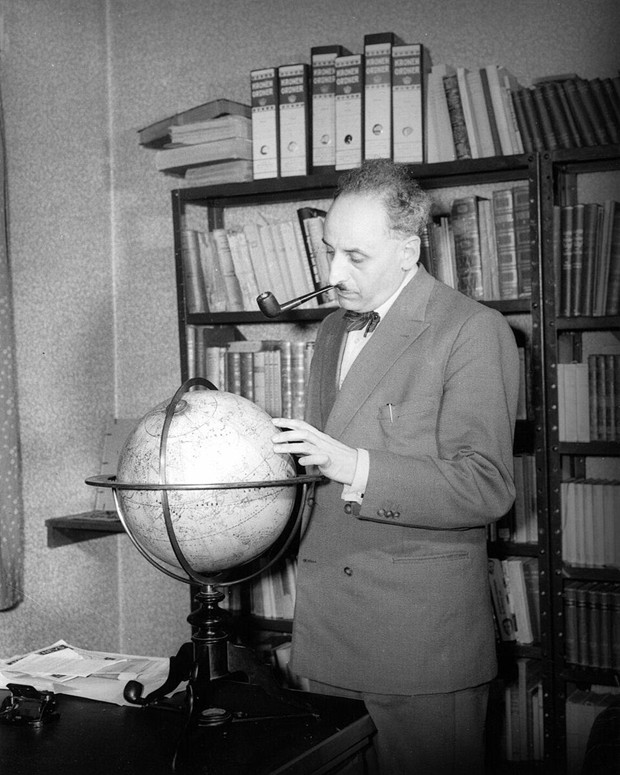
This article is the second part of a two-part series (the first one is to be found here), aiming to provide a short introduction to the intellectual history and genealogy of Hans Freudenthal’s Lingua Cosmica. This second part aims to show the subtle, yet fundamental influence played by the mathematical and philosophical school known as “intuitionism” in Freudenthal’s project. In particular, we will highlight the continuity between some of Freudenthal’s choices in devising his Lincos language and a number of reflections made by Freudenthal’s mentor, the mathematician and philosopher L. E. J. Brouwer.
Enter Freudenthal: Intuitionism, Mathematics, and Misconceptions
Hans Freudenthal (1905–1990) can be described as a topologist and pedagogue of mathematics. Alongside A. Heyting (1898-1980), he is known to be one of the most prolific collaborators of mathematician and philosopher L. E. J. Brouwer (1881-1966), the founding father of the constructivist school of mathematics known as “intuitionism”. Yet, such a short recollection is partial at best. The interests of Hans Freudenthal spanned a variety of topics, from history and literature to philosophy, rivalling even those of his mentor Brouwer. As noted by Van Dalen1 in Brouwer’s biography, the similarities between the two probably contributed to the divide that crept in between the scholars from 1942. In this short essay, I mean to explore some of these less apparent facets of Freudenthal’s work. In particular, I will argue that Freudenthal’s relationship with the wider philosophy of intuitionism played a pivotal role in Freudenthal’s most peculiar endeavour: the devising of an artificial language understandable to possible intelligent extraterrestrial life-forms, as described in his 1960 “Lincos: Design of a Language for Cosmic Intercourse”.
Just as describing Freudenthal solely as a gifted mathematician would be a disservice, the same should be thought when referring to intuitionism as a mere school – or even “philosophy” – of mathematics. Still, intuitionism is often discussed from the standpoint of a precise discipline: mathematical logic. Quite often, when one approaches intuitionism, one approaches intuitionistic logic. At first glance, intuitionistic logic can be described as a weaker, more frugal version of classical logic. Intuitionistic logic, in fact, disavows general principles such as excluded middle “α ∨ ¬α” (establishing that for whatever statement α, either the statement or its negation is true), or indirect reasoning as a general inference (proving the truth of a hypothesis by showing that assuming its negation, one can derive a contradiction). Then, one could think, intuitionistic mathematics is constructed by employing only those principles retained by intuitionistic logic while proving theorems and results. Ultimately, the end-result of this process begets a distinct set2 of mathematical outcomes from the classical one.
From a certain standpoint, such a linear narrative could serve its didactic purpose in securing a student’s first footing in such topics. The issue is, as remarked by Van Atten3, that this story is plainly wrong. As bluntly put by Freudenthal in a note in his 1937 “On the intuitionistic interpretation of logical formulas”: “‘Intuitionistic logic’ is a term that unfortunately gains ever greater currency; it conveys a wholly false view on intuitionistic mathematics.” As Freudenthal was well aware, intuitionistic mathematics rested on far more complicated bedrock. In fact, it was intuitionistic logic that was built on intuitionistic mathematics4, and the very notion of intuitionistic mathematics sprang forth from Brouwer’s philosophy of language, itself strictly intertwined with his philosophy of mind.
The Mystic and the Pedagogue: Language, Logic, and Didactics
Brouwer’s views and even personal countenance have been described as grim5, with a penchant for solitude (both attitudes which resulted in repercussions on both academic and personal life, as his relationship with Freudenthal may attest). Brouwer’s worldview was communicated for the first time in the 1905 pamphlet “Life, Art, and Mysticism”, in which the suffering of the human condition was attributed to the will of power and its inclination towards the phenomenological external world (in ways not unlike Schopenhauer, as noted by Franchella6). Snippets of this worldview can also be gleaned in Brouwer’s 1907 dissertation “Over de grondslagen der wiskunde”, expressed as far as his supervisor Korteweg deemed appropriate for a work in mathematics. As this last detail may suggest, it is paramount to note that Brouwer’s views cannot be reduced to mere addenda to Brouwer’s mathematics, inconsequential for his scientific endeavour. It is, in fact, from this Weltanschauung7 and the various philosophical declinations of it elaborated by Brouwer through the years that precise technical notions of intuitionistic mathematics sprang forth.

Figure 1. Brouwer working at his Cabin around 1924. Photograph Brouwer Archive, Noord-Hollands Archief, taken from Dirk van Dalen, Geurt Jongbloed, Jan Willem Klop, Jan van Mill, L.E.J. Brouwer, fifty years later in Indagationes Mathematicae, (30)3: 387-402, 2019.
As aptly summarised by Franchella8, language is conceived by Brouwer as a way of exerting dominion over other people: if the aim of language is communication, language ultimately aims to convince others. Yet, language cannot actually breach into the inner life of the individual. It may only aim to change its behaviour by inducing a mental construction in the mind of the receiversimilar to that of the speaker, but without a real guarantee that the induced construction would match the original one. From this standpoint, language is utterly flawed if it aims to truly communicate, but it is surely useful to assert power over others. Its only legitimate aim is to influence the world of experience in ways that would (supposedly) benefit us. Where language asserts power over others, science asserts power over nature. Brouwer considered9 classical mathematics both a science (for its uses) and a linguistic endeavour, particularly if grasped through the lens and formalization efforts of mathematical logic. Classical mathematics thus had to be reformed. The beating heart of (mathematical) intuitionism for Brouwer lies in building mathematics in a way which eschews the suffering and ethical failings connected to the appeal to the phenomenological world of experiences. Ultimately, Brouwer conceived intuitionistic mathematics as a language-less activity, exerted purposelessly by the free-willed mind and using only the most aprioristic intuition of time by the consciousness.10
From this standpoint, one of the core tenets of Brouwer’s intuitionism may be seen as an intimate distrust of the very notion of communication. Thus, it is quite ironic that Freudenthal endeavoured to make the most outlandish effort of communication conceivable in “Lincos”: establishing a way to communicate through radio signals with intelligent alien lifeforms. Unlike what might be expected considering his pedagogic interests, the foremost aim of Freudenthal in “Lincos” is not to be understood as an extreme case of teaching mathematics. It is quite the opposite, as Lincos11 appears to deal with the inverse of the problem faced by a teacher when tasked with educating students. As noted by Lentink12, confronting Freudenthal’s didactics and his investigation in “Lincos”, a duality can be seen between human and extraterrestrial students. When teaching to (human) children, it is assumed that they would have little to no knowledge of matters such as mathematics, physics, and so forth. On the other hand, it’s expected that they would easily understand the language with which these new notions are explained (only requiring to improve on the vocabulary of the specific discipline). With “alien students” instead, Freudenthal assumes that the notions he expresses in Lincos (at least with regard to mathematics) are already known to the receivers. In turn, these intelligent (and well-educated) life-forms would obviously be entirely ignorant of human language. In short, the most important task of Lincoswould not be communicating information to alien receivers, but rather to teach the language with which these universal notions are conveyed on Earth.
Intuitionistic Pedagogy: Prelude to Lincos
Despite the personal rift that separated Freudenthal from Brouwer since the 1940s, Freudenthal’s admiration for the latter does not seem to have waned. Both Heyting and Freudenthal were the editors curating Brouwer’s collected works after his passing (Heyting curating the first volume on “Philosophy and Foundations of Mathematics”, Freudenthal the second on “Geometry, Analysis, Topology and Mechanics”). Moreover, the link with Brouwer was never renounced by Freudenthal, even in his later endeavours in didactics. In the preface of his 1972 Mathematics as an Educational Task, Freudenthal writes: “My educational interpretation of mathematics betrays the influence of L. E. J. Brouwer’s view on mathematics (though not on education)”. Whilst this consideration remains – in both its positive and negative assessment of Brouwer’s influence – rather cryptic in the book itself (as noted by Skovsmose13, an intuitionistic-inspired reconstruction of Freudenthal’s ideas on mathematical didactics can be reasonably advanced. We may summarize Skovsmose’s analysis14 as follows: where Brouwer’s constructivism is highly individualistic, casting doubts on the usefulness of language (and even the existence of other minds15), Freudenthal’s interpretation of the notion is social, and mathematics is in fact presented as an interactive human activity (as opposed to a highly idealized mental activity) which nonetheless produces universal results through highly personalized means (described as “invention”, “re-invention”, or “activity”, a collective and social counterpart to Brouwer’s individual “mental constructions”). Moreover, Brouwer’s philosophy and Freudenthal’s pedagogic reasoning opposed similar enemies16: Hilbert’s formalism in the foundation of mathematics debate for Brouwer, and mathematical structuralism represented by the Modern Mathematics Movement in maths education for Freudenthal. Hilbert’s formalism can be (very roughly) stated to construe mathematics as a notation game, thus offering a language-oriented view of mathematics. Similarly, the Modern Mathematics Movement (also known as “New Maths”) presented a highly abstract didactic approach, focused on axiomatisation and formal presentation. The extreme depths of formalization reached by contemporary mathematical logic were opposed by both Brouwer and Freudenthal.17 In short, Brouwer acted in compliance with his philosophical (and mystical) views, and Freudenthal strived for the explicit aim of teaching mathematics. Yet, similar tendencies can be noticed in the approaches of both scholars.
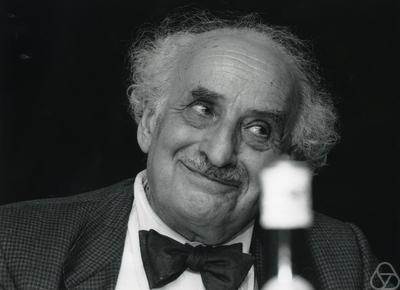
Figure 2. Hans Freudenthal in 1984, on the occasion of the 40th Anniversary of the Mathematisches Forschungsinstitut Oberwolfach. Sourced from the Oberwolfach Photo Collection.
Throughout “Lincos”, logic and philosophy of language are discussed at great length, especially in the introductory chapter of the book. Unlike in the 1972 “Mathematics as an Educational Task”, Brouwer is nowhere mentioned in the 1960 “Lincos”: this absence may be considered somewhat glaring, considering how the introduction of “Lincos” makes several references to Russell and Quine, all logicians who also provided substantial contributions to the philosophy of language. While Brouwer was removed from the state-of-the-art discussion in philosophy of language and its interplay with mathematical logic, the link between logic, language, and intuitionism is hard to overlook (even if the intuitionistic assessment of such matters was mostly negative). Interestingly enough, “Lincos” was published in the series Studies in logic and the foundations of mathematics, of which Heyting and even Brouwer himself were editors.18
Despite this lack of explicit mention throughout the book, I argue that intuitionism plays a hidden but pivotal role in the general framework of “Lincos”. In fact, as argued by Lentink19, “Lincos” appears to entertain a very peculiar relationship with Freudenthal’s pedagogy. Furthermore, we have already seen that we still find quite a lot of intuitionism in Freudenthal’s didactics of mathematics, albeit radically transformed and repurposed. If a link exists between Freudenthal’s “Lincos” and his work on didactics, and Freudenthal’s didactics can be construed as being influenced by intuitionism, then some relationship between “Lincos” and the intuitionistic framework is plausible. In order to explore this link between intuitionism and didactics in Freudenthal, we need to go way back before both 1960 “Lincos” and the 1972 “Mathematics as an Educational Task”. In 1945, during the last year of the Second World War, Freudenthal wrote an unpublished manuscript known as “Rekendidactiek” (“Didactics of Arithmetic”) which has been considered of great interest in tracing a genealogy of Freudenthal’s ideas in mathematical education20: one of the chapters of the manuscript dealt with the influence that “Auxiliary Sciences” could have in teaching mathematics. The first was philosophy. As summarised by la Bastide-van Gemert21, Freudenthal wrote how philosophical considerations were often provided as mere ornaments to mathematics, often at the start of a scientific study, with very little methodological weight in the expounding of the discipline. Needless to say, Freudenthal’s criticism regarding the futility of such an approach is evident. Still, Freudenthal’s analysis does not entail at any point that philosophy in itself is useless for the didactics of mathematics. We are inclined to conclude that if philosophy plays a role in a didactics of some sort, it has to be methodologically relevant.
The Lincos Case
As noticed by Latronico22, Freudenthal feels the urge to “anchor Lincos to reality”. This operation is usually enacted through ostension in standard language (for example, pointing to a rock while explaining the meaning of the word “rock” to a child or a non-native speaker). Yet, this practice is clearly excluded by the means of communication chosen in “Lincos” by Freudenthal: a radio signal. Still, Freudenthal does not entirely abandon this “ostensive” method: he employs a very particular variant of this when he needs to communicate natural numbers and time signals (to set up a shared time unit with receivers of Lincos messages). In fact, natural numbers and time signals are conveyed through a series of repeated pulses, separated by pauses in the signal. This way of presenting the Lincos language for the notions is ideophonetic: that is, they “[…] both signify and represent their significance”, as Freudenthal writes. Ideophonetic words are used in several languages to convey sensory images and sensations. From this standpoint, meaning is mapped into the syntax form of such words, which try to achieve (if not an isomorphism) at least similarity with what they try to convey. Still, the subjects that Freudenthal tries to convey through ideophonetic words are very peculiar. To establish those words as ideophonetic, a theory of the perception (or intuition) of both notions must be conceived. And this is where Brouwer’s philosophy comes into play.
As summarized by Van Dalen , Brouwer describes the birth of natural numbers out of the a priori intuition of time:
The subject is originally in a state of undifferentiated chaos, or state of complete unity of the subject in itself, a state where ‘conscious-ness in its deepest home seems to oscillate slowly, will-lessly, and reversibly between stillness and sensation’ (Brouwer [1948]). In this state sensations come and go, uncontrolled. The subject may now experience (be subjected to) the transition of a sensation, which may be retained by consciousness as a past experience. This is called the ‘move of time’ by Brouwer. […] The ‘move of time’, in Brouwer’s words ‘the falling apart of a moment of life’, is the first step in the creation of a mathematical universe. The iteration of the process yields arbitrarily long sequences of sensations. The subject then starts to compare and classify the sequences, where some are viewed as ‘the same’. Such (equivalence classes of) sequences are called causal sequences by Brouwer, and they make up the world of the subject. In particular the rigorous abstraction of the ‘move-in-time’ or ‘two-ity’, yields by means of iteration the natural numbers.
Natural numbers are given in “Lincos” by ideophonetic ostension, transmitting a series of “peeps” (a short radio-signal) in a wider context: for example, we may transmit the sentence “2 + 3 = 5”, where natural numbers 2 and 3 are represented by two and three peeps. Of course, just one transmission is unfit for inferring the meaning of the message. Freudenthal stresses the importance of providing a large enough number of examples. The understanding of Lincos messages appears to work as follows: identity classes of such peeps are meant to be inferred to be natural numbers, which would then allow deciphering the meaning of conventional Lincos terms (particular radio signal, expressing for example “+”, “-”, and so on) in the wider context. What Brouwer construes as the alternating of “stillness and sensation”, is expressed by the beep on the radio-signal medium of Lincos: the “abstraction process” of the “move-in-time” which allows us to construe natural numbers is eased by the relative simplicity of the medium (radio-signal instead of consciousness). The ability of the subject to “subsume and classify the sequences” is assumed by Freudenthal for receivers of Lincos, and it’s the only way for such receivers to decipher the message.

Figure 3. Excerpt from Hans Freudenthal, LINCOS. Design of a Language for Cosmic Intercourse, North-Holland Publishing Company, 1960, page 45.
The relationship between time and counting, beeps and natural numbers, is also exploited by Freudenthal in establishing time-units with receivers of Lincos. The abstraction process, which allows us to “subsume and classify the sequence” is also enforced by transmitting the messages at different wavelengths, providing a qualitative element from which to abstract, allowing to decipher the message by noting the regularities:
The program text of 2 01 1 [a Lincos program establishing the link between time-signals, and the number a of time-units] will be repeated on different wave-lengths and with different durations of their time-signals until the receiver may be expected to remark that the numbers indicated by a in the different texts are proportional to the durations he observes, independently of their wave-length. So he will guess that the numbers indicated by a are to mean the durations of those time-signals.
Freudenthal places immense value on these parts of Lincos. He stresses that:
The greater part of the Lincos vocabulary will be purely conventional; words may be permutated at pleasure. This is not true of ideophonetic words. Their essential features must not be changed.
After all, receivers of Lincos messages are already supposed to know about time and numbers. For them to understand that we are communicating on those matters, the form of the message should reflect as close as possible our (supposedly) shared experience of both as close as possible.
In conclusion, Freudenthal appears to have devised a language that has, in its fundamental building blocks, features isomorphic to the inner experiencing of the primitive content he is conveying (from an intuitionistic standpoint). We argue that intuitionism can be seen as the silent philosophical premise of “Lincos”. This undeclared choice would impose the methodological pick of the primitive notions of the artificial language, which would then be conveyed in the most isomorphic way possible to the receivers of Lincos messages, to jumpstart the learning process of the communication protocol. This is in line with Freudenthal’s views on the relationship between philosophy and didactics, communicated since his early days in the 1945 “Rekendidactiek”.
Once again, the key to understanding this link lies in understanding the aims of Lincos. Assuming that Freudenthal’s efforts in Lincos are not to teach (for example) our science, but rather to teach a communication protocol appealing to the bulk of a shared pool of knowledge (that is, at least mathematics), then he needs to make sure that the basic notions of the language are unequivocally pointing to some of those shared knowledges. From this standpoint, it hardly seems a matter of chance (or an obligated choice made to work within the limitations of the radio signal apparatus) that the only ideophonetic components of Lincos are the fundamental building blocks of intuitionism. Intuitionism would then constitute the “auxiliary science” (using Freudenthal’s notion from “Rekendidactiek”), laying the methodological first steps in the teaching process of the language. That Freudenthal would care about building a way of communicating through an artificial language based on shared (a priori) knowledge appears hardly surprising, if one once again takes into account Freudenthal’s wider intellectual life. After all, quoting from Brouwer’s 1905 “Life, Art, and Mysticism”: “Only an understanding that already exists, can be accompanied by language”.
- Dirk van Dalen. Mystic, Geometer, and Intuitionist: The Life of L. E. J. Brouwer, 1881-1966, Clarendon Press, 2005. ↩︎
- Considering how intuitionistic logic may be described as a proper subset of classical logic, it is perhaps surprising for the reader to find that intuitionistic analysis is not just a subset of classical analysis: while in some respects intuitionistic analysis appears to restrict its classical counterpart (for example, all total functions on real numbers in intuitionistic mathematics are provably continuous, while classical analysis also allows for discontinuous functions), it also admits the existence of mathematical objects with properties classically unacceptable (Brouwer’s choice sequences, for example). Without entering into further details, this should be the first warning sign that such a naive presentation of intuitionistic logic (and intuitionism in itself) is actually quite misleading. ↩︎
- Mark van Atten. The Development of Intuitionistic Logic. In Edward N. Zalta and Uri Nodelman, editors, The Stanford Encyclopedia of Philosophy. Metaphysics Research Lab, Stanford University, Fall 2023 edition. ↩︎
- Cfr. Ibid. ↩︎
- Dirk van Dalen. Poincaré and Brouwer on intuition and logic. Nieuw Archief voor Wiskunde. Vijfde Serie, 3:191–195, 2012. ↩︎
- Miriam Franchella. Brouwer and Nietzsche: Views about life, views about logic. History and Philosophy of Logic, 36(4):367–391, 2015. ↩︎
- Miriam Franchella. Philosophies of intuitionism: Why we need them. Teorema: Revista Internacional de Filosofía, 26(1):73–82, 2007. ↩︎
- Miriam Franchella. L.E.J. Brouwer: Toward intuitionistic logic. Historia Mathematica, 22(3):304–322, 1995. ↩︎
- Cfr. Ibid. ↩︎
- Dirk van Dalen. From a brouwerian point of view. Philosophia Mathematica, 6(2):209–226, 06 1998. ↩︎
- When we use italics, we refer to the artificial language created by Freudenthal, presented in the eponymous 1960 book. ↩︎
- Anna Lentink. The cosmic language: A history of Hans Fredeunthal’s Lincos, Master’s Degree Thesis, Utrecht University, 2025. ↩︎
- Ole Skovsmose. Intuition revived. In Brian Greer, Ole Skovsmose, and David Kollosche, editors, Breaking Images: Iconoclastic Analyses of Mathematics and its Education, pages 149–174. Open Book Publishers, 2024. ↩︎
- Cfr. Ibid. ↩︎
- As noted by van Dalen in his 1906 “From a brouwerian point of view”, Brouwer appears to have had a somewhat oscillating disposition towards solipsism: most of the time, Brouwer can squarely be considered a solipsist, even presenting arguments against the existence of other minds in his 1948 paper “Consciousness, philosophy and mathematics”. Needless to say, communication can hardly occur if there are no other genuine beings outside of the self. Yet, some of Brouwer’s papers also point towards a (meaningful and autonomous) existence of other individuals: a “[…] way out for solipsism”, as Franchella writes in her 2021 “Solipsism and philosophy of mathematics: intuitionists compared”. This does not change Brouwer’s views on language though: if at all, it just makes them more tragic from an existential standpoint. In fact, Brouwer’s own words appear to interchangeably apply for both a solipsistic outlook stating that only the self exists, and one supporting the autonomous existence of others (whose inner-selves are utterly unreachable): quoting from “Consciousness, Philosophy, and Mathematics”, “By so-called exchange of thought with another being the subject only touches the outer wall of an automaton. This can hardly be called mutual understanding”. ↩︎
- Ole Skovsmose. Intuition revived. In Brian Greer, Ole Skovsmose, and David Kollosche, editors, Breaking Images: Iconoclastic Analyses of Mathematics and its Education, pages 149–174. Open Book Publishers, 2024. ↩︎
- Cfr. Ibid. ↩︎
- Sacha la Bastide-van Gemert. All Positive Action Starts with Criticism: Hans Freudenthal and the Didactics of Mathematics. Springer, Dordrecht, Netherlands, 2015. ↩︎
- Anna Lentink. The cosmic language: A history of Hans Fredeunthal’s Lincos, Master’s Degree Thesis, Utrecht University, 2025. ↩︎
- Sacha la Bastide-van Gemert. All Positive Action Starts with Criticism: Hans Freudenthal and the Didactics of Mathematics. Springer, Dordrecht, Netherlands, 2015. ↩︎
- Cfr. Ibid. ↩︎
- Vincenzo Latronico. Communication against logical form. a critical survey of Hans Freudenthal’s lincos. ACME: Annali della Facoltà di lettere e filosofia dell’Università degli Studi di Milano, 61(1): 237–261, 2008. ↩︎
Daniele Sansoni is a PhD student in the School of Computing at the Australian National University, in Canberra. His research focuses on mathematical logic, from both technical and historical standpoints.
Edited by Elian Schure and Marieke Gelderblom
Header image: Portrait of H. Freudenthal, 1957. Sourced from Utrecht Archives.